

It took senior American journalist Vivian Salama of The Atlantic many months to fully establish the facts that led her to publish “Egypt’s Warning to Israel” about the period before the war in Gaza, in which she revealed the secret visit to Israel by former Egyptian intelligence chief Abbas Kamel 11 days before October 7.
According to the report, Kamel arrived on a chartered Cessna plane, and the pilot was instructed to park in an isolated area of the airport.
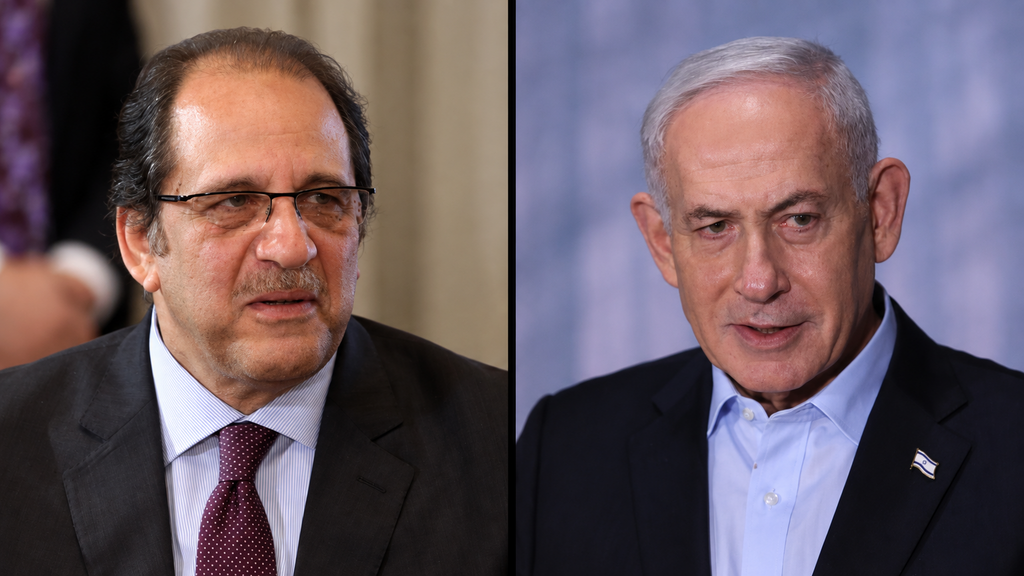
Abbas Kamel, Benjamin Netanyahu
(Photo: Alex Kolomoisky, AP)
It is unclear from the report who boarded the plane. It remained on the ground for 63 minutes before taking off and returning to Egypt. Kamel came to warn Israel out of concern that a Hamas attack on Israel could spill over toward Sinai and into Egyptian territory. According to the report, Kamel was sent on the direct orders of President Abdel Fattah el-Sisi.
The report is now making waves not only in the United States, but also in Israel and throughout the Arab world. On September 26, the first warning arrived from Egypt about “something terrible” being planned in Gaza. Three days after that warning became reality, I received a phone call from a very senior Egyptian source with whom I have worked for many years.
“We passed a warning to Netanyahu,” the source told me. “We warned that something terrible was about to happen from Gaza.”
Along with me, AP, the world’s largest news agency, and a British newspaper received exactly the same wording. ‘But I’ll give you more details,’ the source told me, ‘because you are in Israel, and this warning should have concerned you’
Along with me, AP, the world’s largest news agency, and a British newspaper received exactly the same wording. “But I’ll give you more details,” the source told me, “because you are in Israel, and this warning should have concerned you.”
The source, whom I have never met face to face, has also never given me a false story. As always, he called, told me what he had to say, answered some of my questions and insisted on remaining anonymous.
Once, during a visit to the presidential palace, I saw a long line of Egyptian intelligence officers standing before me. They stood tensely. One of them smiled at me and discreetly waved. That was the only indication I ever received about the identity of my source. Immediately after that wave, the journalists were asked to leave the room.
How ironic that the Egyptian Cessna landed at Ben Gurion Airport only hours before the state ceremony marking 50 years since the Yom Kippur War. Prime Minister Benjamin Netanyahu attended the event, and it remains unclear who on the Israeli side boarded the plane to speak with Kamel.
He came not only to warn Israel, but also to propose that it increase economic assistance to Gaza in order to prevent a confrontation, after 180,000 work permits for Gazans in Israel had been canceled in the month before the attack.
‘Gaza is expected to “explode” in Israel’s face’
Egypt had not come to offer assistance, and intelligence chief Kamel came to warn.
An Israeli security source who was briefed on the secret visit confirmed to The Atlantic, and to me as well, that “if Israel does not change its policy, Gaza is expected to ‘explode’ in Israel’s face.”
No further details were provided, but the Egyptian warning was stark and forceful.
It is important to remember that the main person delivering the warning, Egypt’s intelligence chief, was also known here as a serious, measured and reliable figure. He received endless praise from senior Israeli officials.
Netanyahu did deny meeting Kamel during his public visits to Israel, but photographs of the two of them deep in serious conversation at two different locations in Israel told a different story. According to reports, Prime Minister Netanyahu agreed to expand economic assistance to Gaza after Kamel’s first visit.
 Smadar PerryPhoto: Yariv Katz
In the second warning message, delivered from Egypt on October 5, no precise date was given for an attack, but the warning was particularly grave. It is important to remember that Egypt’s governing establishment despises Hamas and Islamic Jihad no less than Israel does.
Israel’s political and security leadership did not know how to assess Sinwar’s true plans. He deliberately gave an interview to an Italian journalist in order to emphasize his supposed “peaceful intentions,” in double quotation marks, toward Israel.
In doing so, he blinded those responsible here.
Remember how an officer in Southern Command threatened to throw out a surveillance soldier who warned that “Hamas is on the border.”
And let us not forget surveillance soldier Roni Eshel, who was killed on October 7. Her mother, Sharon Eshel, released a recording in which her daughter warned that Hamas forces were “studying us,” and stressed the unusual training and unusual movement toward the border.
And there were other warnings, not only from Egypt.
None of them received a response.