


For those still scanning the horizon for signs of a possible strike on Iran, the most important development this week was not Prime Minister Benjamin Netanyahu’s visit to Washington.
It was a report in The Wall Street Journal that the Pentagon is preparing the option of deploying a second aircraft carrier to the Middle East, in addition to the USS Abraham Lincoln already operating in the region. Given Iran’s threats of a broad response, the arrival of another carrier ahead of a U.S. military operation would appear logical, perhaps even necessary.
Yet shortly after the report, President Donald Trump told journalist Barak Ravid that he was “considering” whether to dispatch the additional carrier to the Gulf. In the same conversation, Trump said the Iranians “very much want” a deal, that talks were being conducted more seriously and expressed overall optimism about the diplomatic track.
What can be inferred? That the United States, exactly as it says publicly and as Trump wrote after meeting Netanyahu, prefers an agreement. That remains Washington’s first priority.
From a Western decision-maker’s perspective, even a highly successful strike offers no guarantee of internal change in Iran. There is a significant risk of a harsh Iranian response, possibly aimed at disrupting global energy markets and triggering escalation. And then what? Eventually, the parties would likely seek a deal. Better, then, to try to reach one now and avoid the maneuver and the risk.
As for the revolution in Iran, Vice President J.D. Vance said this week that America’s focus is on the nuclear program. If the Iranian people wish to topple the regime, that is their task. The statement carries logic on two levels. It lowers expectations and aligns with the administration’s general aversion to foreign entanglements. It also avoids branding any internal Iranian unrest as foreign interference.
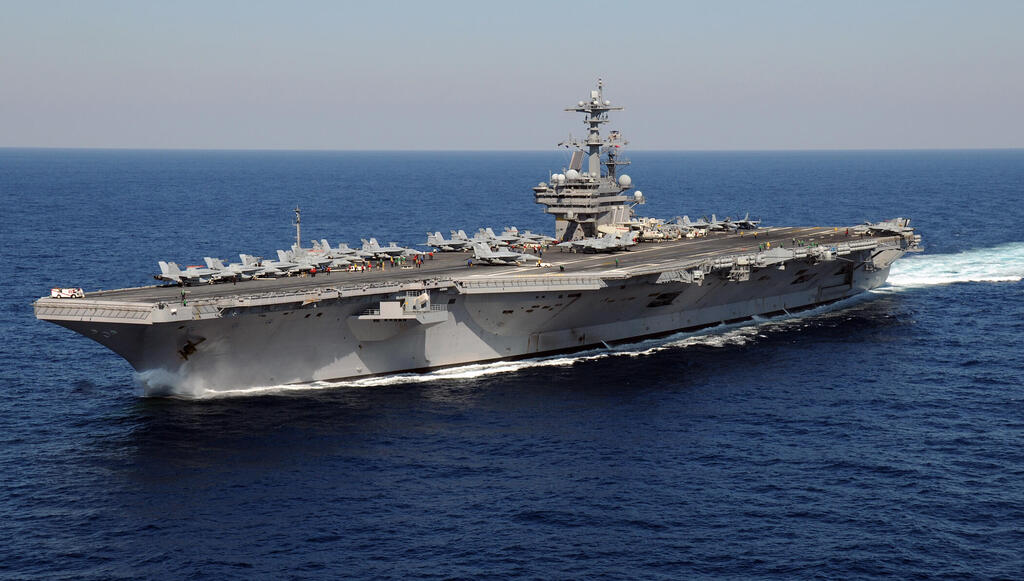
USS George H.W. Bush aircraft carrier
(Photo: MC3 (SW) Nicholas Hall/Wikipedia)
So again, the world waits for Trump. More precisely, it waits for Supreme Leader Ali Khamenei. With painful concessions, he could buy the regime more time. The Islamic Republic’s structural economic bankruptcy is not disappearing, but an arrangement with Washington, even one that merely averts a strike without lifting sanctions, would bolster regime stability.
The central question is whether Khamenei is capable of making such concessions. Most Iran experts believe he is not. Either confrontation follows, they assess, or the United States will have to bend significantly.
At the margins lies another strategic dilemma: If there is military action, would eliminating Khamenei serve the goal of internal change? Or would he be replaced by a figure no less aggressive, perhaps younger, less cautious and more capable? Western intelligence agencies have long favored the maxim “better the devil you know.” After the war and Khamenei’s own rash retaliatory decisions against Israel, that assumption is now debated.
If a strike comes, that debate will weigh heavily on decision-makers.
The burial of truth
In the pre-dawn hours of October 7, amid what would later be called a catastrophic blindness, IDF Chief of Staff Lt. Gen. Herzi Halevi issued an order that was never carried out. According to subsequent investigations, one instruction was to conduct aerial visual collection over Gaza to monitor rocket arrays, even if suspicious activity was assumed to be only a Hamas drill.
It did not happen.
Why remains unclear. The hour was late; the prevailing assessment was that no immediate event was imminent. It could wait until morning. No one acted out of malice or negligence. Security chiefs believed that even if Hamas was planning something, it would take time. Intelligence dominance in Gaza was assumed. There was faith in a powerful, secret technological channel. Hamas’ Nukhba forces, both Military Intelligence and the Shin Bet believed, were in routine posture. By morning, the invasion began.
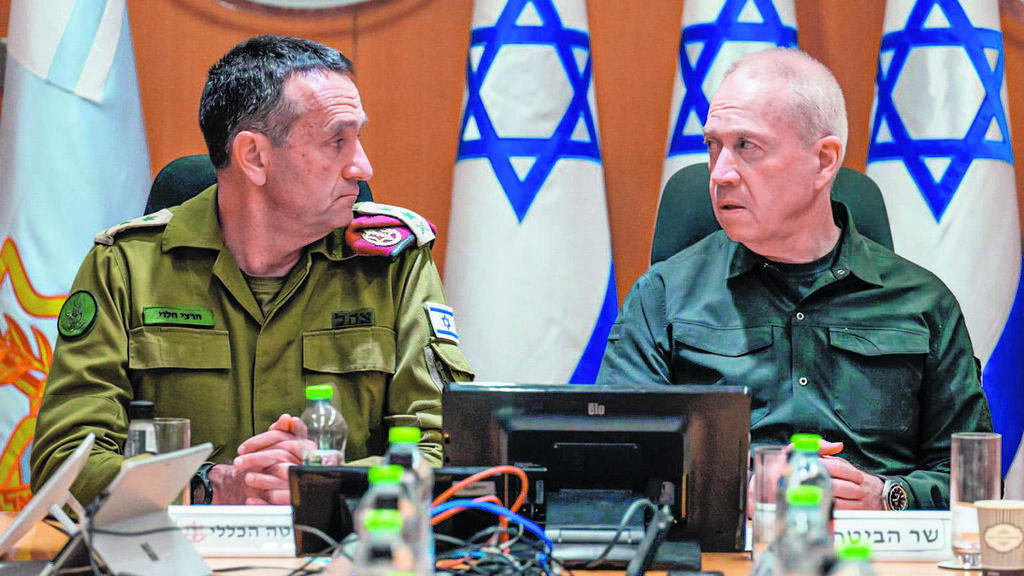
Herzi Halevi and Yoav Gallant
(Photo: Ariel Hermoni/ Defense Ministry)
It is doubtful that additional flights overnight would have produced definitive intelligence. A failure years in the making cannot be corrected in hours, or with several drone sorties.
I once asked a senior officer, one who bears heavy responsibility for the failure, what would have happened had a junior soldier stood up in a meeting and declared that Hamas was about to launch a large-scale invasion. He answered candidly: “I would have said you can debate intentions, but Hamas doesn’t have that capability. It isn’t able.”
That was the prevailing view.
There is no minimizing the security establishment’s failure. Numerous investigations, many by colleagues Ronen Bergman and Yoav Zitun, have documented the depth of the military collapse. After October 7, the intuitive and healthy public instinct was clear: everyone responsible should go home. The General Staff, the Shin Bet and, of course, the government, including the prime minister.
Netanyahu immediately understood the danger to his political survival. The message confronting him was simple and effective: the greatest failure in Israel’s history justifies the resignation of all those responsible. His task became a political one.
This week, Haaretz reported that reservists in the Prime Minister’s Office’s military secretariat were tasked early in the war with collecting material from protocols. Three weeks after the massacre, shortly after 1 a.m., Netanyahu posted on X that “contrary to false claims, at no stage was Prime Minister Netanyahu warned of Hamas’ intention to go to war,” accusing the Shin Bet chief and head of Military Intelligence. The post sparked outrage; it was deleted, and Netanyahu said he was wrong.
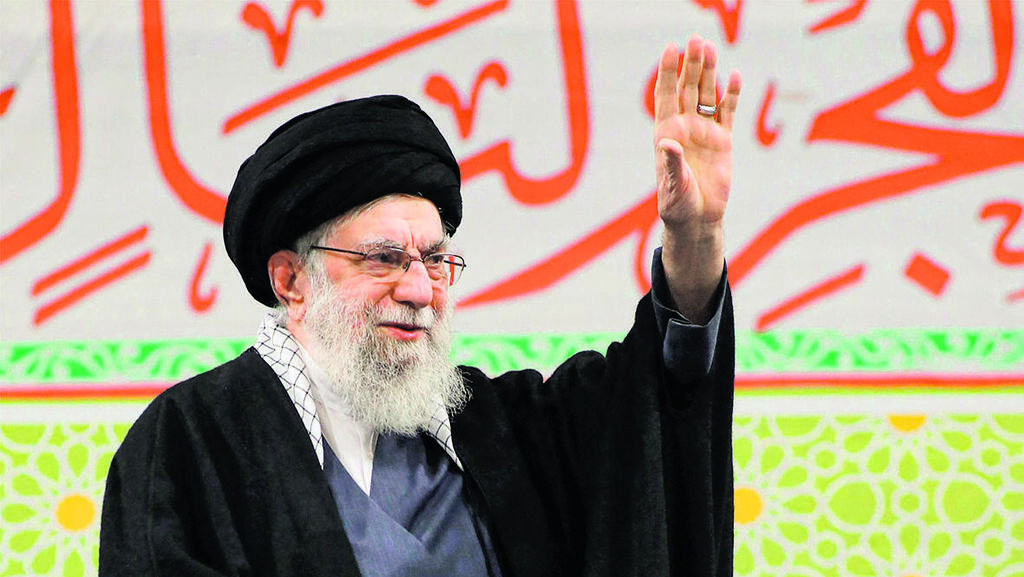
Ali Khamenei
(Photo: AFP)
In retrospect, the mistake was only in timing. Around the same period, cabinet summaries from previous governments were reportedly requested. In July 2024, I reported on ynet that Netanyahu’s former military secretary, Maj. Gen. (res.) Avi Gil, had approached the attorney general suspecting that protocols, including the time Netanyahu was notified of the attack, had been altered. Police questioned Netanyahu’s chief of staff, Tzachi Braverman, under caution; the case was later closed.
Netanyahu’s narrative rests on time and tribal politics. Over time, the shock fades. The second tactic is simpler: shift blame to the military echelon, the “deep state,” the Kaplan protesters and the left. This week he circulated a binder of selective quotes and distortions. Some argue the effort backfired. I am not convinced.
Netanyahu does not require persuasive arguments. He requires arguments — any arguments — that supporters can deploy. As one early television producer once quipped about weekly dramas, “We didn’t have to be good; we had to be there on Tuesday.” Netanyahu seeks to flood the discourse.
The third move is more complex: recast himself as a victim of October 7. To do so requires arguing not only that he was not awakened, but that there was malicious intent behind it. Roughly half of coalition voters now believe in an internal betrayal theory. For others, a more orderly narrative is offered. Netanyahu wrote this week that the Shin Bet’s professional consideration that night was to prevent “miscalculation,” implying that the security chief sought to preempt him from leading Israel into another unnecessary war.
Conspiracy theories merit sober rebuttal. Yes, there was concern about miscalculation in the days leading up to October 7. Intelligence suggested Hamas feared renewed Israeli assassinations. But that is not why Netanyahu was not awakened. Defense Minister Yoav Gallant was also not awakened. The reason was simple: no one believed an immediate major event was imminent.
After speaking with four former IDF chiefs, two former Shin Bet directors and two former defense ministers who served under Netanyahu, none recalled a case in which intelligence assessed no immediate danger and Netanyahu nevertheless ordered extraordinary readiness based on intuition. I asked the Prime Minister’s Office for examples; none were provided.
A senior official involved in the night’s discussions told me that for months, Netanyahu had repeatedly stressed one directive: keep Gaza quiet. With potential diplomatic breakthroughs on the horizon, escalation was to be avoided. Security chiefs internalized that priority. The fear of miscalculation was not only about intelligence assessments, but about a prime minister determined to prevent unnecessary flare-ups.
It would be simplistic to reverse the accusation and claim that Netanyahu alone paralyzed the system. The security chiefs who resigned would reject that framing. Their duty is to the state, not the prime minister.
But nuance is rarely a match for a political campaign. Netanyahu’s strategy is to cloud the waters. In the vast ocean of Israeli public consciousness lies an Atlantis of facts and evidence pointing to political failure. With enough sediment — claim upon claim, debate upon debate — the outlines blur.
Layer by layer, the truth is buried.