

One of the unfortunate and unnecessary phenomena of contemporary discourse is the insistence on veering away from reasoned and measured debate into the psychoanalysis of the speakers. It happens to all of us on the street and on Facebook, especially in political arguments. Logical exchanges pale in comparison to what we believe the person arguing with us “really” thinks. Thus, the intellectual dialectic has become a profiling process for amateurs that leads nowhere on a personal or national level.
Gallery
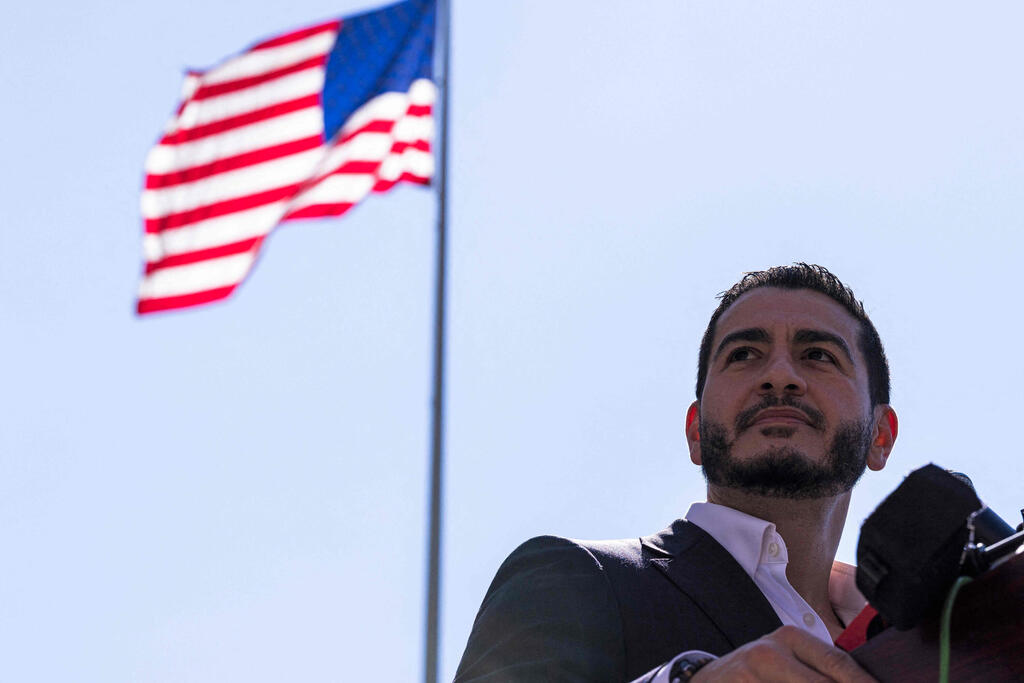
Michigan Democratic Senate candidate Abdul El-Sayed: 'I'm opposed to unconditional military aid for any country'
(Photo: Finn Gomez/Getty Images North America/AFP)
It happens to me all the time - with friends or strangers - who devote themselves to deciphering the composition of my personality instead of responding to the arguments and detailed explanations I present to them. And that is also likely to happen to me on this occasion, as a resident of the United States trying to present to you the prevailing view regarding economic and military aid to Israel. It is a view that is so logical from the perspective of the public in New York, Wisconsin and California, and that probably would also be accepted by most readers of this column, were its implications not a blow to the privileges the State of Israel has enjoyed over the years. You may see them as self-evident and justified. Americans increasingly do not.
Take, for example, Abdul El-Sayed, the Democratic candidate for Senate from Michigan. After his primary victory, the doctor, the son of immigrants from Egypt, was asked about his position on ending military aid to Israel.
“I'm opposed to unconditional military aid for any country. That is Israel, yes, but that's also Egypt, where my family immigrated from. That's Pakistan. That's Saudi Arabia. That's the UAE. And that's not because of a focus on what's happening anywhere, except for a focus what's happening here. We've got communities in my state where the median income is $14,000, and I believe they have a right to their tax dollars,” the progressive candidate said in an interview with CNN.
He did not deny his opposition to Israeli policy, which drove the Jewish lobby AIPAC to pour large sums of money into supporting his rival, Haley Stevens, to no avail, but declared: “I believe in equal rights to peace, dignity, and self-determination for Jewish Israelis and Palestinians alike.”
Even if you doubt the purity of the candidate’s intentions because he is a man of the left whose name is Abdul — or, by his full name, Abdul-Rahman, as Republicans have begun calling him to mock his origin — you still have to contend with his winning message, which is aimed not at you in the Middle East, but at residents of the Midwest. In the United States.
“I believe our responsibility, though, more than anything else, is to use our tax money here in Michigan to provide health care in Michigan, and schools in Michigan, and roads in Michigan, rather than to send it to a foreign government that might use it in the form of bombs and tanks to destroy infrastructure and schools and hospitals there,” he said, concluding: “My responsibility, as the next senator from Michigan, is children in Michigan, rather than thinking about what's in the interest of a foreign government.”

US candidates question why US taxpayers should fund defensive systems like Iron Dome when US children go hungry
(Photo: Israeli Air Force)
It is easy to understand why that argument resonates so strongly in the face of decisions by politicians in Washington, who since October 7 have approved the allocation of more than $20 billion in military aid to Israel.
Like many good and bad people in America, El-Sayed sees Israel’s government as an apartheid regime and accuses it of genocide. He is the latest representative of the winning slate of the progressive wing of the Democratic Party. He and his colleagues echo a hostile sentiment toward Israel that is common in American public opinion today, but they place at the center an argument that concerns everyone, including their ideological opponents on the right, and that seems taken from the libertarian playbook of Republican Sen. Rand Paul. Not because of the scales of justice, or Netanyahu’s poisonous cat’s paw, but because of the price of fruits and vegetables at the supermarket and gas pumps. The link between Israel and its wars and the fight against the cost of living is the most successful inference of all. And it is very logical.
The truth is that most U.S. citizens neither hate nor love Israel. They are simply indifferent to it. But they do care about life itself. Their difficult lives, not yours. They are struggling with the unbearable cost of living, alarmed by soaring health insurance premiums and cuts to social services. Add to that the anger over rising gas prices because of the war with Iran, which is perceived as Netanyahu’s initiative, and you will understand why the American public — from Israel-haters on the left, to neo-Nazis on the right, and the silent and indifferent majority in between — is united in opposition to funneling billions of their tax dollars to the other side of the world. Far across the sea.
In the current situation, ordinary voters are focused on themselves, and they are looking for representatives who will serve them against vested interests, moneyed interests and the politicians backed by them, such as the pro-Israel lobby AIPAC — which poured millions into the fight against El-Sayed — and has meanwhile become the most radioactive force in local politics. The U.S. is an essentially isolationist nation, and sending money abroad goes against its nature. Donald Trump echoed the slogan “America First,” and since returning to the White House has cut budgets for humanitarian organizations around the world, and even reduced allocations to NATO. Somehow, military support for Israel has remained intact with the backing of members of Congress, senators and lobbyists on the right and left, despite public opinion.
The Muslim politicians El-Sayed and Zohran Mamdani, and Brad Lander - the Jewish Zionist on the left, just like Tucker Carlson, former Congresswoman Marjorie Taylor Greene (the Republican version of Tally Gotliv) and even Vice President JD Vance, all want to shed the Israeli baggage. Each has his or her own ideological motives, but what unites them all is the duty of the state to care first and foremost for its citizens, and not waste resources overseas. Certainly not for military purposes of arms and bombs.
If we are honest with ourselves, we Israelis share the approach that “the poor of your own city come first.” After all, it would be unthinkable for your tax money to be funneled to some government in Africa, Asia or on Mars for its wars, whether just or not. Even the burden of funding Hamas fell on the Qatari sheikhs and was not taken from your pocket.
Regardless of one ideological position or another, you too can understand the American public, which includes antisemites and plenty of pro-Palestinians, but mostly acts out of selfish motives of personal welfare, nationalism and a sense of disgust with the status quo. Popular opposition to the establishment in Washington is gaining momentum and, as part of it, the long-standing alliance with Israel is also being reexamined.
Politicians aside, there is broad public agreement that the U.S. cannot continue to be the kindergarten teacher of 78-year-old Israel and fund its adventures on the other side of the world — not out of the altruistic consideration of “not in our name,” but the selfish one of “not at our dime.”
First published: 09:34, 08.11.26