

The leaders of the anti-Netanyahu "change bloc" could hardly have imagined, just minutes after television exit polls were released, that the projected Knesset seat distribution would turn against them. Instead of leading Netanyahu's bloc, they found themselves trailing it.
The emerging distribution of Knesset seats has left them in a particularly difficult political position. Not only has Likud emerged as the largest party in the Knesset, but the bloc led by Prime Minister Benjamin Netanyahu is also the largest, as long as the Arab parties remain outside the alliance of Gadi Eisenkot, Naftali Bennett, Yair Golan and Avigdor Liberman.
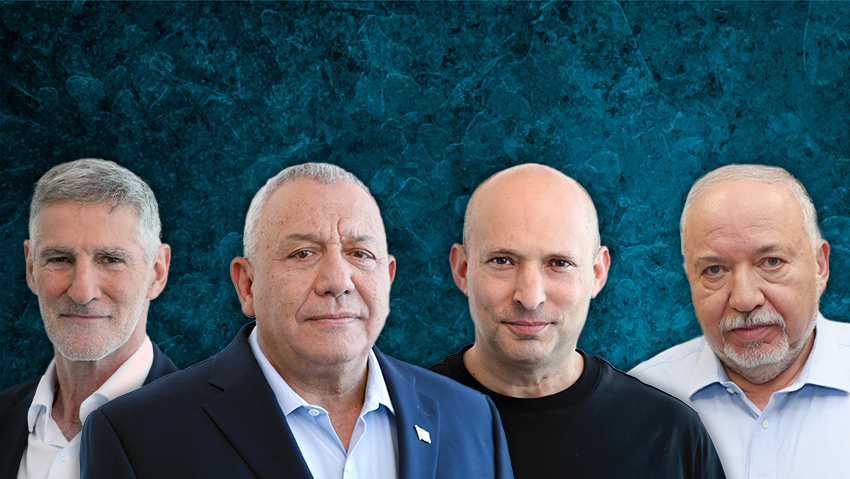
Yair Golan, Gadi Eisenkot, Naftali Bennett and Avigdor Liberman
(Photo: Ryan Frois)
The optimistic statements issued by some change bloc leaders after the exit polls were released, along with Yashar! Chairman Gadi Eisenkot's premature "victory speech," only added to the embarrassment of a camp that had sensed a political upset was within reach.
But the preelection polls, and to a large extent the exit polls as well, demonstrated once again that the gap between projections and actual results can be deceptive to the point of cruelty.
The leaders of the change bloc, with the exception of Yair Golan, opted for a conspicuous silence Wednesday morning. They had not even scheduled a meeting or phone call to coordinate their next steps.
The figure who stepped into the vacuum was none other than the bloc's most outspoken left-wing leader, Democrats chairman Yair Golan. He publicly urged his political partners to reconsider their strategy: Count Ra'am and the Joint List, the two Arab parties, as part of the bloc and declare, "We are the largest bloc."
Golan wrote on X: "Netanyahu has lost. I know how to count to 120 — 65 is more than 55. That's how Israeli democracy works. Period. The reality before us must teach us one resounding lesson: We have no future here unless we stop being afraid. And unless we put an end to racism. We can no longer accept Netanyahu's racist distinction between Jewish votes and Arab votes."
Golan proposed forming a government with both Arab parties: "The change bloc has a Zionist majority: 49 to 39. The change bloc has an Israeli majority: 65 to 55. We have a majority. We have a responsibility. And we have an opportunity to form a government of change in partnership with Israel's Arab citizens. A government that will serve all Israeli citizens."
Golan's appeal fell on deaf ears. None of the other leaders in the change bloc intends to form a government or coalition with both Arab parties. In any case, such a move has no realistic chance of succeeding.
If it were possible to form a government with Ra'am alone to bring the bloc to 61 seats, it would be an entirely different story. In that scenario, Eisenkot, Bennett and Liberman might have been willing to swallow the bitter pill if the price were removing Netanyahu from the Prime Minister's Office.
The parties making up the change bloc may have just one option left: forming a national unity government.
Whether such a government would include a rotation agreement for the premiership remains unclear and depends on the final election results. But the move could fracture the bloc and force its leaders to break the campaign promise they all made: "We will not sit in a government with Netanyahu."
On the other hand, would another election be preferable if the change bloc fails once again to alter the balance of seats between the rival camps? What if another election actually hands Netanyahu a 61-seat majority?
In the coming hours and days, the possibility of a unity government will move to the forefront of the political agenda, both for Netanyahu and for the change bloc.
In the end, it may be the least bad card they have left to play.