


On Friday, October 23, armed assailants opened fire during a funeral service near the Greek Orthodox Church of Saint George in the village of Hamoud, situated in Jordan's southern Karak governorate, south of Amman. Jordan's Public Security Directorate initially reported six fatalities and 28 injuries before revising the official toll at an evening briefing to seven dead and 34 injured. Jordan's health minister separately informed international news agencies that 40 individuals had been wounded, illustrating the initial reporting discrepancies typical of breaking casualty accounts from provincial areas. Eyewitness accounts and circulating video material indicated that armed assailants discharged firearms toward mourners gathered outside the sanctuary before escaping the perimeter.
Jordanian Interior Minister Mazen Al-Faraya swiftly categorized the fatal shooting as an extremist terrorist attack, while King Abdullah II vowed the harshest penalties for those responsible. Official spokespersons stated that it was too early to determine whether the perpetrators belonged to a known militant organization, and no group issued an immediate claim of responsibility for the bloodshed.
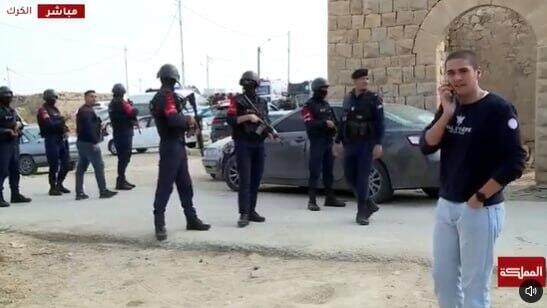
The scene of the shooting attack in Jordan, according to local reports
Shortly after initial official briefings, Amman Prosecutor General Hassan Al-Abdallat issued a comprehensive judicial publication ban concerning the case. The official decree prohibited media outlets, digital publications, and social platforms from circulating information regarding investigative proceedings, collected evidence, or the directive itself, while granting exemptions solely to designated government media channels operating under ministerial supervision. Judicial authorities subsequently clarified that this legal restriction was designed to protect investigative integrity without preventing general public condemnation or broad civic discussion of the tragedy. While the assailants were designated as violent extremists, their logistical preparation, operational sophistication, and underlying motives remain formally unconfirmed by the state prosecutor.
The tragedy in Hamoud occurred against a backdrop of acute regional friction along both banks of the Jordan River. On the same day, Israeli defense authorities ordered a strict security cordon around Hebron and instructed armed units to prepare for a potential comprehensive closure of the West Bank following an armed attack near Hebron that claimed the lives of two Israeli soldiers. While the two deadly incidents took place on the same Friday, there is no evidence establishing an operational connection between them, and analysts must evaluate them separately unless credible forensic findings prove otherwise. However, their coincidence highlights an unavoidable geopolitical reality confronting regional policymakers. Both Jordan and Israel are managing simultaneous domestic security challenges during an era of wider conflict. For three decades, the mutual security architecture established along the Jordan Valley has depended on the shared recognition that localized violence must not be allowed to erode frontier stability.
Evaluating the institutional impact of the attack requires reviewing the unique operational history of Karak governorate. Situated on the rugged plateau east of the Dead Sea, Karak has long formed a crucial demographic pillar of Jordan's East Bank identity, where ancient Christian families have coexisted for generations with traditional Muslim tribes whose allegiance anchors the Hashemite monarchy. Yet the area also retains the sobering memory of December 2016, when armed confrontations involving Islamic State militants and state security forces culminated in a violent standoff at Karak Castle. That confrontation claimed fourteen lives, consisting of four assailants, seven security personnel, and three civilians. While that previous crisis demonstrated that militant cells can exploit peripheral geography to mount operations, Friday's bloodshed must be assessed strictly on verifiable facts rather than assumed ideological continuity. Historical precedent demands professional vigilance without dictating premature conclusions about the perpetrators.
To understand the ideological environment surrounding regional security, we must examine the destructive nature of political Islamism. Islamism is not an expression of faith or private devotion; it is a modern, totalitarian political ideology designed to subordinate civic governance and sovereign legal institutions to clerical dogma. Whether expressed through the gradual social infiltration practiced by the Muslim Brotherhood or the armed violence championed by Salafi-jihadist groups, political Islamism fundamentally rejects the modern concept of equal citizenship within a pluralistic nation-state. By asserting that political legitimacy rests upon theological supremacy rather than constitutional law, Islamist doctrines convert civic disagreements into existential struggles between believers and apostates. This doctrinal intolerance directly threatens communal coexistence across the Middle East. When Islamist narratives penetrate public discourse, indigenous religious minorities are reduced to a precarious tolerance, stripped of full civic equality. The long-term security of sovereign Arab states depends on resolutely rejecting the premise that political Islamism can coexist with constitutional stability.
This ideological context underscores why the choice of target in Hamoud demands careful assessment. The Greek Orthodox Patriarchate of Jerusalem condemned the assault as a vile, cowardly, and bloody act, reflecting deep distress among indigenous Christian communities throughout the Levant. If ongoing official inquiries establish that the victims were targeted specifically on religious grounds, the domestic repercussions inside Jordan will be substantial. The kingdom's social contract rests heavily on interfaith harmony, where Christian citizens enjoy explicit constitutional protection under Hashemite patronage. An attack aimed at intimidating a religious minority strikes at the core of that arrangement. Conversely, if investigators determine that the gathering was chosen opportunistically because an outdoor funeral offered an accessible, unprotected crowd, the political fallout will be far more manageable. For Israel, this first test determines whether Jordanian authorities face an isolated criminal act or a calculated ideological attempt to fracture the kingdom's internal pluralism.
This security challenge unfolds amid complex political crosscurrents inside the Hashemite Kingdom. The prolonged war in Gaza has deepened public anger across Jordan, fueling persistent street demonstrations that call for the formal termination of the 1994 peace treaty with Israel. Navigating this widespread discontent while maintaining international treaty commitments requires disciplined governance from the royal administration. In April 2025, the Jordanian government officially banned the Muslim Brotherhood and prohibited the organization from operating within the kingdom. Its historical parliamentary wing, the Islamic Action Front, continued operating as a licensed political entity and achieved significant electoral gains in the September 2024 parliamentary elections. In April 2026, the party announced that it was adopting the name Ummah Party to address regulatory compliance concerns raised by the Independent Election Commission regarding its internal bylaws. Forceful political opposition to foreign treaties cannot be equated with operational involvement in terrorism.
The second and third tests evaluate organizational depth and cross-border risk. If investigators determine that the shooters acted as self-radicalized individuals using locally acquired weapons, the incident remains a contained police matter. However, discovering structured underground cells or military-grade hardware would indicate a deeper extremist presence. Israel has focused heavily on illicit transit corridors through Jordan, reinforcing a planned 500-kilometer eastern barrier. Yet documented smuggling does not establish a link to Karak. Jerusalem's true strategic interest lies in Jordan's institutional resilience. The 1994 treaty anchors a stable, professionally monitored eastern buffer that allows Israel to allocate defense resources toward active combat fronts elsewhere. Preserving this buffer requires avoiding alarmism while awaiting verified forensic findings.
 Amine Ayoub
Israel's posture must combine quiet security coordination with steadfast support for Jordanian state capacity. Confronting the ideological currents of political Islamism while respecting established legal boundaries ensures that localized violence does not fracture the indispensable peace protecting both nations along their vital shared border.
The bloodshed in Karak is an unmistakable wake-up call for national security establishments across the Middle East. As Israel manages threats across multiple active battlefronts, maintaining a fortified, resilient eastern frontier requires far more than physical security barriers and surveillance arrays. It demands the decisive intellectual and operational defeat of political Islamism before radical networks take deeper root. Jordan’s sovereign stability remains the ultimate strategic buffer preventing extremist chaos from engulfing the Jordan Valley. If regional leaders treat this church attack as an isolated event, they risk allowing radical Islamist ideology to undermine the foundations of regional peace. By confronting extremist recruitment networks, rejecting ideological accommodation, and deepening quiet counter-terror intelligence coordination, Jerusalem and Amman can decisively protect their shared border and secure long-term regional coexistence against emerging ideological threats.
- Amine Ayoub, a fellow at the Middle East Forum, is a policy analyst and writer based in Morocco. Follow him on X: @amineayoubx