

Not a tear was shed when the IDF killed senior Hamas terrorist Raad Saad in Gaza. Anyone who dedicates their life to terrorism should understand it may end this way — with or without a ceasefire.
But a small comment: the academic‑style titles Israeli officials attach to these targeted operatives — once “engineer,” now “architect” — provoke a bitter smile. If Saad’s plans weren’t taken seriously in life, don’t inflate his importance in death. He wasn’t an architect — he was a liability.
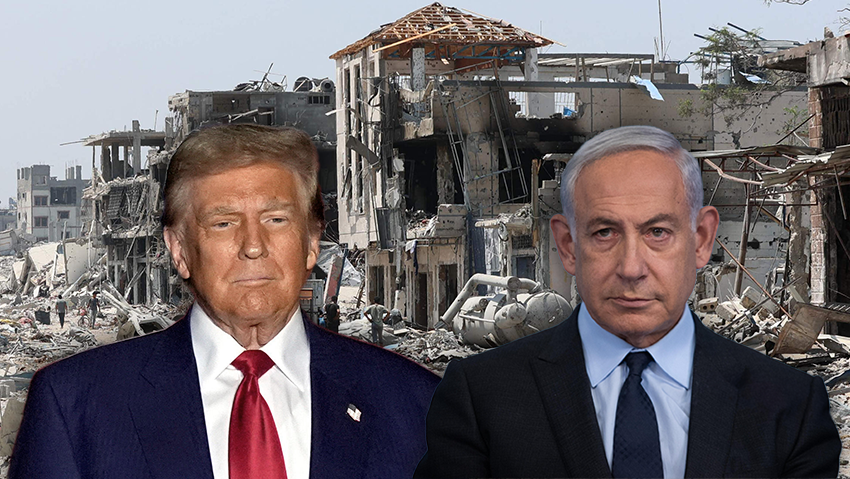
(Photo: Omar AL-QATTAA / AFP, AP Carlos Osorio, Alex Kolomoisky)
Israel justified the strike on two grounds: first, a roadside bomb planted by Hamas wounded two soldiers that day. Israel responded by breaking the ceasefire, in retaliation for Hamas doing the same. Second, Saad had long been on Israel’s list. When the opportunity arose, it was taken — standard logic in wartime.
But that’s not how it was viewed in Donald Trump’s circle. A well‑placed source told me that a torrent of expletives was hurled at Israel’s prime minister following the assassination — words unfit for print in any respectable publication. Some of those may have reached Netanyahu directly over the weekend.
Trump’s aides are convinced the strike wasn’t part of Israel’s negotiation with Hamas — but part of its conversation with Trump. Netanyahu’s public remark the following day — “Anyone who sends, directs, or organizes terror is in our sights. Our policy remains strong and independent” — only fueled those suspicions. Pay attention to the final word: “independent” was meant for American ears.
Trump had hoped to move forward with “phase two” in Gaza. The details didn’t matter much — only momentum. The original vision by Jared Kushner, his son‑in‑law, had already run up against reality. The current plan calls for an international force to operate only in areas of Gaza controlled by the IDF — from the front line inward. The force would be symbolic and weak, similar to the United Nations presence in southern Lebanon. In Washington, officials now understand no European or Asian soldier will risk their life to disarm Hamas. Only two peoples could do that: Israelis and Palestinians. But having Israeli troops in Gaza violates the core promise of the Trump plan: Israel out of Gaza. That leaves only Palestinians.
Netanyahu knew this from the start. He’s not naive. Still, he approved the plan. Just as he approved two previous hostage deals — in January 2024 and February 2025 — and then backed out at the last minute before the implementation phase. He did the same with his power‑sharing agreement with Benny Gantz. And he’s likely to try the same maneuver with his presidential pardon deal with President Herzog.
The curse of phase two
Anyone familiar with Netanyahu knows that any agreement with him has to start with phase two — otherwise, it will never reach that point.
Trump’s advisors took note of a recent incident on November 28: Israeli forces entered deep into Syrian territory near Beit Jinn to arrest suspects affiliated with an Islamist group linked to the Assad regime. The operation went wrong: between nine and 20 terrorists were killed, and six IDF soldiers were wounded. Syria claimed the raid was meant to weaken its grip on power — and that may have been the real intent. The IDF later described the operation as a political message dressed as a military one — much like a failed strike in Qatar earlier this year. Washington interpreted it as Netanyahu signaling that he won’t move forward with a proposed security agreement requiring withdrawal from territory captured during the war. The next phase carries political risks — and he’s not ready to take them.
Trump has engaged in both the war in Ukraine and the conflict in the Middle East, defying his usual isolationist instincts and the “America First” doctrine of his MAGA movement. His goal was to prove he could succeed globally where past presidents failed. So far, the results have been meager — his claim to have brokered peace in eight wars borders on farce — and he’s paid a political price at home. His hunger for quick wins is now putting him on a collision course with Israel’s current leadership.
Many were curious why Trump launched a campaign for Netanyahu’s pardon. Equally intriguing is why he suddenly told Netanyahu he was dropping the idea. The clemency push vanished overnight, without explanation.
Is this the end of the political romance? It’s too early to tell. But 2026 is an election year in both Israel and the United States. It will be increasingly hard to reconcile Trump’s ambition to be a global kingmaker — the leader whom other leaders flatter and seek — with Netanyahu’s desire to act as a regional strongman, picking fights that clash with the interests of Trump’s allies, wrapping it all in praise, and hoping it won’t stick in Trump’s throat.
Netanyahu should pack a warm coat for his trip to Washington — it’s cold out there.