


In recent days, the IDF has formed a clear impression from talks with US military officials: Washington is not preparing to end the war at this stage. On the contrary, the United States is preparing to expand it. More and more forces are being deployed to the region, and American strikes are expected to intensify. In the IDF, the sense is that the campaign is only entering deeper phases in the scope of its attacks.
This also explains the unusual operational coordination that has developed between the two militaries. In practice, Israel and the United States entered the campaign following a joint operational directive. At the headquarters of US Central Command (CENTCOM), two Israeli officers with the rank of brigadier general — one from the Israeli Air Force and one from the Operations Directorate — are working with their American counterparts to manage operational plans. At the same time, a US three-star general is present in Israel around the table where the war is being managed.
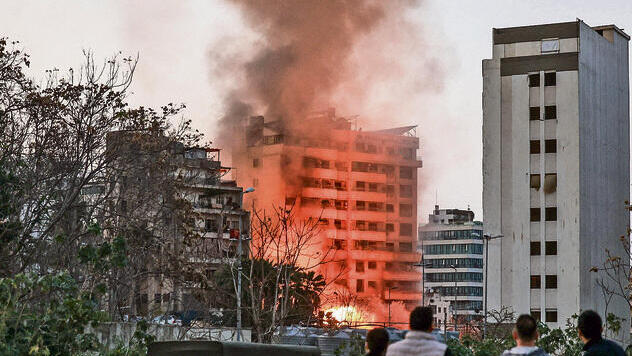
(Photo: Mohamed Azakir, REUTERS)
The division of labor is clear: different strike zones for each military, but a shared intelligence target bank and coordinated strike plans. In Israel, a special intelligence cell is operating to feed targets in real time, including for American unmanned aircraft operating over Iran.
A less glamorous but necessary phase of the war
After the dramatic opening blow — which included strikes against Iran’s security leadership, the achievement of air superiority and the suppression of a large portion of the missile fire toward Israel — the campaign has entered a less glamorous but decisive phase: the phase of grinding down capabilities.
In Israel’s defense establishment, this is defined as a planned war of attrition. The goal is not only to damage Iran’s existing capabilities but also to erode the regime’s future research and development capacity — in other words, not only to break what already exists but also to prevent what is planned to be built.
This effort relies on intelligence work that has been built up over months. Since December, an accelerated intelligence focus has been directed at regime targets, senior figures and key centers of power within the Islamic Republic.
One of the central targets of the campaign now is Iran’s missile array. On the eve of the war, Iran held about 460 missile launchers. According to IDF figures, roughly 140 remain.
The effort continues to locate and destroy the remaining launchers, alongside attempts to disrupt their use — including by creating “traffic jams” in the tunnel networks where the Iranian regime hides parts of the missile array.
The pace of missile launches toward Israel also reflects the damage to Iran’s capabilities. According to Tehran’s original plan, after the opening strike Iran was expected to launch more than 100 missiles and then maintain a pace of dozens per day. In practice, the rate has averaged about 15 missiles per day — a gap that Israeli officials say represents a significant failure for Iran.
The threat to Israeli Air Force aircraft still exists. Surface-to-air missile systems have been dispersed across Iran, but despite this, Israel’s air superiority has been maintained.
The nuclear issue remains in the background
In the IDF, officials say they are beginning to identify early signs of erosion within the regime’s mechanisms. According to military sources, initial cracks are beginning to appear within the Islamic Revolutionary Guard Corps, along with early cases of defections — although these are still considered very preliminary developments.
In the General Staff, commanders are looking beyond the daily statistics of strikes and launches. The objective is broader.
“We are working to create military conditions for regime change,” senior officials say. According to them, the deep damage inflicted on the regime’s institutions could create conditions for change — even if the results become visible only after the fighting ends.
Alongside the other objectives, the issue of Iran’s nuclear program remains in the background.
“If we had not attacked now,” a senior General Staff officer said, “Iran’s military nuclear program would have entered a zone of immunity.”
In the IDF, officials stress that there is no intention to be dragged into unnecessary adventures — but also no intention of stopping too early.
“If we stop now,” military officials say, “the question that will be asked is how we failed to complete the historic mission.”
The fronts converge against Israel
From Israel’s perspective, this campaign is not another regional round of fighting.
“We are fighting the head of the octopus,” senior IDF officials say. “To solve Israel’s biggest strategic problem, you have to defeat it.”
At the same time, they stress that beyond Iran itself, Israel must also deal with one of the octopus’s arms across the border.
As the days pass, the arenas in Iran and Lebanon are increasingly converging in attempts to challenge Israel. Hezbollah leader Naim Qassem, Israeli officials say, did not “give in” to Iranian pressure — he is committed to it.
Qassem is a Lebanese Shiite, and in his worldview there is a clear hierarchy: first Shiite, and only afterward Lebanese. When the Shiite-Iranian core is threatened, Israeli officials say, it is not a matter of pressure but of ideological and religious commitment.
Therefore, when Hezbollah decided to join the fighting, it did not limit itself to symbolic fire. Two nights ago, it escalated the conflict with a large barrage of about 200 rockets and around 20 drones.
After that barrage, the IDF acknowledged the following morning that it had failed to properly prepare civilians for the attack, leaving local leaders — Nahariya Mayor Ronen Marli and Mateh Asher Regional Council head Moshe Davidovich — to inform residents.
The incident created a serious crisis of trust that should not be underestimated, especially during a large-scale war that is also affecting Israel’s home front. The military must act to correct this immediately.
Operationally, the IDF has increased its strikes in southern Lebanon, evacuated large parts of the area and expanded the number of defensive positions — mobile outposts deployed along the strip near the border fence.
Still, Israeli officials note the scale of the threat that might have existed in the north during a war with Iran had Israel not launched Operation Northern Arrows against Hezbollah.
There were voices in Israel who opposed that operation or believed it would be possible to rely on unwritten understandings with former Hezbollah leader Hassan Nasrallah. But the reality, Israeli officials say, included more than 100,000 rockets and missiles — thousands capable of reaching central Israel — along with the Radwan force deployed along the border and in the first line of Lebanese villages.
The simple truth, officials say, is that if Hezbollah had remained at the level it was two years ago, the IDF likely would not have attacked Iran at all — neither in Operation Rising Lion nor in Operation Roaring Lion.
Hezbollah suffered a severe blow in Operation Northern Arrows. The force that ultimately stopped the IDF’s campaign, Israeli officials say, was the United States, which pushed for a ceasefire agreement.
It must be said honestly: Hezbollah — from an organization that once had the readiness within hours to launch a scenario resembling the October 7 attack in the north, alongside thousands of rockets per day and serious concern among Israeli leaders about major damage to Tel Aviv’s skyline — is not in that position today.
Nevertheless, Israeli officials warn against the illusion of a quick and decisive victory.
“There is no such thing,” they say.
Even after a very successful operation such as Operation Defensive Shield, and despite the fact that the IDF has operated in the West Bank almost every night for more than two decades, attacks and attempted attacks still occur. That is the reality of a prolonged campaign against terrorist organizations.
The same is true with Hezbollah. The achievements are enormous, but the campaign is not over.
The group still retains capabilities — roughly about 20% of what it had on the eve of the war. That is still enough to launch dozens of precision rockets toward central Israel and at least about 20,000 short-range rockets toward northern Israel.
Dismantling Hezbollah’s military capabilities must remain a central objective of the war. The challenge is how to pursue that goal while the main front is Iran — rightly so.
Resources are limited. There is no avoiding that reality.