

It is well worth following the duo at the top of the Turkish government — President Recep Tayyip Erdoğan and his foreign minister, Hakan Fidan, who until two years ago served for 23 years as head of Turkey’s intelligence services. Fidan is known as the president’s absolute loyalist and confidant, and Erdoğan has already declared that he is the one who will “continue in my path.”
Fidan has made clear that he is not interested in becoming president of Turkey, but he still has two years to deliberate. The two fit together like hand and glove when it comes to decision-making. In the West, Fidan has come to be seen as the “brain” of the ruler.
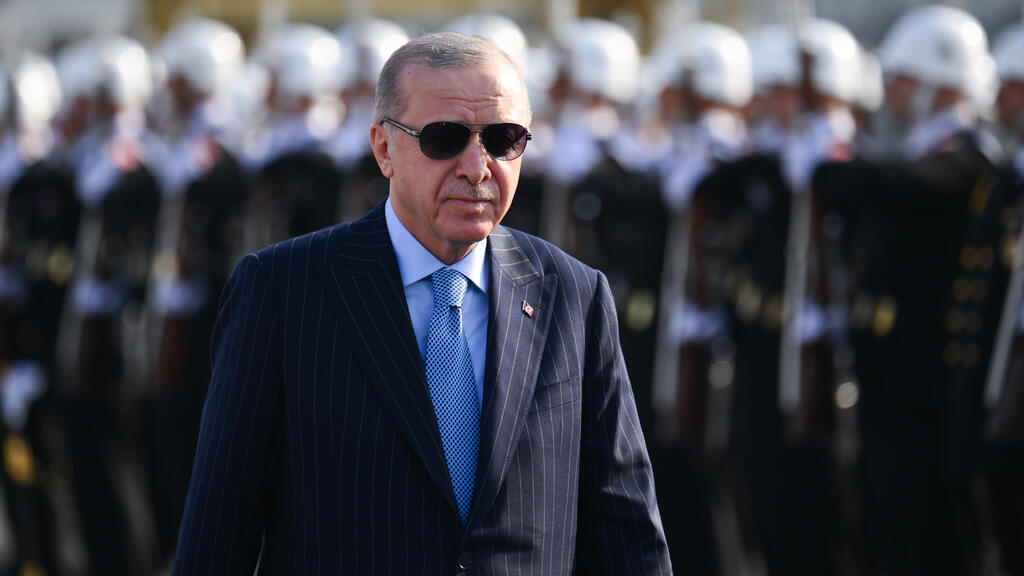
Turkish President Erdogan is leading the move to form a united Arab front against war with the Islamic Republic
(Photo: From X)
Erdoğan, who received pointed praise from President Donald Trump (“a tough leader I like”), is aiming for the big prize in the Middle East. So it pays to watch the Turkish president’s recent round of visits and hosting of leaders from key countries in the region, in an effort to forge a “supra-regional alliance” and, along the way, improve relations.
Saudi Arabia, Egypt, the Emirate of Qatar, and Jordan’s King Abdullah - who was invited to Istanbul before all of them: Erdoğan continues to dream of a “summit of summits” to be hosted in Ankara, featuring a senior American representative opposite an Iranian “colleague,” with Erdoğan himself at center stage.
The duo, Erdoğan and Fidan, do not hide their deep concern about a wave of Iranian migrants who could flood into Turkey the moment the U.S. military acts in the Islamic Republic. That nightmare has only grown since the influx of three and a half million Syrian refugees into Turkey, even before the fall of President Assad. Most of those refugees still refuse to return, and Turkey has been forced to expel them by force.
The equation is clear: Iran sells (at “friendly” rates) 10% of the oil Turkey requires, and even larger quantities of natural gas. In return, Turkey supplies Iran with food products. A war would be expected to disrupt the supply chain, and also to widen the Turkish-Kurdish front along the Iran-Turkey border. Israeli support for the Kurds in Syria, even if not particularly tight, does not escape the notice of Erdoğan and Fidan.
The two are not sitting idly by. Erdoğan is quietly working to tighten the Arab camp on the Iranian issue. The frozen peace with Egypt, the anger of the Jordanian royal house toward Netanyahu, the Saudi royal family’s turning away from Israel after Crown Prince Mohammed bin Salman committed — just two and a half years ago — to join the Abraham Accords, all of this encourages the presidential palace and the foreign minister’s office. All at once, Turkey finds itself in every corner of the Middle East.
We can see that Israel has been pushed out of the arena. In Saudi Arabia, Erdoğan conducted negotiations to sell hundreds of Turkish-made stealth aircraft. In Egypt, commitments were made for nearly $15 billion to be invested in new factories that would employ thousands, perhaps tens of thousands, of unemployed Egyptians. Jordan, too, is expected to receive large-scale assistance. Each country pursues its own interests, except for the United Arab Emirates, which Erdoğan has decided to punish because of what he sees as excessively close ties with Israel.
Netanyahu is now preparing to present to President Trump the “Turkish danger.” It is far from certain that Trump will be moved as his advisers will take notes.
It was odd to hear Fidan in recent days speak of a good chance of renewing economic cooperation between Turkey and Israel. He does not make slips of the tongue. The question is whether he intended to release a “calming injection” ahead of the meeting at the White House.
If we look at the Arab states — Saudi Arabia, Egypt, Jordan and Qatar — we find a contradiction: on the one hand, they maintain ambassadors in Tehran, a form of normalization; on the other, their relations with the leadership in Washington are excellent.
And there is more: each of these countries “excels” in having very poor (very!) relations with Israel. And let us not forget: none of the Arab states, not even Turkey, sees Iran as an ally. There is interaction, there are ambassadors, but there is also considerable suspicion. Of course, no one is truly thinking about Iran’s 93 million citizens.