


The Iranians, like a wounded animal, launched a missile and drone attack Monday evening on the United Arab Emirates and the Omani capital. Alongside attacks on ships and tankers in the Gulf, this appears to be only the beginning. Senior Revolutionary Guards officials may not be done, and Israel must prepare for the possibility that its home front could soon become a target.
Against the backdrop of recent events, Tehran appears to have understood that if the U.S. succeeds in even partially reopening the Strait of Hormuz to commercial shipping, Iran will lose not only its main and only bargaining chip in negotiations — its leverage over the global energy market — but also suffer a humiliation that could threaten the regime’s survival.
Iranian fire toward US ships


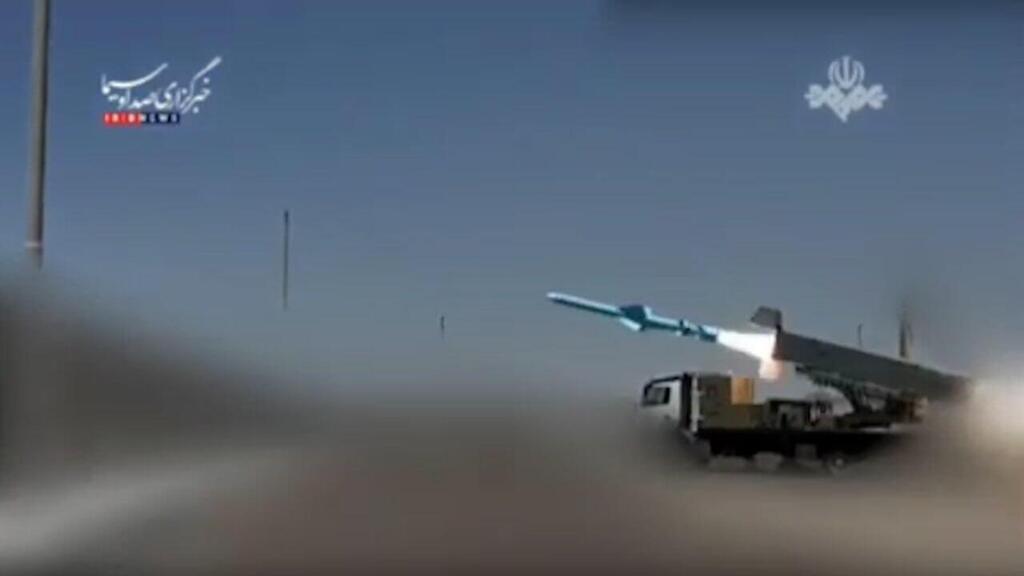
Iranian fire toward US ships
Iran understands that Trump has declared “Project Freedom,” which began Monday after the U.S. used the ceasefire to build up a massive naval, air and ground force facing southern Iran and the Strait of Hormuz. That force gives U.S. Central Command decisive military superiority, including “soft” weapons, electronic warfare and cyber capabilities, in the strait and the Gulf of Oman.
And not only military forces: During the ceasefire, the Americans also diligently gathered intelligence on the locations of naval mines laid by the Revolutionary Guards in the Strait of Hormuz and identified safe routes for commercial ships. U.S. Navy destroyers now stand between the Iranian coast and the vessels, ready to respond by all means to attacks against them. That includes missile-jamming systems, as well as U.S. Central Command reconnaissance aircraft and drones patrolling above the destroyers, detecting every launch and striking it. The same applies to speedboats, six of which the U.S. military says it has already sunk.
In such a situation, the Iranians have no chance of succeeding in a confrontation in the Strait of Hormuz, which would almost certainly end with the destruction of Revolutionary Guards facilities and launchers along the nearby coasts and in southern Iran. That is why Tehran decided to strike the Gulf states, first and foremost the UAE, whose rulers openly encourage Trump to neutralize Iran’s nuclear and ballistic capabilities.
The UAE leads opposition to Iran among the Gulf states, but Tehran has an almost unlimited ability to strike its oil facilities and ports, the source of its wealth. According to reports, the U.S. and Israel have recently worked to bolster the UAE’s missile and drone defenses, but its oil industry remains highly vulnerable to anything launched from nearby Iran.
Given all this, it is reasonable to assume that the launches toward the UAE and Oman were only the beginning. Tehran understands that if it loses this campaign, and Trump’s economic siege on Iran continues, the regime’s survival will be in real danger in the foreseeable future. Iranian citizens will not remain indifferent to the combination of economic hardship and national humiliation, and sooner or later, they may take to the streets.