

U.S. President Donald Trump announced late Sunday night Project Freedom, set to begin Monday morning, under which the Americans will help free "neutral" ships stuck in the Strait of Hormuz and escort them to safety. The U.S. president described the move as a “humanitarian gesture,” stressing that “if, in any way, this Humanitarian process is interfered with, that interference will, unfortunately, have to be dealt with forcefully”
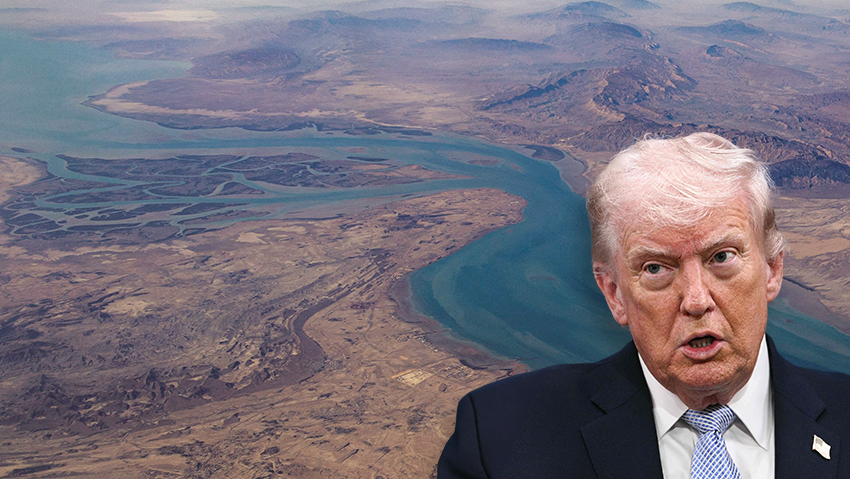
Trump announces Project Freedom to free ships stuck int he Strait of Hormuz
(Photos: Brendan Smialowski/ AFP, Reuters/Stringer)
In a post on Truth Social, Trump wrote: “Countries from all over the World, almost all of which are not involved in the Middle Eastern dispute going on so visibly, and violently, for all to see, have asked the United States if we could help free up their Ships, which are locked up in the Strait of Hormuz, on something which they have absolutely nothing to do with — They are merely neutral and innocent bystanders! For the good of Iran, the Middle East, and the United States, we have told these Countries that we will guide their Ships safely out of these restricted Waterways, so that they can freely and ably get on with their business. Again, these are Ships from areas of the World that are not in any way involved with that which is currently taking place in the Middle East.”
He added that: "I have told my Representatives to inform them that we will use best efforts to get their Ships and Crews safely out of the Strait. In all cases, they said they will not be returning until the area becomes safe for navigation, and everything else."
Trump emphasized that he is “fully aware that my Representatives are having very positive discussions with the Country of Iran, and that these discussions could lead to something very positive for all.”
“The Ship movement is merely meant to free up people, companies, and Countries that have done absolutely nothing wrong — They are victims of circumstance. This is a Humanitarian gesture on behalf of the United States, Middle Eastern Countries but, in particular, the Country of Iran. Many of these Ships are running low on food, and everything else necessary for largescale crews to stay on board in a healthy and sanitary manner. I think it would go a long way in showing Goodwill on behalf of all of those who have been fighting so strenuously over the last number of months,” he also wrote.
Iran’s Foreign Ministry said Sunday evening that Tehran had received a response from the U.S., via Pakistan, to its latest proposal to end the war, and that the response is being examined. Israel is following the negotiations between the sides, but believes the chances of a deal are very low because of Iran’s refusal to meet Trump’s demand and give up its enriched uranium in the first stage of the agreement.
Saturday night Trump wrote on Truth Social: “I will soon examine the plan Iran sent us, but I cannot imagine it will be acceptable, given that they still have not paid a heavy enough price for what they have done to humanity and the world over the past 47 years.” Earlier, when asked by reporters about a possible resumption of strikes on the Islamic Republic, the president replied: “There is a possibility that could happen.”
Meanwhile, the British maritime trade agency UKMTO reported Sunday evening that several vessels near the port of Ras al-Khaimah in the United Arab Emirates had received a message over the radio network telling them to move away from their anchorages. “Authorities continue to investigate and vessels have been asked to report any suspicious activity,” UKMTO reported, without saying who exactly ordered the ships to move from the area, or whether the Revolutionary Guards were involved.
Earlier, UKMTO reported a cargo ship attacked by small boats in the Strait of Hormuz. Iran denied Sunday evening that the vessel had been attacked. “A passing vessel was stopped on the orders of the Iranian navy to examine documents as part of monitoring procedures,” Iran’s Fars news agency reported.
Details of the Iranian offer
According to a report by Al Jazeera, confirming previous reports, the Iranian proposal includes three stages. The first deals with stabilizing the ceasefire and turning it into an end-of-war arrangement; the second involves temporarily freezing uranium enrichment; and the third concerns building a regional security framework. The network also reported that the Iranian proposal includes a ceasefire in the region and on all fronts, and a commitment by Iran and its allies not to attack U.S. forces in the region or Israel, in exchange for an Israeli commitment not to attack Iran.
The details of the Iranian proposal have not been officially released, but it includes 14 points that Iran says are intended to bring a full end to the war within a month. Al Jazeera reported that the first stage of the proposal includes reopening the Strait of Hormuz, though it did not specify under what conditions.
On Sunday evening, Iran’s Fars news agency, affiliated with the Revolutionary Guards, published a report denying that the proposal includes the possibility of opening the strait before a final agreement is reached. Fars also claimed the proposal does not include consent to suspend uranium enrichment for up to 15 years, as Al Jazeera reported.
First published: 00:20, 05.04.26