

Since the start of the war against Iran — and in fact since October 7 — we have seen the smiling faces of female soldiers, heard about the courage of paramedics under fire, and of course admired mothers who continue to function under sirens and closed schools. But in the shadow of all this, there is a large group of women fighting a silent rear-guard battle. They do not wear uniforms, they have no military spokesperson, and their war did not begin on October 7 — it simply became an endless trap.
These are women living with complex post-traumatic stress disorder (C-PTSD). For them, Israel during the past months of war has become a minefield of triggers. While Israeli society mobilizes for the “front,” these women are pushed out of sight. They are the invisible ones within the home, those whose past traumas — the prolonged, quiet and wounding injuries they endured — come back to life with every alert, every knock on the door, every news headline.
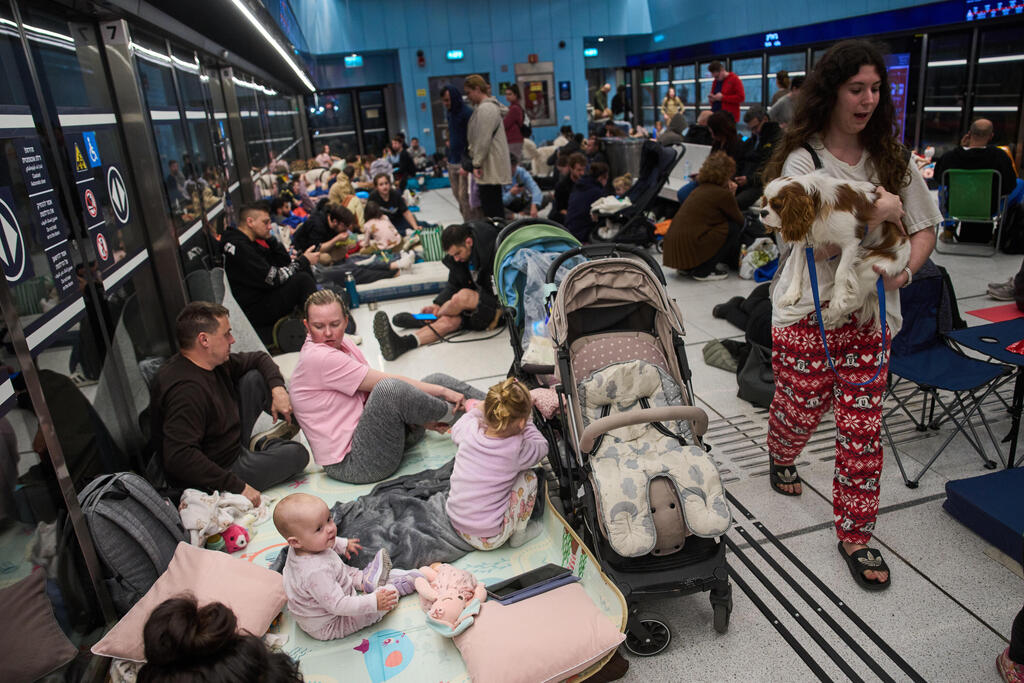
(Photo: AP Photo / Oded Balilty)
Trauma, at its deepest essence, is an act of invalidating reality. It tells the victim: “What happened to you didn’t really happen,” or “It wasn’t that bad.” Recovery from trauma, therefore, is the opposite process: it requires recognition. It needs a society that says, “I see you. Your pain is real. It has a name.”
But in Israel’s current reality, a cruel hierarchy of pain has emerged. In a country under existential threat, there is an unspoken sense that anyone who was not directly harmed by the current war must “wait their turn.” These women are forced to swallow their cries, to wait until the national storm subsides just to receive permission to ask for help. They feel their pain is “less urgent,” “less heroic.” Meanwhile, in this enforced silence, complex trauma only deepens its roots.
Alongside the pilots and soldiers, there is a home front carrying old wounds that have begun to bleed again. For a woman who experienced prolonged harm in the past, the loss of a national sense of safety is not just a security event — it is a total collapse of the survival mechanisms she worked so hard to build.
In a country under existential threat, there is an unspoken sense that anyone who was not directly harmed by the current war must 'wait their turn' to ask for help
This is where a radical shift in perception is required. We cannot allow ourselves to be a society that sees only the “wounded of the moment.” True social resilience is measured by our ability to validate pain that has no expiration date and no clear front line.
For this reason, we developed the “Eden Model,” which offers precisely what Israeli society tends to forget during wartime: visibility. The model does not ask, “What’s wrong with you?” but rather, “What happened to you?” It understands that healing does not begin with medication or technique, but with the moment a woman stops being invisible. It recognizes that validating complex female experiences is not a “bonus” reserved for quieter days, but a necessary condition for building a healthy society.
That is why we must also salute the kind of courage that does not make headlines — the courage of the woman who gets up in the morning despite a night filled with nightmares from both the past and the present. The courage of the woman fighting for her sanity in a world that demands she “be strong” and “understand that there are more urgent things.”
 Ronit Shoval
We do not need to wait for the war to end in order to see them. Visibility is the treatment. Recognition is the healing. Our duty as a society is to ensure that no woman has to wait for the storm to pass before someone notices that she is drowning.
It is time to turn invisible women into visible ones — not as victims, but as the complex fighters they truly are, deserving of a safe space, full recognition, and a helping hand — not tomorrow, but now.
Ronit Shoval is the CEO of the Eden Association and specializes in the treatment of post-traumatic stress and complex post-traumatic stress