

“The state, which is supposed to protect life, cannot itself take life without descending to the level of those it condemns,” Czech leader Vaclav Havel once warned. His words were not abstract philosophy, but a hard-earned lesson from a country that chose to abandon capital punishment in favor of restraint over retribution. Yesterday, Knesset moved in the opposite direction, passing a law that embraces the death penalty as a tool of counterterrorism. In doing so, it has set Israel on a path that Havel cautioned against — one that risks blurring the line between justice and vengeance.
If the law itself raises profound moral and strategic questions, the manner of its passage only deepened the unease. As the vote was gaveled through, Deputy Speaker Limor Son Har-Melech marked the moment with a triumphant declaration of “Am Yisrael Chai,” invoking a near-messianic sense of vindication. Shortly afterward, National Security Minister Itamar Ben-Gvir and Heritage Minister Amichai Eliyahu attempted to open champagne in celebration, only to be stopped by Knesset ushers. The scene was telling: a measure authorizing the state to take human life met not with gravity, but with enthusiasm. It was not the image of a society reluctantly embracing a tragic necessity, but of one treating it as a political victory.
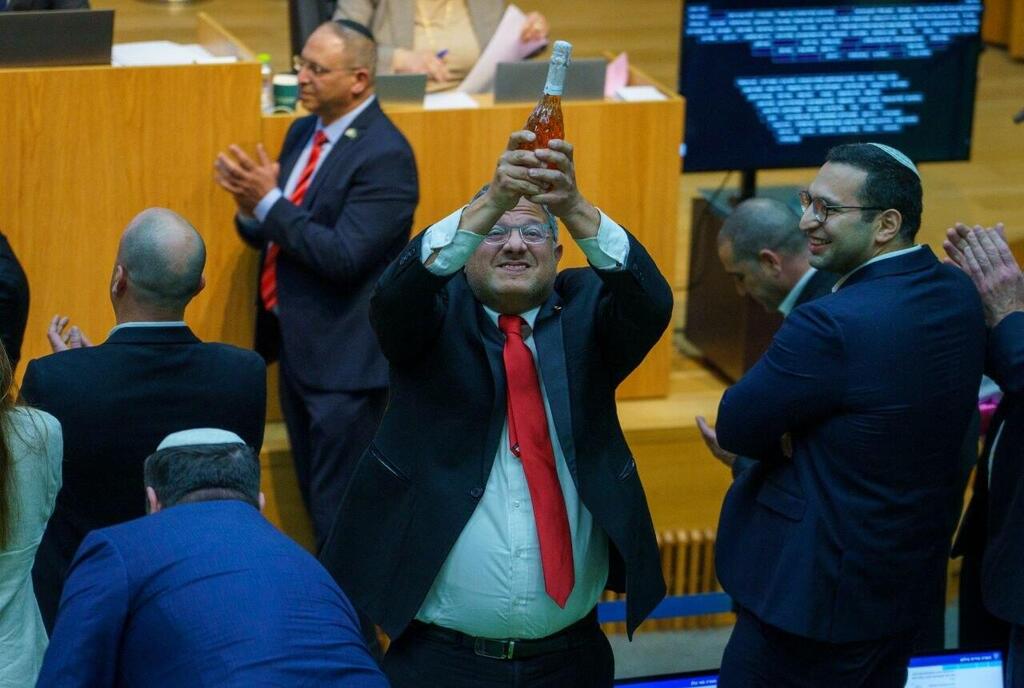
(Photo: Shalev Shlom)
None of this is to suggest sympathy for those who carry out acts of terrorism. Those who deliberately target civilians commit crimes that are indefensible and demand accountability. But rejecting this law is not compassion for terrorists, nor an endorsement of the narratives advanced by Hamas or the Palestinian Authority. It is a recognition that the standards a state sets for itself — especially in moments of anger — define its character far more than the crimes of its enemies.
Those who carried out such attacks did so knowingly and willingly, leaving their homes with the intent to take a life — whether that of a civilian, a soldier or a police officer. There is no ambiguity about the gravity of their actions. But that is precisely what makes this law so misguided. It assumes harsher punishment will deter future attackers, yet many already act with the expectation they will not survive. For individuals prepared to die in the act, the threat of execution months later is not a deterrent, but an irrelevance.
Deterrence depends on the assumption that the perpetrator values their future. When that assumption collapses, so does the policy built upon it. Worse still, in a conflict where death is often glorified, such a policy risks reinforcing the motivations it seeks to suppress. Instead of deterring violence, it may entrench a narrative of martyrdom, turning punishment into validation. A state cannot deter those who do not fear death — but it can, inadvertently, elevate them.
Some supporters imagine a swift process — trials followed quickly by execution. That is not how this will unfold. There is little chance the law, in its current form, will survive unchallenged before the High Court of Justice, given its legal vulnerabilities, from unequal application across populations to the removal of longstanding safeguards. Even if upheld in principle, the right of appeal cannot simply be stripped away.
What follows is not deterrence, but delay: prolonged legal battles unfolding under intense international scrutiny. The law’s 90-day execution window would not be administrative, but a global spectacle. Every stage would be debated and broadcast. Those sentenced would risk becoming symbols — fueling diplomatic pressure, potential sanctions and, in the worst case, inspiring further violence rather than preventing it.
If much of the debate has focused on symbolism, far less attention has been paid to the practical reality. What does implementation look like? Will gallows be built in prison yards? Who will carry out the executions — police, soldiers, medical personnel? Will there be an official role, or will individuals be asked to assume responsibility for taking a life?
The law specifies hanging, but legislation is one thing and practice another. Will cases be handled in military or civilian courts? What happens when the accused is a citizen of Israel? These are not peripheral questions. They expose how unprepared the system is for what this law demands.
Capital punishment is not a slogan; it is an apparatus. It requires infrastructure, personnel and legal frameworks for an irreversible act. Here, the logistical and legal pitfalls are so vast that it is difficult to see how even a single case could proceed without becoming mired in challenges and contradictions.
And beyond strategy and logistics lies a more fundamental question: what is the role of the state? The prohibition against killing is not only a constraint on the individual, but on the state itself. Jewish legal tradition, often invoked by proponents, approached capital punishment with extreme caution. Rabbinical courts set such stringent standards that executions became exceedingly rare. The Talmud describes a court that executed once in seventy years as “destructive.”
Appeals to concepts such as Amalek offer no serious legal basis in a modern state. The identity of Amalek is uncertain in Jewish tradition, and such ideas were never intended as contemporary policy. Invoking them today substitutes symbolism for substance.
A person who takes a life commits a crime; a state that does so must justify not only its power, but its restraint. A democratic society is measured not by how closely it mirrors its enemies, but by how firmly it refuses to. Once the state claims the authority to take life as punishment, it crosses a line that cannot easily be redrawn.
It is difficult to ignore the political context. For National Security Minister Itamar Ben-Gvir, this is an ideological victory. For Prime Minister Benjamin Netanyahu, it offers alignment within a fragile coalition. Both have yet to fully reckon with their roles in the judicial overhaul or the failures surrounding October 7.
Against that backdrop, the law risks appearing less like policy and more like political theater — a way to project strength while avoiding harder questions. This, despite warnings from legal experts, security officials and international partners. That such a measure could gain support as political currency only deepens the concern.
This is not a debate over budgets. It is about the most irreversible act a state can carry out — the deliberate taking of a human life — and the possibility it is being leveraged for short-term political gain.
Havel’s warning was not theoretical. Knesset has now crossed that line — not out of necessity, but out of impulse and politics.
This law will not bring back the dead. It will not deter those prepared to die. It will not make Israel safer. What it will do is hand its enemies a moral weapon, entangle its courts and normalize state-sanctioned killing.
There is nothing strong about this. Nothing strategic. Nothing just. A state is tested when it resists abandoning its principles. This law is not resolve. It is surrender — to anger, fear and political expediency.
Those serious about combating terrorism understand it requires difficult decisions — not slogans. It demands strategy, patience and a willingness to take politically costly positions. That is precisely what is absent here.
And it is no coincidence. Avoiding such decisions has long defined Benjamin Netanyahu’s leadership. This law fits that pattern — not as a solution, but as a substitute for one.
The first step is recognizing this reality: that those leading the state are not acting with clarity or with the public’s long-term interests at heart. The second is political — replacing leadership that confuses spectacle with strategy. The third is immediate: repealing this law and returning to the harder work of pursuing policies that actually address terrorism.
Because once theater replaces strategy, it does not easily give way again.