

Even before the Bank of Israel’s Monetary Committee formally convenes, one thing is already clear: this is one of the most difficult, complex and politically charged decisions the central bank has faced since the outbreak of the war.
Not because there is no direction, but because there are too many directions at once. And when there are too many directions, there is no clear one.
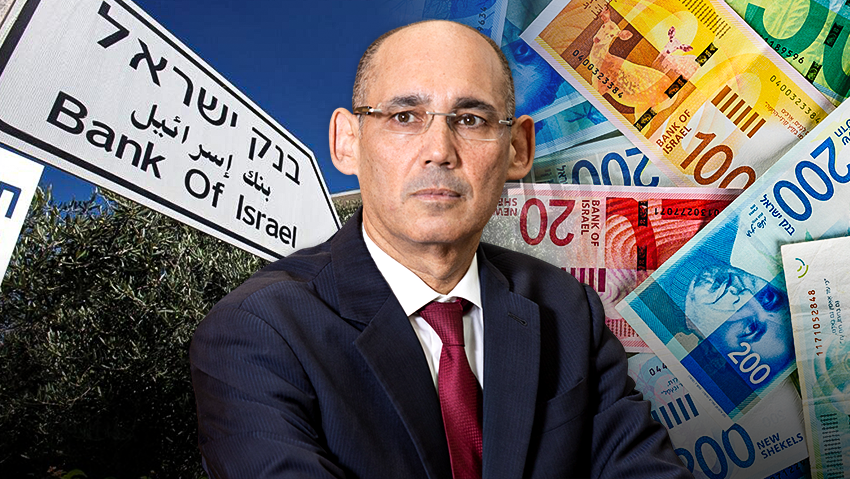
A long list of events is unfolding simultaneously and colliding head-on with the Bank of Israel’s three parallel objectives: price stability, support for growth and employment, and financial market stability. The pressure is clearly toward a rate cut, but a central bank must weigh far more than that, especially against the backdrop of deep security, geopolitical and economic instability.
The first consideration is inflation. Under the Bank of Israel Law, price stability is the central bank’s primary objective, and inflation is moderating. The fuel behind the disinflationary process is the strengthening of the shekel, which according to UBS has recently been the world’s strongest currency against the dollar.
The situation is unusual. Last week, Bank of Israel Deputy Governor Andrew Abir gave an interview to Calcalist that shed considerable light on the likely policy direction of Governor Amir Yaron and his colleagues. Abir signaled, almost explicitly for the first time, that the Bank of Israel could return to foreign exchange intervention if inflation continues falling toward the lower end of the target range.
He was referring to the prospect of a deeper shekel appreciation, and not by chance. UBS made a similar point this week in unusually direct terms.
In a special review on Israel and the shekel, UBS strategists Nimrod Mevorach and Manik Narain wrote that intervention may be approaching not to protect exporters or manage foreign currency reserves, but because if the exchange rate reaches 2.8 shekels to the dollar, inflation could fall below the government’s 1% lower bound as early as this summer.
That would be a dramatic and unusual event.
While many countries are again battling inflationary pressures caused by the war with Iran, Israel is moving in the opposite direction, largely because of the relatively broad energy independence enjoyed by the Israeli economy. The effect of the stronger shekel on inflation is becoming highly significant. UBS notes that tradable goods inflation, which accounts for about 37% of the consumer price index, is already close to zero.

(Photo: CNN)
It is hard to believe that less than two years ago, the Bank of Israel was fighting unusually high inflation, sharp shekel depreciation and fear of losing control over prices. Now, under some scenarios, it may find itself fighting the opposite threat: deflation caused by an overly rapid strengthening of the local currency.
That is exactly what makes the current rate decision so difficult. Even if inflation appears relatively under control for now, the risk environment remains extreme. Israel is still in the middle of a regional war with Iran. No one knows where energy prices will be in a week or a month, or even in two days, even if an initial arrangement with Iran is reached.
One event in the Strait of Hormuz, one disruption to shipping routes or one renewed spike in oil prices could completely reverse the inflation picture.
In other words, the Bank of Israel is seeing powerful disinflationary forces: a strong shekel, low tradable goods inflation, weaker demand and easing core pressures. At the same time, policymakers know the entire picture could turn quickly if the energy market ignites again.
Israel is not fully energy independent. It is still dependent on oil. And April 2026 inflation, at 1.2%, was the highest for that month since 2008, even if it was low relative to other countries and expectations. Adding another layer of complexity, inflation expectations from all sources remain well anchored between 1.7% and 2%, around the midpoint of the government’s target range.
That is only the first problem. The second is growth, and here the picture is much clearer and much more negative.
First-quarter growth figures were very weak against the backdrop of renewed war with Iran. GDP contracted by 3.3% in annualized terms, private consumption was hit and the economy again lost momentum because of the security escalation. The Bank of Israel’s current activity indicators also point to a slowdown. Its monthly activity index fell in April for the third consecutive month.
JPMorgan, the world’s largest bank, which also focused on the Israeli economy over the weekend, noted early signs of a recovery in activity in April. But it also acknowledged that the Bank of Israel faces a “very close call” on whether to cut rates.
(Photo: REUTERS/ Florion Goga)
From the perspective of the real economy, there is a strong argument for beginning to lower rates now. Israel’s real interest rate is among the highest in the Western world. Credit is expensive. The real estate market continues to stagnate. The business sector is operating in an almost impossible environment of reserve duty call-ups, work disruptions, high insurance and financing costs and persistent security uncertainty. Exporters, meanwhile, are suffering badly from the strong shekel.
But here too, reality becomes more complicated. The Bank of Israel must think not only about the present, but also about the day after. If the fighting fades relatively quickly, the Israeli economy could move rapidly into a burst of pent-up demand. This happened after previous rounds of fighting. The last thing the Bank of Israel wants is to cut rates too early, as Yaron himself has warned more than once, only to find Israel facing a new inflation wave within a few months that would require renewed rate hikes.
The third objective is financial and macroeconomic stability in a period of extreme uncertainty.
The Bank of Israel is no longer operating in a normal macroeconomic environment. It is managing policy inside a volatile geopolitical reality in which every monetary decision is affected by regional war, market turbulence, the foreign exchange market and political risk.
JPMorgan wrote explicitly that one of the main reasons for the Bank of Israel’s caution is geopolitical uncertainty. It also noted that the Israeli central bank has shown a clear reluctance over the past two years to make significant rate cuts during periods of security instability.
That is not surprising. In Israel’s current reality, conservatism has to be the central compass, especially when the government refuses to take responsibility. At the same time, and somewhat counterintuitively, Israel’s five-year CDS level, a measure of risk premium that is approaching 60 basis points, has erased all the increase accumulated since the October 7 massacre and is now even lower than it was before the judicial overhaul legislation.
(Photo: Alex Kolomoisky)
The question is whether that decline reflects current reality or a market bet on a scenario of calm with Iran and a change of government in Israel.
The situation becomes even more complicated because of politics. In the background of this rate decision is an approaching election, a full-scale election economy and an already highly expansionary fiscal policy. The deficit is expected to jump again this year, defense spending is enormous and still rising, political pressure to increase spending is intensifying and the government is operating in an almost constant populist atmosphere.
According to UBS, markets are currently focused more on Wall Street, high-tech and capital flows than on local politics. But political uncertainty surrounding the election and the budget remains very high, and the fog will only lift closer to the 2027 budget, whose authorship is still unclear.
From the Bank of Israel’s perspective, this is another reason for caution. When fiscal policy is expansionary and populist, the central bank, the last responsible adult in the room, cannot afford to look too dovish or loosen too quickly.
The result is almost paradoxical: every argument in favor of a rate cut is correct. At the same time, every argument against a rate cut is just as correct.
As Prof. Uri Heffetz, the lone external member currently serving on the Monetary Committee, put it in an interview with Calcalist last week: “Making decisions at moments like these is like flying a plane from the rearview mirror. You cannot look through the front window, not even through the side windows.”
Today’s decision is far more than a rate decision. It is risk management under extreme conditions.