


On August 7, 2026, the al-Safa palace in Makkah provided the backdrop for a grand display of diplomatic choreography. Crown Prince Mohammed bin Salman, Turkish President Recep Tayyip Erdogan, and Pakistani Prime Minister Shehbaz Sharif stood side by side to sign the Makkah Joint Defense Agreement.
Global media outlets immediately erupted into hyperventilating headlines, proclaiming the arrival of a massive Sunni security bloc and an Islamic NATO capable of reshaping the balance of power in the Middle East. Yet stripping away the religious imagery, the photo opportunities, and the dramatic declarations of mutual defense reveals a much simpler truth.
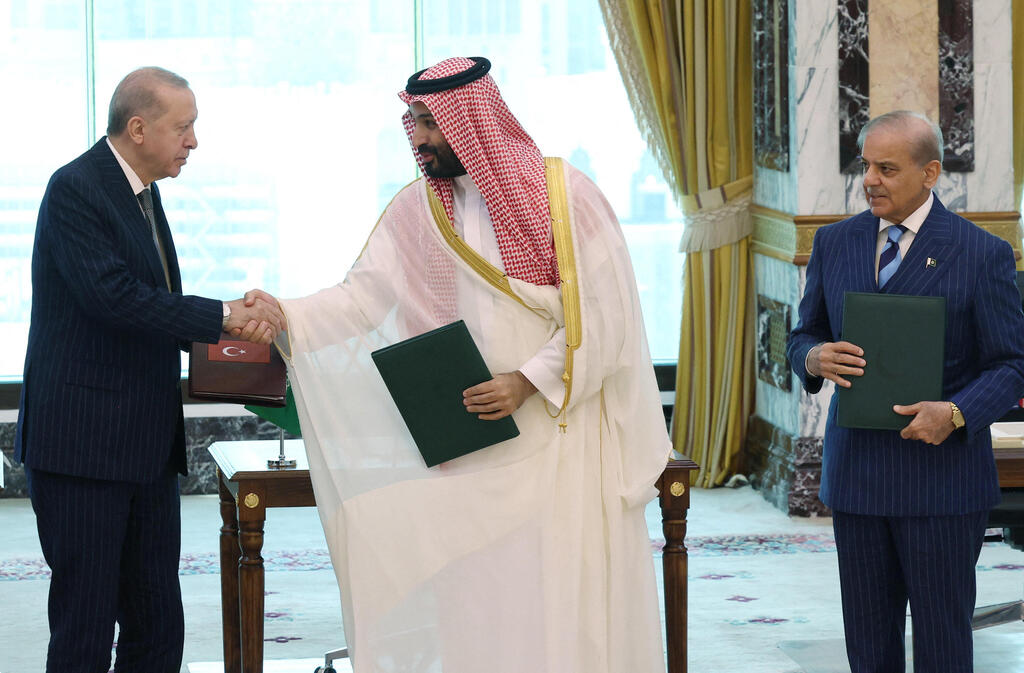
(Photo: Murat Cetinmuhurdar/Turkish Presidential Press Office/Handout via REUTERS)
This pact is not an aggressive super-axis poised for conquest, nor does it mark the beginning of a sweeping regional war. It is a defensive hedge born of shared anxiety, signed by three leaders who are far more focused on internal survival and economic preservation than projecting military power abroad.
To understand why this treaty poses no real military danger, one must look past the signatures and examine the cold realities of hardware, logistics, and operational command. The text of the Makkah agreement borrows heavily from the mutual defense language of Western alliances, stating that an armed attack on one member will be treated as an attack on all. However, signing a document does not magically build a functional military force. The Makkah pact lacks a joint command structure, an integrated air defense network, standard operational protocols, or shared logistics bases. Pakistan contributes raw troop numbers and nuclear depth, Turkey brings advanced defense manufacturing and uncrewed aerial systems, and Saudi Arabia offers immense financial capital alongside Western missile batteries. Yet on a real battlefield, these forces cannot operate as a single unit. Putting three completely different military doctrines onto a single piece of paper creates a public relations victory, not an operational fighting force capable of changing the military balance.
The central falsehood is the idea that this coalition is preparing to launch an offensive war against Iran. The reality on the ground is precisely the opposite. Not a single leader who signed that document in Makkah has any desire to pick a fight with Tehran. For Saudi Arabia, the entire focus of state policy is the execution of Vision 2030, a multi-trillion-dollar economic transformation designed to move the Kingdom away from oil dependence. Building futuristic megacities, attracting global technology firms, and establishing international tourism hubs requires absolute stability. Missile strikes on energy facilities and Red Sea trade routes devastate those economic ambitions. Riyadh signed the Makkah agreement purely as a defensive shield, attempting to raise the diplomatic cost for proxy drone strikes on its infrastructure rather than initiating an aggressive conflict. It is an insurance policy meant to protect economic development, nothing more.
Turkey and Pakistan are operated by equally cautious calculations. President Erdogan shares a long, fragile border with Iran, relies heavily on Iranian natural gas imports, and maintains a delicate diplomatic balance with Tehran across Syria and the Caucasus. Ankara's primary objective in Makkah was commercial. Turkey wants to secure lucrative defense contracts for its shipbuilders, drone manufacturers, and defense contractors across the cash-rich Gulf. Turkey will not risk a catastrophic border war with Iran to defend Saudi oil refineries. Meanwhile, Pakistan is drowning in economic debt, soaring inflation, and a mounting security crisis along its border with Afghanistan. Prime Minister Sharif and the military establishment in Islamabad view the Makkah deal as a lifeline to secure financial bailouts and economic assistance from Saudi Arabia, not as an invitation to deploy Pakistani soldiers into Middle Eastern conflicts.
The most telling aspect of the entire Makkah summit was the chair that remained empty. President Abdel Fattah el-Sisi was nowhere to be found, and Egypt's complete refusal to join the agreement exposes the deep structural fault lines running through the Sunni Arab world.
This absence is particularly striking given the recent, high-profile rapprochement between Cairo and Ankara. In recent months, Egypt and Turkey have aggressively expanded their military-to-military cooperation, conducting extensive joint war games across multiple operational domains. The two armed forces revived the Friendship Sea naval exercises in the Eastern Mediterranean, deployed multi-role fighter wings together in the Anatolian Eagle aerial maneuvers, and staged elite counter-terrorism drills like Golden Eagle.
Yet there is a massive strategic gulf between conducting tactical exercises and signing a binding collective defense treaty. For Cairo, joint military drills are low-risk tools of pragmatic diplomacy. They allow Egyptian commanders to exchange operational tactics, test naval and aerial coordination in the Mediterranean, and maintain bilateral leverage without sacrificing a shred of sovereign command.
A binding mutual defense pact, by contrast, is a red line Egyptian leadership refuses to cross. As the most populous Arab nation with the largest standing army in the region, Egypt holds immense institutional pride as the traditional anchor of Arab defense. Cairo is willing to run drills with Turkish pilots and sailors, but it will never subordinate its armed forces to a tripartite command structure influenced by Turkish regional ambitions, Saudi financial leverage, and Pakistani nuclear assets.
Beyond ideological friction, Egypt is simply too overwhelmed by threats on its own doorstep to participate in foreign defense pacts. Cairo is currently managing the chaotic spillover from the civil war in Sudan directly to its south, persistent instability along its western border with Libya, counter-terrorism operations in the Sinai Peninsula, and an existential water security dispute with Ethiopia over the Grand Renaissance Dam. Plagued by severe domestic economic distress, Egypt refuses to pledge its soldiers to distant defense guarantees in the Gulf or South Asia. For Israel, Egypt staying out of the Makkah agreement is a major structural victory. It guarantees that the bilateral security framework established by the Camp David Accords remains completely insulated from foreign military pacts, leaving Cairo as a locally focused actor along the southern border.
When evaluated with realism, the Makkah pact poses no threat to Israeli military superiority. Defense capability does not rely on foreign promises or political treaties, but on an unquestioned Qualitative Military Edge built on advanced intelligence networks, multi-layered air defenses, unmatched cyber capabilities, and total air dominance. A paper alliance between three nations with competing domestic priorities cannot undermine those structural advantages. In fact, a defensive Sunni alignment that deters proxy strikes without escalating into an offensive war indirectly serves regional stability. Protecting global energy shipping lanes through the Red Sea and keeping trade routes open prevents radical groups from causing chaos across the Middle East.
The proper response to the Makkah agreement is technical vigilance rather than political panic. Israel must monitor defense hardware transfers between Turkey, Pakistan, and Saudi Arabia, paying close attention to electronic warfare platforms, drone technology, and missile defense integration. At the same time, observers must recognize that Saudi Arabia's foreign policy is inherently multi-vectored. Signing a defensive agreement in Makkah does not signal an end to quiet security cooperation or future diplomatic normalization with Israel. Saudi Arabia pursues self-preservation above all else. When shared threats emerge, informal coordination and pragmatic security ties will endure, regardless of the ceremonies staged in Makkah.
 Amine Ayoub
The Makkah Joint Defense Agreement is another headline in a complex, shifting region. It represents three nations seeking self-reliance in an unpredictable world, bounded by their own economic limits and divided by regional rivals like Egypt. It is not an offensive crusade, it is not an Islamic NATO, and it poses no fundamental threat to the enduring security architecture of the Middle East.
Amine Ayoub, a fellow at the Middle East Forum, is a policy analyst and writer based in Morocco. Follow him on X: @amineayoubx