


The latest statements by U.S. President Donald Trump during the G7 summit sound like an earthquake, feel like an earthquake, and could lead to dramatic, tectonic shifts in the Middle East. The problem is that this time they are drawing a highly problematic new map for the State of Israel. Even his earlier remark that the agreement with Iran is only a “memorandum of understanding” and that “if they don't behave, we'll go right back to dropping bombs right smack in the middle of their head,” no longer really softens the blow. In plain terms, Israel simply got burned.
When Trump speaks about Iran’s right to maintain ballistic missiles because other countries have them too, and about Syria under Ahmed al-Sharaa being able to handle Hezbollah, it amounts to a severe blow to Israel. Not only to Benjamin Netanyahu, who has once again failed in his role and has not managed to translate significant military achievements by the IDF, Mossad, and Military Intelligence into a single meaningful diplomatic gain vis-à-vis Iran. This is a blow to any future prime minister after the October elections and to every Israeli citizen. The series of brilliant assassinations of nuclear scientists and senior Iranian officials, the strikes on missile cities, the damage to Iran’s nuclear program—none of it has led to diplomatic moves that would meaningfully constrain Iran’s ability to act against Israel or halt its nuclear project, nor even to regime change in Iran.
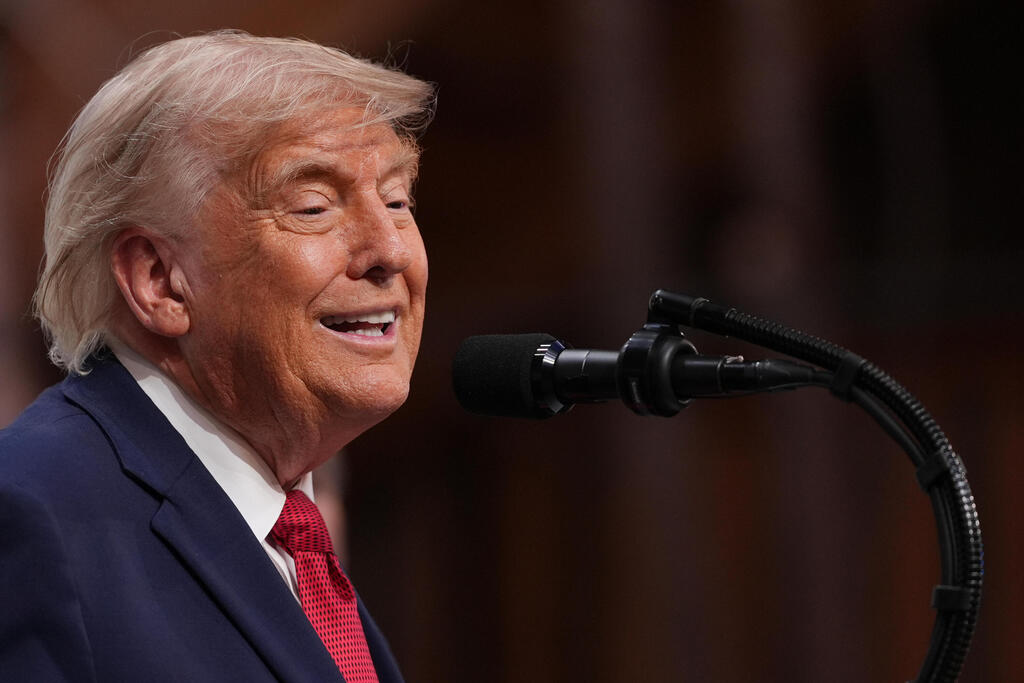
The latest statements by U.S. President Donald Trump during the G7 summit sound like an earthquake, feel like an earthquake
(Photo: AP Photo/Julia Demaree Nikhinson)
This is not meant to gloat over Netanyahu’s supporters, because the reality is far harsher: Trump is drawing before our astonished eyes a new Middle East in which Iran is a full regional power, alongside it, no less significant, the “complex” state of Qatar.
The talks between Tehran and Washington, mediated by Qatar, highlight the worrying process unfolding beneath the surface—no less significant than Iran’s growing power: Jerusalem out, Doha in. And it is not only Jerusalem that has reason for concern. Gulf states, which themselves became targets of Iranian missiles in the recent war, now understand who will be dictating Washington’s moves in the Middle East. Not only could hundreds of billions of dollars flow to the Iranian regime and its allies in the Shiite axis, but Qatar—the main sponsor of the Muslim Brotherhood and Hamas—is becoming a key player in the eyes of the White House and Trump’s team. Is this driven purely by economic interests? Perhaps. But in the end, the state that hosted Hamas’s leadership on the eve of October 7, that operates Al Jazeera, that funded and supported the Muslim Brotherhood and even, in the best case, ran influence operations inside Prime Minister Benjamin Netanyahu’s office, is now shaping U.S. strategy in the region.
This development could have severe and dramatic consequences for Lebanon, Gaza, Yemen, and beyond. It is doubtful that, in light of the U.S.–Iran agreement under Qatari sponsorship, Lebanon’s anti-Hezbollah government will be able to continue acting against the organization’s dominance. On the contrary. Iranian funds are likely to flow more freely, and under the cover of a ceasefire in which Israel’s hands may be tied, Hezbollah’s rebuilding will likely not take long. The Houthis will gain renewed momentum in Yemen, and the same applies to Gaza—where it is difficult to see the U.S. administration, so attentive to Qatar, giving Israel a green light to freely act against the reconstitution of Hamas’s military infrastructure in the Strip.
Israel is stuck in a complex geopolitical reality in the Middle East, and it must be acknowledged as such. Even if Netanyahu were to leave office tomorrow morning, it is doubtful much would change. The situation is even more difficult on the international diplomatic stage and in American public opinion. Israel’s standing among Democratic voters is deteriorating, but so is its standing among Republicans. And if a major third party were to emerge in the United States, one can assume the situation would be no different there either. In Europe, the situation is even worse, and all of us—not only Netanyahu’s supporters—will pay the price for this legacy after the elections.
Netanyahu’s gamble on war with Iran, without thinking about an exit strategy, without defining a clear and realistic objective, is now exploding in all of our faces. At the beginning of the war with Iran, there were those who mocked anyone who argued that an “exit strategy” was needed, even calling them “well-poisoners.” The problem is that the arrogance of Israel’s decision-makers at the start of the war, as well as the blindness of many who refused to ask difficult questions and insisted on numbing us into complacency, has led us into a new regional reality that will harm us all in the future.