

President Donald Trump is presenting the attack on Venezuela as a war on drugs: narco ships, cartels and cross-border terrorism. That is the stated justification, and it is a narrative that is easy to sell to the American public and to the legal system. But anyone who stops there is mistaken. Drugs are only the key to the door. Behind it is a far broader struggle over energy, technology and global power.
The explosions heard overnight in Caracas were not an isolated event. They were the final stage of a process. Trump is no longer issuing threats; he is acting. Strikes on military facilities, airports and power systems were not designed to deter gangs, but to cripple a regime. And now, with Trump’s announcement that Nicolas Maduro and his wife were captured and flown out of Venezuela, it is clear the operation has reached a decisive point.
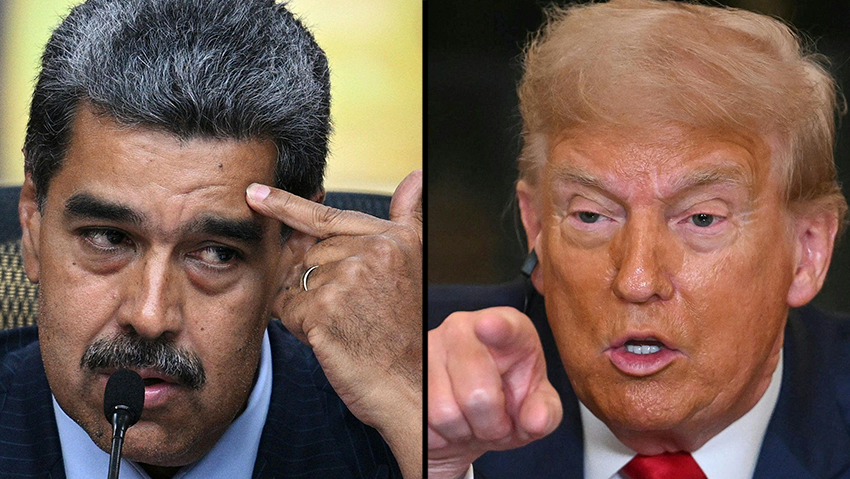
Nicolás Maduro, Donald Trump
(Photo: Jim WATSON / AFP, Federico PARRA / AFP)
The dynamic between Trump and Maduro illustrates the method well. At first, Maduro dismissed the threats. He took to the streets, marched with supporters, projected confidence and portrayed himself as unafraid. As US pressure mounted and military forces drew closer, his tone shifted. Maduro moved to calm rhetoric and attempted to appeal to Trump through cultural gestures, even playing John Lennon peace songs on a guitar. Later, he reportedly offered access to Venezuela’s oil resources in hopes of buying time. It did not work.
From Trump’s perspective, this was never a story that would end with gestures or interim deals. He was not seeking bargaining but severance — cutting Venezuela off from smuggling routes and, more importantly, from China’s energy axis.
The backyard
To understand why Venezuela became a flashpoint, it is necessary to return to an old American principle: the Monroe Doctrine. Latin America is Washington’s backyard, and outside powers are not meant to establish strategic footholds there. That doctrine never disappeared; it was neglected. Trump is reviving it in an updated form, with fewer declarations and more force.
Venezuela is not just a failed state. It is an energy hub. Over the past decade, about 90% of its oil flowed to China, not through free markets but as debt repayment. That gave Beijing a stable, cheap energy supply insulated from geopolitical risk. For Trump, that crossed a red line: a rival power entrenching itself energetically in the heart of the Western Hemisphere.
This is the real strategy. Airstrikes, a naval blockade, the designation of Venezuela as a terrorist entity and attacks on oil tankers were not intended to topple a regime overnight. They were meant to halt production, paralyze exports and dry up the pipeline connecting Caracas to Beijing. Maduro’s capture is not a deviation from that strategy, but proof that it is working.
His capture is not a message only to Venezuela. It is a regional and global warning.
In Tehran, the implications are well understood. Only recently, Trump explicitly warned the Iranian regime that live fire against protesters is not an internal matter and that continued repression would be met with action. For years, Trump was seen as a president who threatened but did not follow through. Venezuela shatters that illusion. When a threat is ignored, it does not disappear; it is carried out. Decision-makers in Tehran now face dramatically increased pressure.
Alarm bells are also ringing in Beijing. Venezuela was not just an ideological ally but a critical energy block: cheap, steady oil shielded from international pressure. Maduro’s capture and the disruption of exports are not only a blow to Caracas, but the loss of a strategic asset for China. A supply chain built over years has been severed overnight.
Hezbollah also understands the signal. Venezuela served as a forward base for drug distribution, money laundering and weapons smuggling. The collapse of the regime there is not just an economic loss, but the dismantling of an operational infrastructure — another link removed from a global network.
But Trump does not operate only through states; he operates through people
His strategy in Latin America is built on a network of local leaders he identifies as natural partners — personal loyalties, similar governing styles and direct confrontation with liberal elites and international institutions. This is not a formal coalition, but a network.
In Argentina, the implicit threat that US support would vanish if voters did not back President Javier Milei’s party contributed to a surprise parliamentary victory. In Honduras, Nasry “Tito” Asfura, a conservative with a clear pro-US stance, was recently elected. In Bolivia, Rodrigo Paz is expected to lead a pro-Western course and pull the country away from China’s orbit.
Brazil is the most sensitive arena. President Luiz Inacio Lula da Silva, a longtime ally of Beijing, has pursued what Trump views as political persecution of Jair Bolsonaro, one of Trump’s closest allies. In Trump’s eyes, this is not an internal Brazilian dispute, but an effort to dismantle a key link in the personal network he is building across the continent.
 Dr. Kobby Barda
Photo: Tal Givony
Dr. Kobby Barda
Photo: Tal GivonyAdded to this is Nayib Bukele of El Salvador, perhaps Trump’s most ideologically aligned partner — a leader waging an uncompromising war on crime and willing to do what liberal Western governments refuse to do. For Trump, Bukele is proof that a strong leader can restore order and become a strategic ally.
Energy is not just fuel. It underpins artificial intelligence, semiconductors, cloud computing and technological dominance. Whoever controls energy flows controls the pace of innovation. Whoever controls that pace shapes the coming decades. China built itself around stable supply chains. Venezuela was one of them. Trump dismantled that link.
Venezuela, then, is not a deviation from US policy but a return to it. Not a war on drugs, but the use of drugs as a pretext. Not a local operation, but a deep strategic move linking energy, governance and personal alliances in a global struggle against China. At least for now, the West is winning — decisively.
Dr. Kobby Barda is a researcher of American political history and geo-strategy at the Multidisciplinary School – HIT Holon.