

At the center of Israel’s media and public discourse this week was a “quiz” that developed following a “report” claiming that one country in the region had advised another to sign an agreement with Israel and violate it after some time.
The vague information — which did not make clear which countries were involved, when the talks took place, at what level or in what context they were held, or how seriously they should be taken (an ambiguity that forces the public to accept the information as “fact”) — sparked a feverish guessing game. Saudi Arabia, Egypt and Turkey emerged as the leading candidates for the advising country, but there was a consensus over the country that was supposedly being advised: Syria.
Gallery
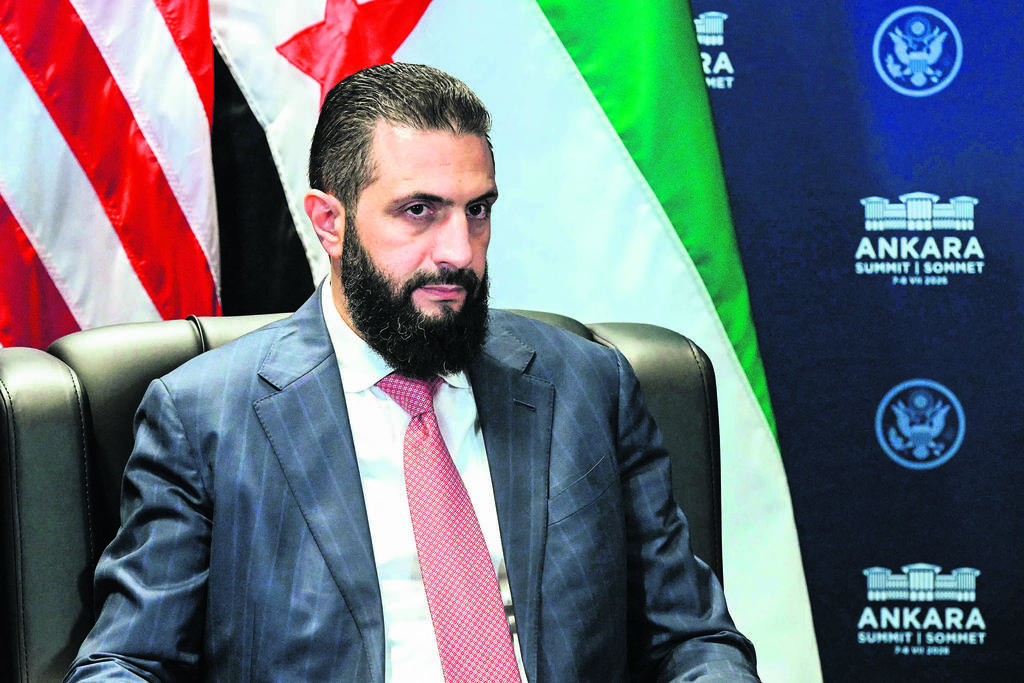
Al-Sharaa. The week’s “quiz” can also be used to justify why Israel failed to advance normalization with Saudi Arabia (the alleged 'advising' country) and why it must not withdraw from captured territory, particularly in Syria
(Photo: Saul Loeb/AFP)
Indeed, Syria under Ahmad al-Sharaa (Abu Mohammad al-Julani) is a mystery that has become a strategic dilemma for Israel. The leader with jihadist roots who seized Damascus in December 2024, bringing an end to more than half a century of Alawite rule, makes it difficult to cast him as an unequivocal enemy who should be confronted.
Al-Sharaa quickly shed his traditional clothing and military uniforms, donned a suit and tie and, above all, has acted in ways contrary to what might be expected of a jihadist who takes power, as happened, for example, in Iran and Gaza: He speaks in moderate language, has become an accepted and even admired figure in the international community, particularly in the Arab world, which sees him as an effective means of reducing Iran’s influence in the region and stabilizing it after two tumultuous decades, and welcomes Damascus’ return to the Sunni fold.
Among his admirers is President Donald Trump, who has lavished praise on al-Sharaa and is working to remove Syria from the list of state sponsors of terrorism. Al-Sharaa’s more moderate approach was evident this week in an agreement he reached with Russia, Assad’s patron and a staunch enemy of the Syrian opposition during Assad’s rule, to maintain a military presence, albeit a reduced one, at several locations in the country. It was also evident in his agreement to hand over components of Syria’s nuclear program — most of which was destroyed in an Israeli strike in 2007 — to the IAEA and the Americans.
Another arena in which al-Sharaa is demonstrating a cautious and calculated approach is Lebanon, where he is facing heavy pressure from Trump to invade, confront Hezbollah and help “restore order” as an alternative to the war Israel is waging.
Al-Sharaa has repeatedly made clear that he greatly appreciates the American president but does not intend to invade Lebanon. He even surprised observers by saying he does not rule out sitting at the same table for talks with Hezbollah, a bitter enemy of the Syrian opposition during Assad’s rule. In recent days, he also sent his adviser, Farah al-Atassi, to Beirut to deliver a message from him to Lebanon’s leaders along the lines of “extending a hand and zero problems.”
At home, too, al-Sharaa is trying to project a moderate approach, but this is fraught with obstacles given the major challenges he faces — primarily tensions with minorities, some of which supported the Assad regime — as well as the presence of extremist elements within his own camp that at times promote murderous actions, such as the massacres carried out last year against Druze, Alawites and Kurds.
At the same time, the purge of the remnants of the Assad regime continues, as reflected this week in the death sentences handed down to Bashar Assad and his brother Maher, who are living in Russia, as well as Atef Najib. Najib is a relative of the former Syrian president and his brother and a former senior official in the Political Security Directorate. He is imprisoned in Damascus and was responsible for the brutal “handling” of a group of teenagers in Daraa province who sprayed anti-Assad graffiti in 2011, an incident widely considered the spark that ignited Syria’s brutal 13-year civil war.
In Israel, as noted, many seek to cement al-Sharaa’s image as yet another Middle Eastern terrorist whom it is possible and even desirable to eliminate, but they encounter an international wall. One example came last year, when Washington barred further attacks on Syrian government facilities in response to al-Sharaa’s regime targeting Druze in the south of the country.
At the heart of the current dilemma is the security zone Israel seized near the Golan Heights immediately after the fall of the Assad regime. There have been no major security incidents there, apart from reckless incursions by the so-called Bashan Pioneers, but external pressure — particularly from the United States — is mounting for an Israeli withdrawal and for talks with Damascus on a security arrangement, essentially a renewal of the 1974 Agreement on Disengagement following the Yom Kippur War.
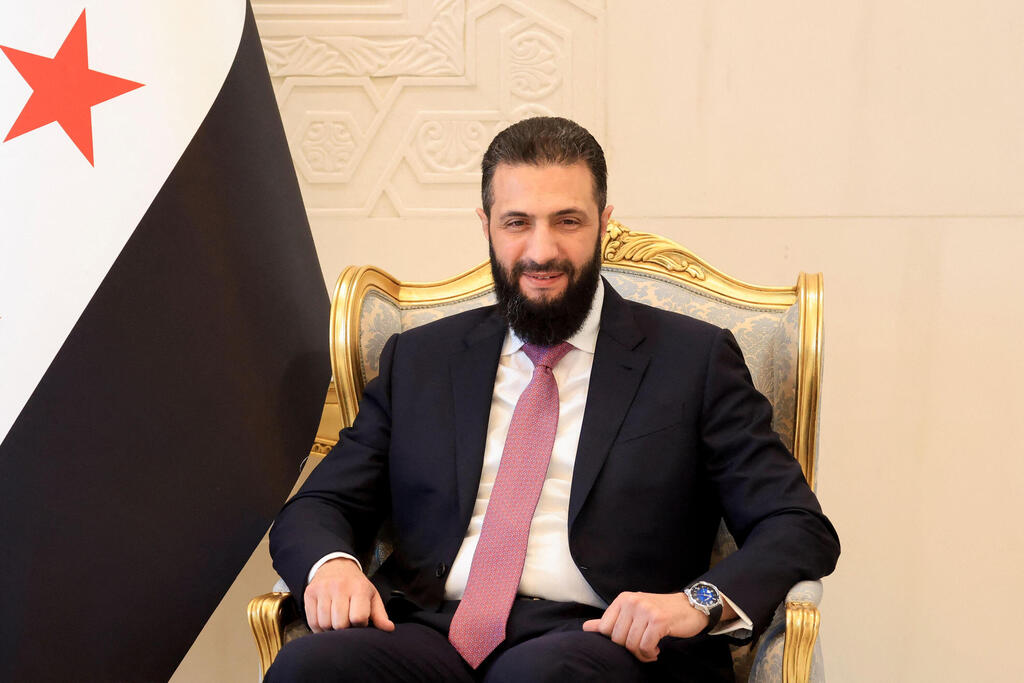
(Photo: Ludovic Marin/AFP)
Israel’s dilemma has intensified in light of statements by al-Sharaa, including in a recent interview with Al Jazeera, in which he expressed support for a security agreement that could serve as a gateway to comprehensive peace between the two countries. But, he said, this would not come at the expense of Damascus’ demand for sovereignty over the Golan Heights, a fundamental claim dating to the Assad dynasty that the current president has also maintained.
“The displacement from the Golan is embedded in my identity because my family comes from the area,” al-Sharaa explained in the unusual Al Jazeera interview, during which he walked alongside presenter Ali al-Zafiri from his childhood home in Damascus’ al-Mazzeh neighborhood — “a Nasserist national home, definitely not Islamist” — to the elementary school he attended and the mosque where he prayed and where he began gravitating toward Islamic ideas that eventually led him to join the jihadist struggle in Iraq. Along the way, he met residents, hugged children and took selfies with young people.
“The land that was lost to my family, which was displaced from the Golan in 1967, and the dream of returning to it were always present in the conversations in our home.”
The Golan issue sparked heated debate in Syria this week following a declaration by Colombia’s new president that his country recognizes Israeli sovereignty over the area, a move that prompted attacks from across the Arab world.
The complex approach al-Sharaa is taking toward Israel can also be seen in new school textbooks being published in Syria. Alongside strong hostility toward Iran, they also contain negative attitudes toward Israel. There is, however, a difference from the Assad era: Israel is referred to by name and the purpose of the conflict with it is not defined as advancing toward its annihilation or as an expression of support for the Palestinian cause, but rather as a means of realizing Syria’s territorial integrity.
Similar messages can also be found in the country’s media discourse and among religious figures. No one is talking about peace or normalization, but many support advancing some form of arrangement between the two countries. Most criticism of Israel focuses on its continued control of the security zone in Syrian territory and on IDF raids from time to time in areas beyond it.
The dilemma surrounding al-Sharaa has sparked a sharp debate among Syria experts. Dr. Carmit Valensi described the complexity surrounding the Syrian ruler in a conversation on Wednesday. According to her, al-Sharaa is currently focused on stabilizing his shaky rule and has no interest at present in a confrontation with Israel. He understands that he would be at an overwhelming disadvantage against Israel and that such a scenario could even bring about his downfall.
“It is important to avoid a fixed, binary view of ‘either war or peace’ and understand that this is a ruler who is showing some degree of change and that it may be possible to reach some kind of security arrangement with him. Israel must, of course, act wisely and cautiously, but it should not categorically conclude that this is a ‘trap.’ An arrangement could be explored based on Israel’s gradual withdrawal from the area it captured, provided there is demilitarization of southern Syria, American involvement in a future agreement, serious guarantees for the protection of Syria’s Druze and preservation of Israel’s freedom of action against emerging threats in the country.”
On the other side are researchers and media figures warning of a “conspiracy” and arguing that “al-Sharaa is more dangerous than Iran and Hezbollah” because of the “smiling and deceptive mask” he wears. Some contend that the threat he poses is more serious than that embodied by the Assad regime because his is a regime with religious characteristics.
It is worth noting that some of those advancing these arguments enthusiastically supported the conceptual framework that preceded the Oct. 7 debacle. They wholeheartedly believed Sinwar’s assurances that he was serious about advancing an arrangement in Gaza, but now call for avoiding an agreement with al-Sharaa and present their current arguments as a “clear-eyed correction” of past mistakes and an antithesis to the views of “naive people who learned nothing from Oct. 7.” Against this backdrop, “reports” emerged this week, at a curious time, about the reconstruction of the Syrian air force, most of which was destroyed by Israel with the fall of the Assad regime, allegedly with vigorous Turkish assistance.
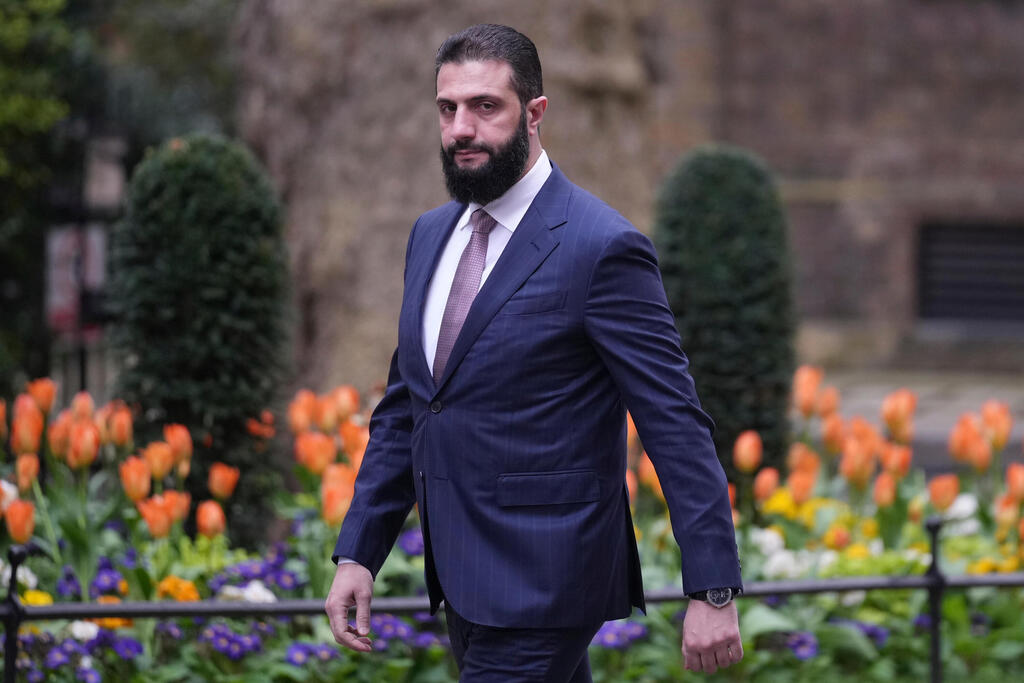
(Photo: Alastair Grant/AP)
A more substantive criticism was offered by Dr. Reda Mansour in a conversation this week: “The al-Sharaa regime is jihadist and, at best, will become Islamist. Every actor in the world that is engaging in dialogue with him today has an interest in doing so. For example, Europe wants millions of refugees returned to Syria, the Gulf states plan to lead Syria’s reconstruction and reap enormous financial gains, while Turkey sees Syria as a central component of the Sunni axis it wants to lead in the region.
Israel, for its part, can aspire at most to a security agreement, under the cover of which al-Sharaa could build a modern and powerful army. However, a hasty withdrawal from southern Syria and abandonment of the Druze could quickly lead to a Turkish presence on Israel’s northern border and a loss of trust in Israel throughout the region, particularly among the Druze.”
The “reports” of the past week bear a striking resemblance to the Bild affair — claims attributed to Sinwar that were intended to portray him as opposing a hostage deal during the war — as well as to “reports” over the past year, often from the same sources and in the same wording, about plans by Egypt or Turkey to attack.
All of these sharpen the sense that someone with an interest is feeding the Israeli discourse with the same information, information whose reliability is unclear — whether it is credible, distorted, exaggerated or entirely false — and is often driven by political or ideological motives, particularly those connected to seizing more territory or perpetuating control over territory captured in war.
It is essential to question not only the goals and worldview behind the leak but also its timing. In general, this is “information” intended to perpetually preserve the image of an enemy that must be fought, while reinforcing suspicion and hostility toward Arabs as a whole — a trauma from Oct. 7 that some appear to be trying to preserve rather than heal and address. This may help reinforce a message prevalent on the right ahead of the elections: distrust and rejection of any ties with Arab parties and alienation toward the Arab public.
The “report” can also serve to justify why Israel failed to advance normalization with Saudi Arabia, which may be the country “advising” others and acting “maliciously,” and why Israel must not withdraw from captured territory, particularly in Syria.
Along the way, many media figures and politicians became experts on Islam this week and recited the claim that the “report” reflects the familiar adherence of Israel’s enemies to the model of the “Treaty of al-Hudaybiya,” which the Prophet Muhammad signed with and later violated against his enemies in the seventh century. They did so without considering that both in the Abraham Accords, including the agreement with the United Arab Emirates, and in the peace treaty with Egypt, Arab leaders enlisted religious rulings invoking this historical precedent.
This week’s “scoop” was supposedly a warning light for the “naive people who believe the Arabs,” but it should be an even more jarring warning about efforts at perception management and influence operations that have been promoted in public discourse since Oct. 7. These require the public to display a degree of critical thinking and skepticism that was absent on the eve of the debacle.
What should be a substantive debate becomes a discourse driven and shaped by political and ideological interests and fantasies mixed with entrenched thinking and a failure to learn from the past.
This is a discourse in which conclusions always precede analysis, facts are not considered essential, criticism is seen as a sign of weakness or weakening — and at times is actually treated as an “enemy from within” — and a nuanced approach belongs to the “world before Oct. 7” (or when Qatar is being discussed ...).
As for al-Sharaa, it is difficult to determine with certainty whether he is in fact a cynical politician who has never attached importance to ideology or whether he is indeed a “jihadist in disguise.” But it is clear that caution and skepticism toward him are essential in either case. At the same time, just as he should not be viewed as a “new Sadat,” there is also no need to begin planning a deliberate confrontation with him or label him a “ticking time bomb,” as many did this week.
Middle-ground options can be considered, such as the security arrangement currently on the table, although discussions over it are deadlocked. Israel, which prefers to rely on holding territory, the continued use of force and avoiding diplomatic engagement, is not defeating its enemies on any front, but neither is it resolving the dilemmas before it. It appears that in the Syrian arena, too, Trump will ultimately make the decision for Israel, exactly as happened in Lebanon and is happening these days in Gaza, even when this runs counter to Israel’s interests.
Dr. Milshtein is a senior researcher at Tel Aviv University’s Moshe Dayan Center