


The experience we have accumulated over 44 years of fighting in Lebanon shows that more of the same will not solve the problem. Another 200 dead Hezbollah terrorists, another 10 high-rise buildings (known in IDF as "power targets") collapsing into clouds of dust and fire in Beirut's Dahieh district, another 20 destroyed villages in southern Lebanon and another underground rocket-production facility in the Bekaa Valley struck by a devastating direct hit — none of these measures alone will solve the problem.
Hezbollah will continue driving Israelis into bomb shelters and, from time to time, will kill an IDF soldier or a farmer in Metula because that is its reason for being. As long as the terrorist organization retains the physical ability to carry out that mission with the rockets and drones it still possesses, it will continue to receive support from Iran.
Footage of the impacts on the beach in Nahariya


Any effort to formulate a response that will put an end to the Hezbollah threat for years to come must take into account that the organization's motivation stems from an explosive mix of religious fanaticism fueled by the ayatollahs in Tehran, support from Iran's Revolutionary Guard and years of friction with the IDF, which have transformed Hezbollah into a significant military force.
No less important is the support Hezbollah receives from Lebanon's Shiite community, now the country's largest sect. For centuries, that community was characterized by a sense of victimhood and marginalization. Over the past 40 years, however, many Shiites have experienced an intoxicating sense of power and pride because Hezbollah is the strongest armed militia in Lebanon and, in their eyes, it is Hezbollah, not the Lebanese army, that protects Lebanon from Israel and Sunni jihadists in Syria.
There is also an economic dimension that underpins Hezbollah's hold over the Shiite community. Traditionally, Shiites in southern Lebanon and the Bekaa Valley relied on subsistence farming and the drug trade for their livelihoods. But cannabis cultivation and the processing of semi-refined narcotics arriving from Asia and destined for Europe suffered a severe blow during the Syrian civil war. Farmers in the Bekaa Valley were left with few sources of income.
Into that vacuum stepped Hezbollah's social and economic institutions, along with the nearly $1 billion in annual Iranian funding the group received, which helped finance its thousands of full-time operatives. This became the economic safety net that kept many Shiite families afloat, even during Lebanon's current economic collapse.
The deterrence achieved in 2024 has eroded
These facts help explain how Hezbollah, despite suffering a devastating, some would say near-fatal, military, operational, physical and psychological blow during Operation Northern Arrows in the summer of 2024, including the killing of Hassan Nasrallah, managed to recover by the winter of 2026 and resume fighting against Israel.
Moreover, with the limited financial support it still receives from Iran, the organization continues to recruit young members, pay reduced salaries to its operatives and purchase hundreds of inexpensive fiber-optic-guided drones on the global market. By fitting them with RPG warheads, Hezbollah has succeeded in creating a frustrating sense of helplessness among Israelis.
IDF strikes in South Lebanon
(Video: IDF)
It must be acknowledged, regrettably, that the deterrence created by Israeli intelligence capabilities and airpower two years ago has eroded. The continued destruction of villages in southern Lebanon, rather than pressuring Hezbollah to stop, has only increased the anger of displaced villagers and provided Radwan Force operatives with greater legitimacy to continue fighting.
Jihadist motivation, combined with the hope that a postwar Iran will reward the organization for its loyalty, allows Hezbollah's leadership to ignore heavy losses, collapsing buildings and growing opposition within Lebanon — and continue the fight.
The truth is that Hezbollah is currently under severe pressure on every front. Hundreds of thousands of Shiite residents displaced from southern villages remain without permanent housing and are struggling to make ends meet. The Lebanese government, backed by all sects in the country, including some Shiites, rejects Hezbollah's claim to retain an independent armed force. Naim Qassem has failed to fill Nasrallah's shoes, while Nabih Berri, the aging and widely criticized speaker of parliament and leader of the Amal movement, has effectively become the leading political figure within the Shiite community.
Hezbollah's strategy of steadfastness
For that reason, Hezbollah and its leadership, in coordination with Iran, have adopted a strategy of sumud — steadfast endurance, holding out until the storm passes. Hezbollah hopes that the old formula of winning by not losing, a tactic that has served jihadist organizations around the world so well, will work for them too.
If Hamas can do it, Hezbollah's leaders tell themselves, then surely we can as well.
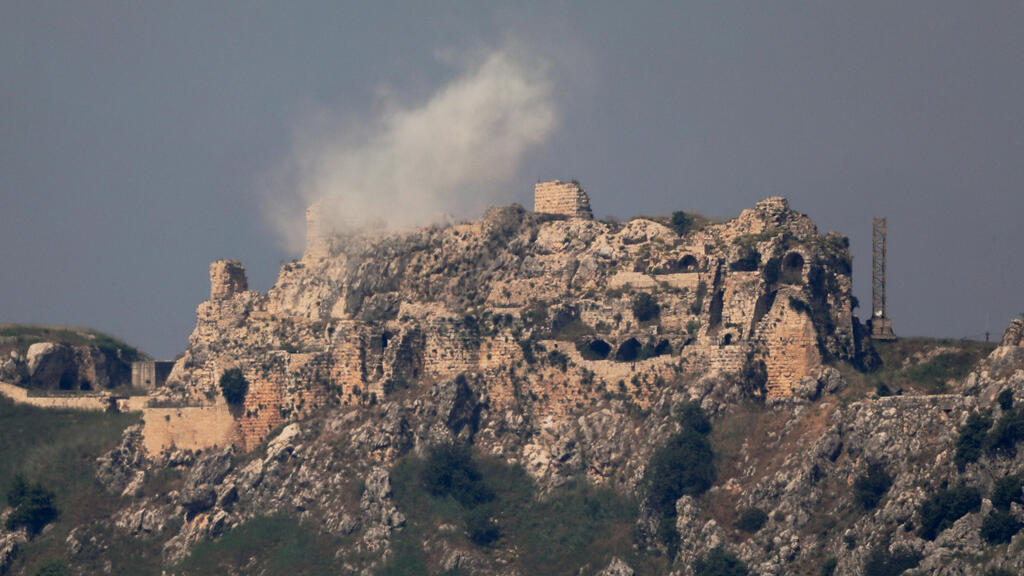
Strike in Beaufort
(Photo: REUTERS/Stringer)
Under these circumstances, there are two strategic paths that could remove the threat Hezbollah poses to Israel.
The first would be the occupation of Lebanon, including the Bekaa Valley, coupled with a siege of Beirut — roughly along the lines of Israel's actions during the First Lebanon War. Such a move would make it possible to dismantle Hezbollah's strategic military capabilities and allow the Lebanese government and army to complete the process. An Israeli occupation would also deny Hezbollah the ability to prevail in a potential civil conflict should Lebanon's other communities eventually move against it.
Those are the principal advantages of such a course in the Lebanese arena. From Israel's perspective, however, the disadvantages outweigh the benefits.
The IDF is exhausted and in desperate need of combat personnel and maintenance for its military platforms after more than two years of fighting. Occupying Lebanon would require Israel to remain there for at least six months as a garrison force until an agreement could be reached. Israel's international isolation would deepen. President Donald Trump, and certainly European and Arab governments, would likely pressure Israel before it had achieved its objectives. There is little point in listing the rest.
A possible solution
There is, however, another course of action that has a chance of succeeding without exacting an unbearable cost. It would involve simultaneous action on several fronts, taking advantage of a window of opportunity that remains open under current conditions.
The first track is military pressure and deterrence, delivered by the IDF through maneuver operations and airstrikes carried out by surprise, marked by deception, speed and limited but meaningful scope and duration. Such an operation may not completely solve the problem of fiber-optic-guided drones, but it could push Hezbollah away from the border and the so-called Yellow Line while forcing its operatives to disperse.
In this context, I am not convinced that a ceasefire in Lebanon is such a bad idea. Even if such a ceasefire were imposed in the coming days as part of an agreement between Trump and Iran, it could serve Israel's interests, particularly if Iran compels Hezbollah to abide by it.
Even if a forced ceasefire prevents the IDF from launching a large-scale rapid maneuver, it would provide Israel's defense establishment with time to complete development and procurement efforts aimed at countering not only individual explosive drones but also the swarms of drones that are likely to appear on future battlefields.
The second track is diplomatic: effective and accelerated negotiations between Israel and the government of Lebanese President Joseph Aoun, rather than the current slow-moving process in Washington. The very existence of such negotiations would deprive Hezbollah of the legal legitimacy it claims as Lebanon's defender.
The goal would be to create a reality in which no threat to Israel emanates from Lebanese territory, supported by a mechanism to verify compliance. In return, Lebanon would regain territories currently held by the IDF, along with minor border adjustments.
The third track is economic: guaranteeing large-scale assistance for Lebanon's reconstruction if Hezbollah ceases to function as an armed militia. This would include the creation of funding mechanisms by Saudi Arabia, Qatar and the United States to provide an economic horizon and incentives for all Lebanese communities, as well as the government, to isolate and neutralize Hezbollah as a way out of the country's crisis.
It would also include U.S., French and Emirati assistance to strengthen the Lebanese army through equipment and training for special units composed of non-Shiite personnel capable of playing a meaningful role in dismantling Hezbollah as a fighting force and preventing its reconstitution, as well as efforts to sever Hezbollah's military and financial lifelines from Iran in cooperation with Syria's new leadership.
Details could be added or removed, but this is, more or less, the formula that could succeed if implemented.
The question is whether Israel's current government, led by Benjamin Netanyahu, is willing and able to initiate such a multi-track effort, enlist Trump's support and agree to a genuine deal with Aoun that would include territorial concessions in Lebanon whose security value is, at best, questionable.
First published: 01:47, 05.31.26