


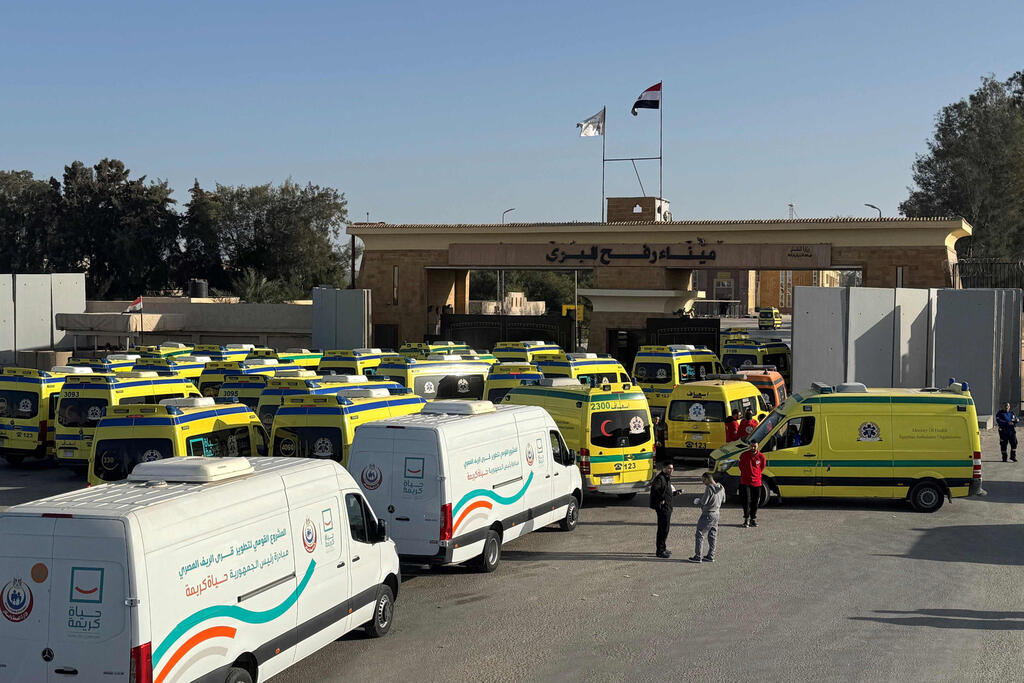
The reopening of the Rafah crossing and the start of operations by a technocrat government in Gaza offer a bleak reflection of the consequences of wartime decision-making — and of the price paid for refusing to adopt a sober strategy from the outset of the war.
Rather than shaping the “day after” in Gaza, the current trajectory shows that others — led by Washington — have assumed that role. After a failed strike in Qatar, the United States moved to enforce an end to the fighting and took the lead in designing postwar arrangements.
EU delegation at Rafah crossing


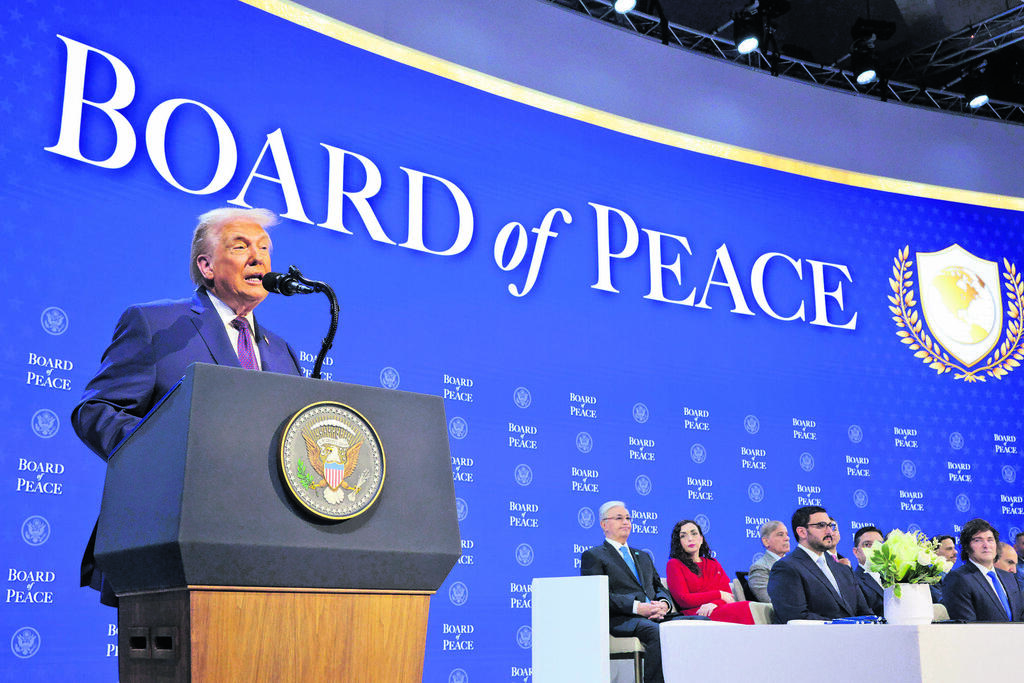
President Donald Trump declared an end to the hostilities and later announced a transition to Phase B of the agreement, despite Hamas remaining armed — a condition that has repeatedly been described as a red line.
The core problem is an inability or unwillingness among decision-makers to explain honestly, especially to the public, that a dual gap has emerged in Gaza.
The first gap lies between the war’s stated objectives and the reality on the ground: Hamas remains the dominant force in Gaza, is rebuilding its capabilities and is positioning itself to operate under the technocratic government, following a Hezbollah-style model.
The second gap is between the belief that fighting can be resumed at any time — including scenarios involving full reoccupation of Gaza or even renewed settlement — and Trump’s apparent lack of enthusiasm for a return to war. Instead, he is pushing an alternative that gradually reduces the likelihood of renewed conflict.
Despite this, leaders continue to insist there are no gaps and no failures. Challenges are portrayed as marginal, while the overall course is described as proceeding according to plan. This posture has muted any visible discomfort over developments such as the establishment of the CMCC headquarters in Kiryat Gat — a move that reflects a shrinking margin of freedom in Gaza and an unprecedented internationalization of the conflict.
At the same time, there is a sustained effort to downplay emerging challenges, including the prospect of future Turkish or Qatari involvement in Gaza, Hamas’ continued strengthening, and security lapses reflected in recent smuggling cases.
The opening of Rafah should be seen as the opening shot in a series of challenges yet to come. The technocratic government is already looking ahead to the next stages: advancing reconstruction, introducing Palestinian and foreign forces into Gaza, and possibly pressing for withdrawal from the yellow line.
Operating Rafah without requiring Hamas to disarm should serve as a warning that future stages may also proceed without the dramatic “opening of the gates of hell” occasionally promised by Trump.
Meanwhile, the very presence of a technocratic government in Gaza is likely to impose constraints on military activity, particularly under pressure from international actors eager to give that government a chance to impose order and weaken Hamas. Large-scale strikes on Hamas targets — such as those carried out recently — may become harder to execute if forces defined by the international community as “positive” are operating on the ground.
Officials continue to argue with confidence that dismantling Hamas and demilitarizing Gaza are unattainable under current conditions, and therefore that a return to intense fighting remains inevitable. Two concerns stand out.
(Photo: AFP)
First, there is no defined mechanism responsible for disarming Hamas. Second, while full disarmament is demanded, mediators are advancing compromise formulas focused only on heavy weapons. Hamas may accept such a formula, and there is no certainty it would be rejected by Trump, who is eager to present images of success — even at the expense of local interests.
Given Trump’s close ties with Turkey’s President Recep Tayyip Erdogan and with Qatar, this scenario cannot be dismissed.
As doubts about renewed fighting grow, the reality taking shape is one in which acceptance of the technocratic government becomes unavoidable — an entity likely too weak to change conditions in Gaza but acceptable to much of the world.
 Dr. Michael Milshtein
Renewing the war remains an option, but doing so against Trump’s wishes would likely be disastrous. Continued refusal to adjust course promises further erosion of influence in Gaza and additional forced concessions.
At this stage, the emerging arrangement appears to be the lesser evil. Instead of clinging to fantasies, the focus should shift to three essential interests: preserving freedom of security action, as in Lebanon; preventing Palestinian control of the Philadelphi Corridor, particularly Rafah; and retaining veto power over the deployment of hostile foreign forces in Gaza.
Beyond that, there is a need to articulate a realistic vision for Gaza that goes beyond occupation and indefinite presence — and to reconsider failed initiatives that exacted a heavy price, including the Gaza Humanitarian Foundation and the cultivation of local armed groups.
Absent such a reckoning, the refusal to acknowledge the gap between promises and reality — and the deep aversion to investigations — all but guarantees the repetition of past failures, the creation of new false assumptions and the paving of the way for future disasters.
- Dr. Michael Milshtein heads the Forum for Palestinian Studies at the Dayan Center, Tel Aviv University.