

Israel's emerging election results have once again produced no clear winner. The political system finds itself trapped in stagnation and paralysis, with both sides able to claim a measure of success. Benjamin Netanyahu can point to Likud's position as the largest party, while the anti-Netanyahu camp can argue that, together with the Arab parties, a larger number of Knesset seats oppose his continued tenure. Either way, the result is a political deadlock.
There are now three main possible ways out of this impasse.
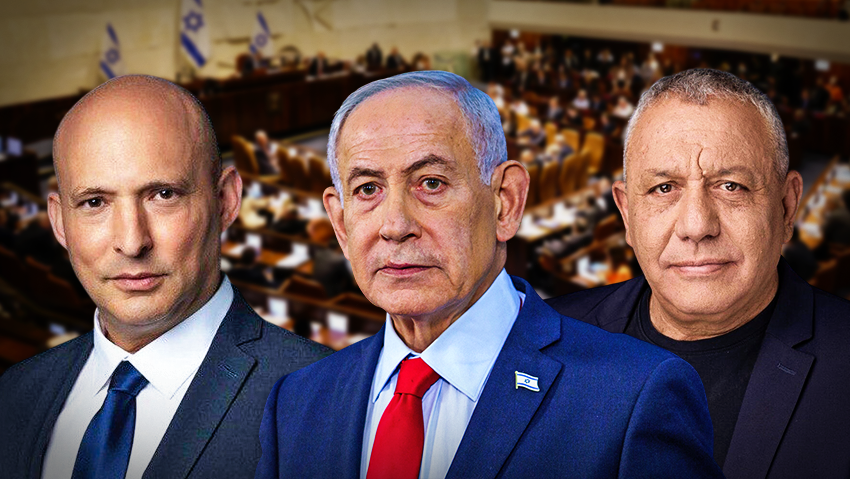
Benjamin Netanyahu, Gadi Eisenkot and Naftali Bennett
(Photo: Beyachad party campaign, Shalev Shalom, Shutterstock)
The first option is for Gadi Eisenkot to attempt to form a coalition with the Arab parties, allowing the parliamentary arithmetic to determine the outcome. But such a move appears politically and publicly unworkable, particularly after the Joint List's recent accusation of Netanyahu's "bloody government". Even if such a coalition were attempted, it would be unlikely to survive for long, especially if it also sought to include Avigdor Liberman, whose participation in such an arrangement appears almost entirely unrealistic.
The second option is for Netanyahu to do everything possible to force another election. He would presume that Ofer Winter, whose independent party failed to cross the electoral threshold, would probably not run separately next time, increasing Netanyahu's chances of securing the 61 seats needed for a parliamentary majority.
The problem for Netanyahu is that the newly elected Knesset includes a bloc opposed to him, including the Arab parties, that could potentially pass legislation specifically designed to prevent him from running again. Calling another election under these circumstances would therefore be an extremely risky gamble.
That brings us to the third option, which I believe offers the most significant and logical solution to Israel's political deadlock. It lies at the intersection of the responsibilities and interests of two presidents: Israel's Isaac Herzog, who faces the complex task of choosing which lawmaker to entrust with forming a government, and U.S. President Donald Trump.
The proposal is a three-party unity government brokered by Trump.
Trump would not hesitate
As I argued in a previous column, Donald Trump would not hesitate to intervene personally in Israeli politics if the country found itself in a deadlock.
Trump has an overriding interest in ending the conflict and securing a historic normalization agreement with Saudi Arabia ("Abraham Accords 2.0"). That ambition is driven by three central considerations.
The first is his fixation on his historical legacy and his desire to be remembered as the president who brought peace between the descendants of Isaac and Ishmael after 3,000 years.
The second is the technological and energy competition with China, particularly the need to advance the India-Middle East-Europe Economic Corridor, or IMEC, a planned trade and infrastructure network linking India to Europe through the Middle East.
The third concerns economic and commercial interests: the billions of dollars that would flow into the project, potentially generating profits for people close to Trump as well.
To advance this vision within the narrow window of opportunity provided by his remaining two years in office, I would not be surprised if Trump summoned Naftali Bennett, Gadi Eisenkot and Benjamin Netanyahu to Washington, brought them into the same room and applied overwhelming pressure to impose a political arrangement that would allow his regional ambitions to move forward.
Under this proposal, which now appears more relevant than ever, the three-way rotation would work as follows:
Benjamin Netanyahu: He would serve as prime minister first, remaining in office until July 7, 2028, when Isaac Herzog's term as president expires. Netanyahu would then leave day-to-day politics and become Israel's president as part of a broader agreement that would also include a pardon.
Gadi Eisenkot: He would take over as prime minister on July 7, 2028, serving until January 1, 2030.
Naftali Bennett: He would become prime minister at the beginning of 2030 and remain in office until the next election.
Why would Netanyahu go first?
Because he leads the largest party. The premiership would provide him with a secure bridge to the next presidential transition in less than two years, while Trump would still be serving as U.S. president and acting as a personal guarantor of both the rotation agreement and the proposed pardon arrangement.
Why would Netanyahu agree?
He could conclude his political career as the leader responsible for "Abraham Accords 2.0," leaving behind an unprecedented diplomatic legacy.
Moreover, he could prevent further damage to Israel's international standing without having to fear for his political or personal future. Trump's support would provide him with substantial political safeguards, while the proposed pardon and move to the presidency would offer a degree of personal security.
Why would Eisenkot agree?
For Eisenkot, such an arrangement would provide an opportunity to build public trust and broaden his political legitimacy. It would offer a legitimate and workable route to the premiership, backed by Trump's American guarantee, allowing him to lead the country's reconstruction and rebuild the military without depending on extremist political factions.
Why would Bennett agree?
Bennett would finally have the opportunity to deliver on a central promise of his election campaign: drafting ultra-Orthodox men into military service, an issue he also pursued during his previous governing partnership with Yair Lapid.
He would also secure a second term as prime minister, this time entering office with a powerful political advantage and a strong starting position in the post-Netanyahu era.
Why would any of this happen?
First, consider what Trump himself said about the election results: "When President Trump endorsed Bibi Netanyahu, the whole tide turned ... rather than a decisive defeat for a great prime minister, it looks like a big come-from-behind stalemate."
Personally, I believe there is considerable logic to his assessment. The change came directly after Trump declared that he trusted Netanyahu to bring the military campaign against Iran to an end. In effect, Trump was telling Netanyahu: I saved you from defeat. Now it is time to repay the favor.
The second reason is that Trump would simply force the arrangement on the Israeli leaders. To understand why, consider what Ynet diplomatic correspondent Itamar Eichner reported: people close to Trump made it clear that "a government with Ben-Gvir is not an option."
Trump is effectively overseeing efforts to keep Itamar Ben-Gvir and Bezalel Smotrich out of the next government. That is because there is an enormous gap between the understandings reached by Trump and Netanyahu and the political reality in the Middle East.
Under those understandings, the first year would be devoted to dealing with Iran, while the second would focus on advancing the Abraham Accords, followed by Netanyahu's retirement.
Saudi Arabia, however, has made it unequivocally clear that it will not pursue normalization with Israel while extremist figures remain in the government. To protect his own legacy, Trump would therefore bring the full weight of his presidency to bear, pushing for a unity government and rotation agreement that exclude the parties on the political extremes.
Why exactly these three parties?
This formula is designed to reconcile interests that appear contradictory but are actually complementary. On one hand, a three-party arrangement would allow Netanyahu to break with his traditional coalition partners, at least temporarily or under the pretext of American pressure. Those partners include the religious and ultra-Orthodox parties, particularly those led by Smotrich and Ben-Gvir.
It would also allow Eisenkot and Bennett to present a significant achievement to their voters: they would have formed a focused, pragmatic government without extremist parties pulling it toward ideological extremes.
On the other hand, such a coalition would avoid creating an excessively large parliamentary majority. Adding Liberman, for example, and expanding the government to four or five parties could produce a coalition so broad that Netanyahu would find himself politically overwhelmed and reduced to a minority within his own government.
In effect, this would be a modern version, a "2.0 model," of the national unity governments formed by Israel's two major political parties in the 1980s, Likud and the Labor-led Alignment. The difference is that instead of two parties, there would be three principal players, each receiving a share of the premiership proportional to the electoral strength demonstrated at the ballot box.
Anyone seeking historical evidence that a rotation government, even one involving three leaders, can be both feasible and effective need only look at the national unity government of the 1980s, built around the rotation agreement between Shimon Peres and Yitzhak Shamir.
That government also emerged from political deadlock and an election that produced no decisive winner. Yet it succeeded in implementing sweeping reforms that helped rescue the country and transformed the lives of Israelis.
Among its most significant achievements were the introduction of the new Israeli shekel, the 1985 economic stabilization program and the successful effort to bring down inflation that had reached hundreds of percent annually and threatened to devastate the economy.
Forced unity, it turns out, can sometimes deliver achievements that conventional coalition governments are unable to accomplish.
 Dr. Kobby BardaPhoto: Tal Givoni
Ultimately, we must acknowledge that this solution would leave a bitter taste for everyone involved. Those who remain in the coalition would be forced to make profound compromises on their ideological convictions. Those relegated to the opposition would find it equally difficult to watch a historic political transformation unfold without them.
But precisely because this solution would be so uncomfortable, and because it would produce no outright winners, it may also be the most realistic, and perhaps the only, way to pull Israel out of its current political quagmire.
Dr. Kobby Barda is affiliated with the multidisciplinary HIT Holon Institute of Technology and is a senior researcher at the Jewish People Policy Institute (JPPI).