


Gradually, as the days pass, the course of action taken by Israel and the United States in Iran is becoming clearer. It is now evident that the campaign was planned in several stages, with the first stage officially ending yesterday after the first 100 hours had passed.
This is how the Israeli-American plan is structured: first, a tactical surprise in the opening strike, which enabled the elimination of 40 senior commanders in Tehran and, most importantly, Supreme Leader Ali Khamenei. This was followed by relentless bombardment of air defense targets: surface-to-surface missiles, radar systems and detection arrays. A senior IDF official said yesterday that the Air Force has now achieved freedom of aerial action not only over Tehran, but over all of Iran.
The downing of the Iranian aircraft Wednesday may be a sign of Iranian desperation, as it deployed an old aircraft in a last attempt to defend its airspace. It can be said that, for the first time in history, the Israeli Air Force is operating without restrictions in the Middle East.
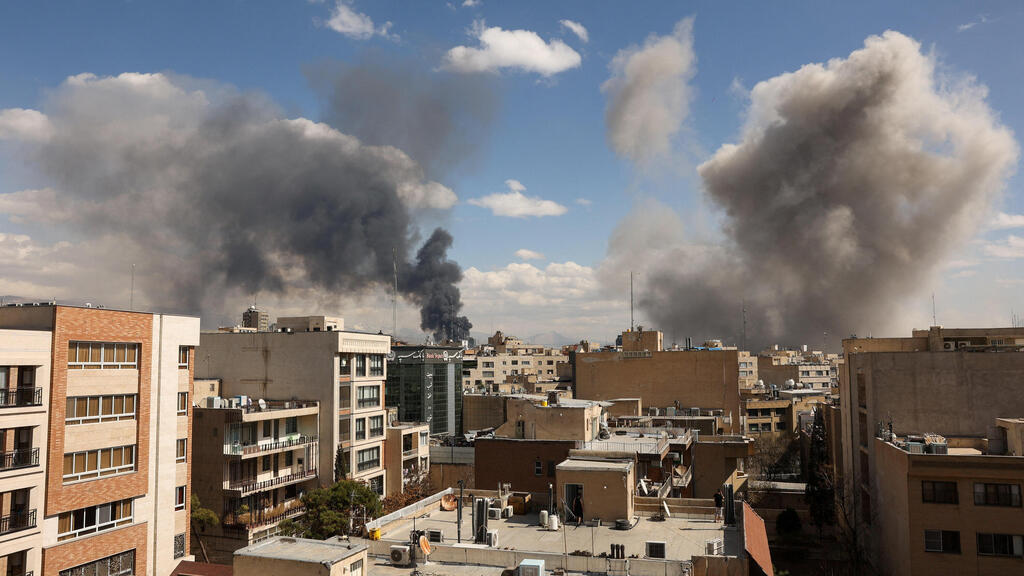
Smoke rises over Tehran after Israeli airstrike
(Photo: Majid Asgaripour/WANA)
After that, the effort shifted to disrupting — or in military terms, “suppressing” — surface-to-surface missile launches. The U.S. chairman of the Joint Chiefs of Staff said Wednesday that this led to an 86% drop in missile fire, and the results are clearly felt on the home front. If not for Hezbollah’s fire, the current situation would resemble periods of heightened intensity in the campaign against the Houthis more than a war with Iran. In the past 48 hours, the focus has shifted to intensive strikes on the regime’s combat headquarters in order to disrupt its ability to manage the fighting.
Thus, after 100 hours, Israel and the United States are operating with complete aerial freedom of action, missile fire toward Israel’s home front has dropped significantly compared with Iranian plans and Tehran’s command-and-control capability is limited. Israel can now move to the second stage of the campaign: the systematic destruction of Iran’s regime military capabilities. Israel is preparing for the war to continue for several more weeks and is encouraged by the Americans’ patience, as there is no indication they intend to ease off the gas anytime soon.
One of the main efforts in planning the campaign was the intelligence effort to generate targets. In this context, IDF officials say this is only the beginning, since there are thousands of targets and the effort amounts to a “systematic pounding of military targets,” as one official described it. In addition, according to a security source, within two days the Americans are expected to complete the total destruction of Iran’s naval fleet — a move intended to establish full maritime freedom of action.
 Yossi Yehoshua
The major question mark has been and remains the ability of the United States and Israel to translate military achievements into regime change. It was previously reported here about strikes along Iran’s border designed to prepare the ground for Kurdish militias, but it is still unclear how coordinated the move is and whether it will succeed. The military is taking a more sober approach: regime change is desirable, but it may come as a result of the strikes and only after the campaign ends. Meanwhile, as a senior IDF official said yesterday, there is no intention of stopping until all targets have been struck. One way or another, this campaign will end with a very significant weakening of Iran’s capabilities for many years to come.
On the northern front, Hezbollah continues trying to challenge forces along the line of contact and the anti-tank fire proves that the decision to adopt a forward defense posture was the correct one for protecting residents. Yesterday also saw what appeared to be coordinated fire between Hezbollah and the Iranians for the first time, but even that was in quantities far smaller than Israel had prepared for when it assumed in advance that the campaign would develop in a way that would draw Hezbollah into it.