


Prime Minister Benjamin Netanyahu’s decision to open negotiations with the Lebanese government on peace and the disarmament of Hezbollah is unlikely to produce the desired outcome. The Shiite group is not expected to disarm voluntarily. Still, it is an important and positive move for Israel, which, for now, appears capable of yielding only beneficial results — what could be described as a “win-win” situation.
Even if Hezbollah is unlikely to give up its weapons, negotiations with the government in Beirut could achieve significant diplomatic gains: improving Israel’s global standing and, perhaps more importantly, generating substantial international and domestic pressure on Hezbollah to hand over its arms to the Lebanese army, while branding it as the party responsible for any escalation if talks fail.
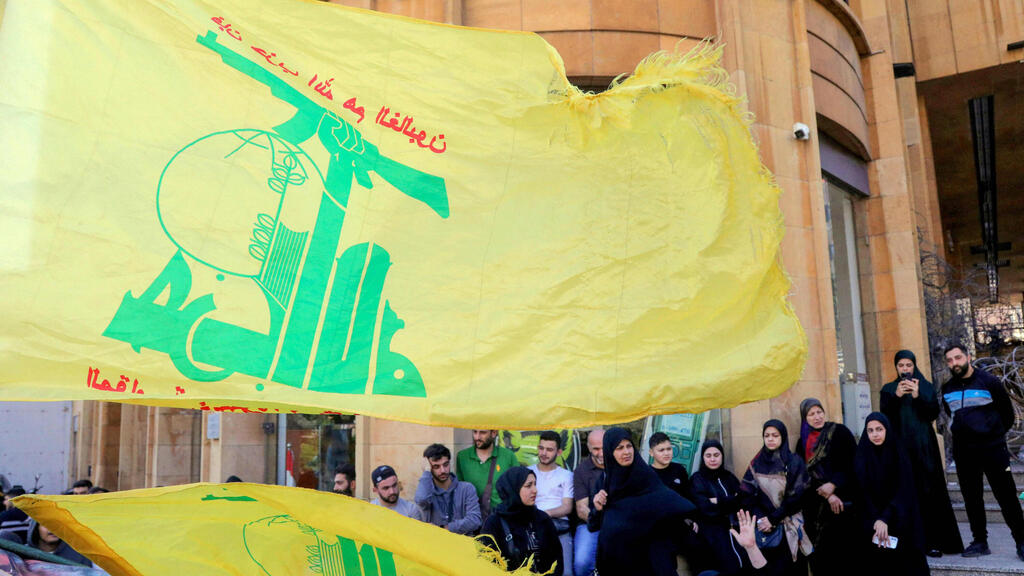
Protest by Hezbollah supporters outside the government palace in Beirut
(Photo: Ibrahim AMRO / AFP)
Since its founding, Hezbollah has been the only faction in Lebanon to refuse to disarm, even after the 1989 Taif Agreement that ended the Lebanese civil war. At that time, under Saudi mediation, all militias agreed to surrender their weapons to the state — except Hezbollah, and possibly a few minor groups. Over time, Hezbollah evolved into an independent military force separate from the Lebanese state, loyal primarily to Iran and Lebanon’s Shiite community. It also invested heavily in messaging to portray itself as Lebanon’s true defender, rather than the national army.
Cooperation between Hezbollah and the Lebanese military has increased over the years, largely due to the group’s deep influence over state institutions, including senior military appointments. In practice, the appointment of a Lebanese army chief required Hezbollah’s approval, and even command positions in sensitive areas, such as the Beirut airport, needed its consent.
In recent years, however, particularly after Israel struck Hezbollah’s leadership in September 2024, along with operations targeting its communications and rocket systems, the fall of Syria’s Bashar Assad and a decline in regional support weakened Hezbollah politically. Lebanon has since elected a president and prime minister opposed to the group’s continued existence as an armed organization. Still, even at its weakest politically, Hezbollah has resisted internal Lebanese pressure to disarm and become a purely political party. It remains stronger than the Lebanese army, limiting the government’s ability to act against it.
Even after the November 2024 ceasefire with Israel, the Lebanese army attempted limited efforts to dismantle Hezbollah infrastructure in the south but was unable to take meaningful action against its core capabilities.
Ultimately, Hezbollah operates under Iran’s direction and funding. Tehran is unlikely to agree to its disarmament and would likely prefer a civil war in Lebanon over relinquishing Hezbollah’s weapons — a scenario widely feared across Lebanon.
Most Lebanese citizens, particularly non-Shiites, do not want a war with Israel and would prefer a peace agreement. These voices are expected to grow louder once talks begin. France and other European countries are also likely to support the negotiations and push for an agreement
Nevertheless, Netanyahu likely understood that opening negotiations with Lebanon would trigger political pressure within the country and intensify criticism of Hezbollah. Most Lebanese citizens, particularly non-Shiites, do not want a war with Israel and would prefer a peace agreement. These voices are expected to grow louder once talks begin. France and other European countries are also likely to support the negotiations and push for an agreement, further increasing pressure on Hezbollah, which would be portrayed as the main obstacle.
It must be acknowledged that military pressure on the Lebanese government — including threats to its infrastructure — would likely backfire, fostering unity between Lebanon and Hezbollah rather than deepening divisions. In this sense, Israel’s decision to pursue negotiations reflects strategic thinking.
The talks are unlikely to succeed or lead to a peace agreement. Ultimately, Israel may have no choice but to escalate military operations against Hezbollah, possibly even more forcefully than before.