

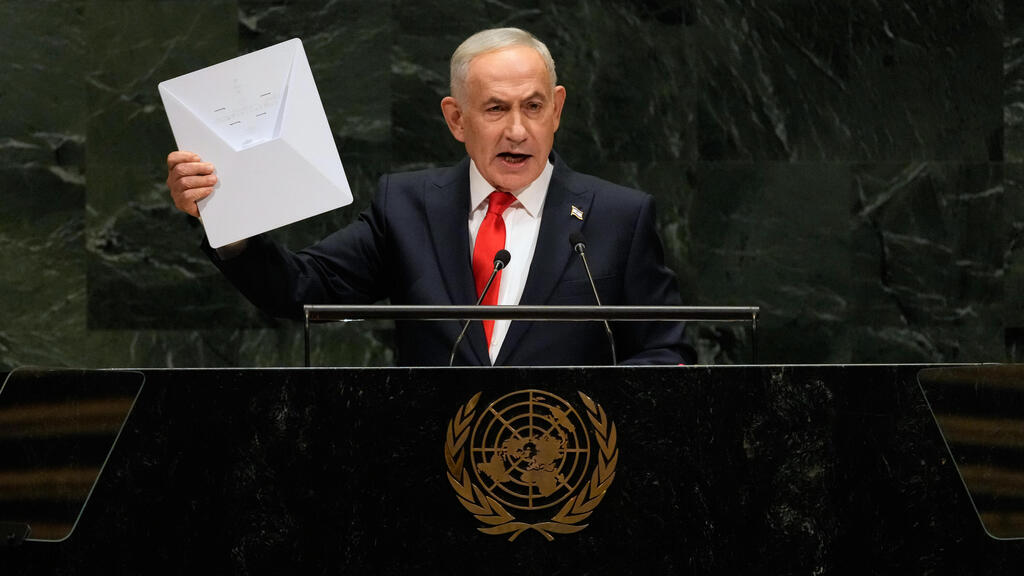
Prime Minister Benjamin Netanyahu’s speech to the United Nations on Thursday was intensely militant and combative, something close to a “blood, sweat and tears” address. He condemned enemies and critics in every direction: Iran, Qatar, Hezbollah and Hamas; Turkish President Recep Tayyip Erdogan; Western leaders who have turned sharply against Israel; and New York Mayor Zohran Mamdani.
What was missing was peace.
Prime Minister Benjamin Netanyahu addresses the UN General Assembly
(Video: UN WEB TV)


There was no real discussion of expanding the Abraham Accords, no diplomatic horizon and not even a glimmer of hope about what might follow the wars Netanyahu described. The vocabulary was overwhelmingly one of victory, enemies seeking Israel’s destruction and a country left with “no choice.”
It was a bombastic speech, delivered fluently and forcefully, but without a vision for the day after victory. Netanyahu spoke to a largely empty hall and, more importantly, to a world that appears increasingly unwilling to listen to him.
The contrast with his September 2023 UN address was striking. Then, roughly two and a half weeks before the Oct. 7 massacre, Netanyahu spoke about the choice between “blessing” and “curse” and presented a regional future built around normalization. He even met Erdogan, who has since become one of his fiercest critics.
This time Erdogan was one of Netanyahu’s main targets. So were Mamdani, French President Emmanuel Macron and Britain. Netanyahu’s address was a broad counterattack against governments and political figures he believes have turned against Israel.
One theme returned again and again: Israel has no choice.
Netanyahu sought to expose what he portrayed as the hypocrisy of the United Nations and the machinery of falsehoods directed against Israel. But there were no major intelligence revelations of the kind he has sometimes brought to the UN podium. Instead, he answered much of the international criticism of Israel by accusing its critics of hypocrisy, siding with Hamas or yielding to antisemitic pressure.
He did not mention the International Criminal Court arrest warrant against him. He did, however, spend considerable time rebutting accusations that Israel is committing genocide in Gaza, calling the charge a lie and defending Israel’s military conduct.
The speech also bore the unmistakable imprint of Israel’s approaching election campaign. With Israelis due to vote in little more than a month, Netanyahu had one of the world’s most prominent stages on which to remind voters of what has long been one of his political strengths: his ability to deliver an English-language speech and present himself as Israel’s defender before an international audience.
He praised the morality of IDF soldiers and also offered words of support to Israeli Ambassador to the United States Yechiel Leiter after his son Neriya was seriously wounded in an attack a day earlier.
But the defining image of the speech was not one of Netanyahu’s carefully planned props. It was the walkout.
Viewers leave the hall in protest ahead of Prime Minister Benjamin Netanyahu’s UN speech
(Video: UN WEB TV)
Dozens of delegates left as he approached the podium, leaving most seats empty afterward. Netanyahu responded immediately: “If there are any other moral cowards who haven’t yet left this hall, please do so now.” The Palestinian mission had urged delegations to participate in the protest.
The protest was larger and more visually striking than last year’s. Some delegations had not been in the chamber in the first place, and the walkout itself unfolded without the kind of sustained disruption that had been feared. But none of that changed the image that spread rapidly around the world: diplomats streaming out as Israel’s prime minister began speaking.
That was Netanyahu’s central problem.
He came prepared to fight for Israel’s version of events, but he arrived at a stage where much of the audience had already reached its conclusions. He had a speech, but few listeners. It was like a dancer arriving last to the performance.
The words were there; the ability to influence the room was not.
Netanyahu’s office ensured there was a strong Israeli presence in the gallery, where supporters cheered, shouted “Bravo” and “Am Yisrael Chai,” drawing repeated calls for order. But that only sharpened the impression that much of the address was being delivered not to the international community sitting before him, but to the political audience watching at home.
Netanyahu might have benefited from arriving in the United States earlier and spending several days trying to shape the diplomatic and media environment: holding news conferences, briefing journalists and making Israel’s case before the speeches of other leaders hardened the atmosphere around it.
Instead, he arrived after days in which leaders had already used the UN podium to direct severe criticism at Israel.
The prime minister also returned to one of his most familiar themes: Israel’s survival depends ultimately on itself.
He attributed to his late brother Yoni a line to the effect of, “We’re going to win because we have no choice.” It is not a quotation Netanyahu has commonly used in the past, and it recalls another famous formulation associated with former prime minister Golda Meir: the idea that Israel’s ultimate weapon is that Jews have nowhere else to go.
There were other notable absences.
Netanyahu did not discuss negotiations with Lebanon. Nor did he address Palestinian Authority President Mahmoud Abbas, who had spoken to the General Assembly by prerecorded video after the United States denied him a visa to enter the country.
Instead, Netanyahu went looking for memorable visuals.
He held up a pager to invoke Israel’s operation against Hezbollah. “Remember the beepers?” he asked. “Hezbollah certainly remembers them.” He also presented a Starlink terminal as a “gift” for the Iranian delegation, saying it could one day help Iranians circumvent internet restrictions and tell the world what was happening inside the Islamic Republic. The pager moment was confirmed in the published text and footage of the address.
One of his more effective rhetorical comparisons concerned the roughly 1,000 Iranian missiles he said had been fired at Israel. Netanyahu asked his audience to imagine the reaction if only two such missiles struck the UN complex and destroyed it. The point was straightforward: Iran, he argued, is not merely an Israeli problem but an international one.
In that sense, much of the speech functioned as Israel’s defense brief to a hostile world, an extended “J’accuse” directed at those Netanyahu believes condemn Israel while ignoring the forces threatening it.
He said many of the things Israel’s supporters wanted said, and he said them with the fluency that has defined his international appearances for decades.
But the positive message was missing. There was no outstretched hand, no picture of what peace might look like after the fighting and no attempt to connect military victories to a broader diplomatic objective.
Even his relationship with U.S. President Donald Trump appeared at the margins of the speech rather than its center. Netanyahu praised Trump, but the president was not meeting him during this visit. At the same time Netanyahu was addressing the UN, Trump’s attention in Washington was focused on Chinese President Xi Jinping, who was in the United States for a state visit.
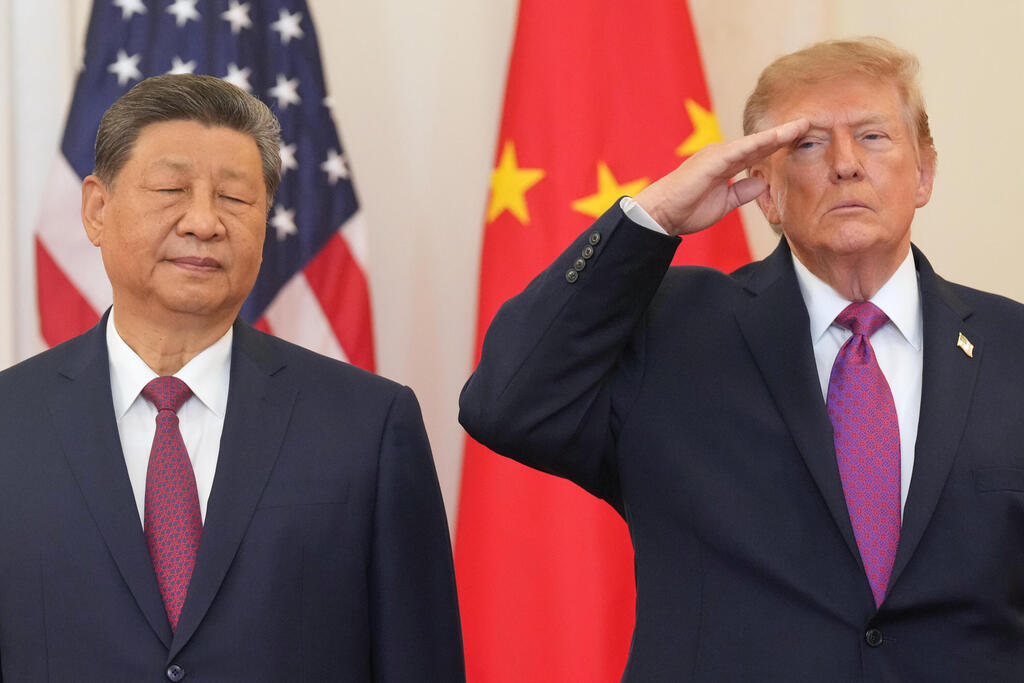
US President Donald Trump meets Chinese President Xi Jinping in Washington
(Photo: AP Photo/Jacquelyn Martin)
A source close to the U.S. administration interpreted the absence of a Trump-Netanyahu meeting as deliberate and argued that Trump’s circle does not want to be seen helping Netanyahu politically before Israel’s election. That is an interpretation attributed to the source, not an established explanation for the scheduling decision.
And that, ultimately, was the contradiction at the heart of Netanyahu’s speech.
He came to New York determined to tell the world that Israel was right, that its enemies had sought to destroy it, that its soldiers had fought morally and that its military victories had protected countries whose representatives were now condemning it.
But he also came without a convincing answer to a different question: What does Israel want the world to see beyond the next victory?
The speech had force. It had anger. It had memorable lines and props. It had Netanyahu doing what Netanyahu has always done exceptionally well at the UN: speaking in polished English and placing Israel’s case in stark moral terms.
What it did not have was a horizon.
And by the time Netanyahu stepped up to defend Israel, much of the world had already left the room.