


Attitudes toward the Palestinian issue serve as a litmus test for the change Israeli society has undergone since October 7. The profound trauma was seared into the collective consciousness and became the central force shaping thought and action in the country. On the one hand, it gave rise to offensive initiatives and military achievements. On the other, its powerful, unprocessed and unexamined hold has stifled critical thinking and a sober view of reality.
Those are now labeled expressions of “pre-October 7 naivete,” while the lesson prescribed by the self-styled “realists” — many of whom were also responsible for shaping reality three years ago — is that from now on only force should be used, the world’s opinion does not matter, Israel can rely only on itself and it has the power to engineer reality.
After October 7, the average Israeli does not want to see Arabs, hear Arabic, trust Arabs or, certainly, discuss a Palestinian state. Against that backdrop, there has been a clear public shift to the right. But it is not toward the positions of the old Likud, which accepted the Oslo Accords and spoke, Netanyahu included, about two states. Rather, it is toward parties embodying a messianic vision that has now become widespread across the right.
In the past, the public was broadly divided between supporters of a Palestinian state and those who opposed the idea and proposed autonomy instead, while extremists who advocated full annexation remained on the margins. Since October 7, those ideas have become mainstream and normalized to the point that the current divide is between supporters of Smotrich’s 2017 “decisive plan,” whose goal is a single state with two kinds of citizenship, and what are dismissed as “weak ideas that will bring destruction.”
There is no discussion of an alternative path, and the right alone is treated as having the authority to determine whether a position is legitimate.

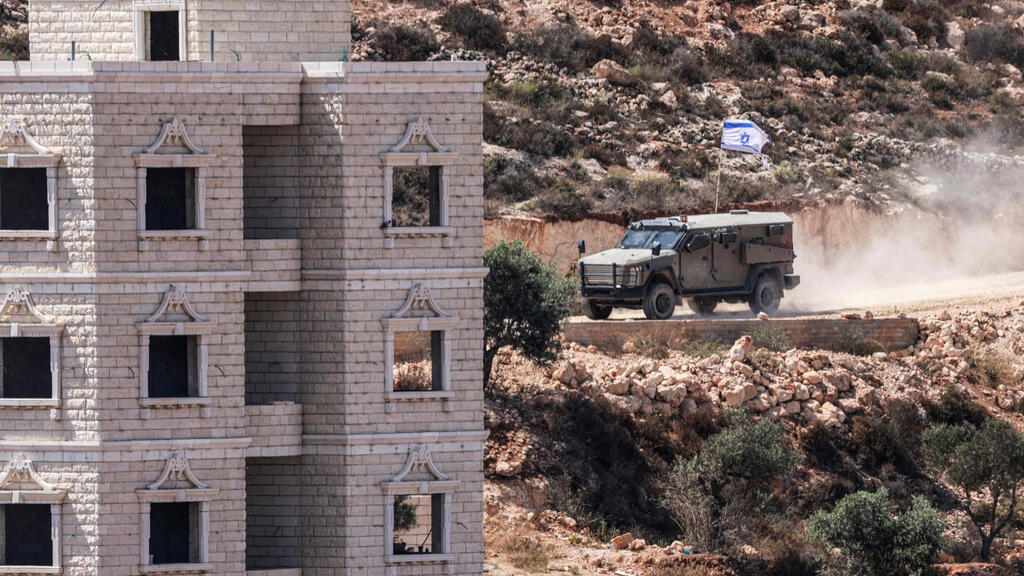
Masked JEwish extremists enter Qusra
Against this backdrop, Smotrich — who in practice is shaping Israeli policy on the Palestinian issue and advancing the annexation of the West Bank even without a formal declaration — now asks whether opposition leaders support construction in the E1 area between Ma’ale Adumim and Jerusalem, whose purpose is to prevent the establishment of a Palestinian state in the future.
All this is accompanied by routine contempt for opposition from the rest of the world, including Washington. The opposition, for its part, responds with a mixture of embarrassment, concealment of its positions, vague formulations or even support for government policy, as in the case of E1.
Perpetuating fear, hostility and fantasies creates precisely the confusion and blindness that decision-makers seek. Israelis strongly oppose a Palestinian state, but it is doubtful whether they are thinking — or being encouraged to think — about the alternatives, what a one-state reality would mean or whether they understand that this is an ideological and sectoral goal accompanied by hopes of applying biblical law and rebuilding the Temple, ideas with which most Israelis do not identify.
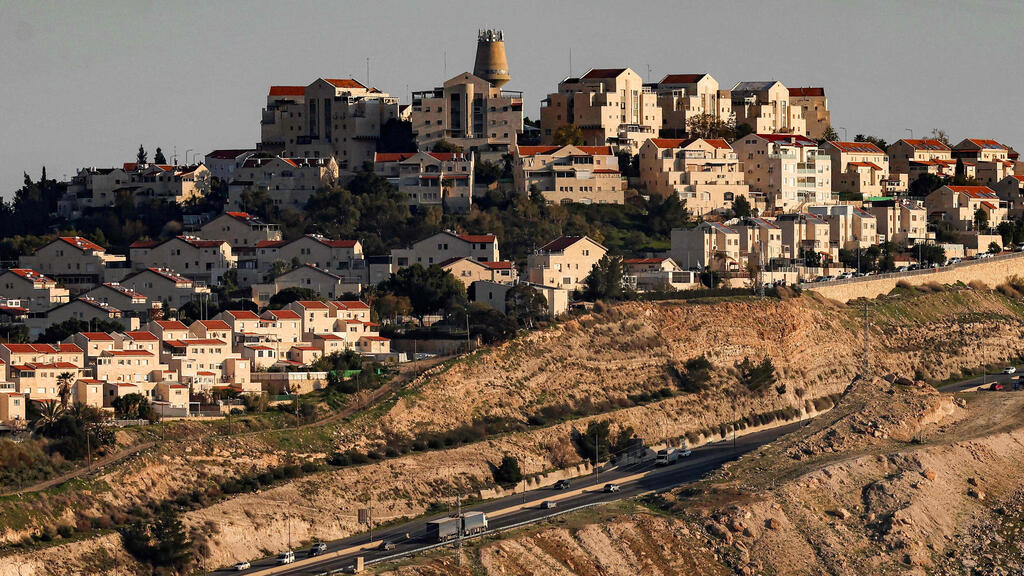
Maale Adumim and hte E1 area
(Photo: Ahmad Gharabli/ AFP)
What is being obscured in the background is the future reality: the possibility that the violence and chaos characterizing the West Bank as an increasingly extraterritorial space will spill over into the rest of the country, along with the entrenchment of an entity based on discrimination that would be treated as a pariah by much of the world — something that, in any case, does not concern adherents of the doctrine that “a people shall dwell alone.”
And so, on the eve of the election, an absurd situation has emerged in which slogans of transfer and sovereignty are considered sober and legitimate, while calls for a political arrangement on the Palestinian issue are treated as delusional and reckless.
At the same time, there is a deliberate and carefully managed tension in Israel’s conduct in the West Bank. With one hand, the government fuels unrest. With the other, it ostensibly seeks to extinguish it, or at least present itself as doing so.
Many in the leadership profess to be “shocked” by the rising Jewish violence in the West Bank and condemn it, while at the same time encouraging the establishment of farms — described as a “strategic asset” — most of which lack a legal basis, and pushing an expansion of settlement that would absorb some 3 million Palestinians. This is done, of course, without a debate over the consequences and without making clear that Israel would be fundamentally transformed, primarily for the worse.
The “schizophrenia” between the roles of arsonist and “astonished firefighter” is also reflected in the growing portrayal of the Palestinian Authority as an imminent threat that Israel will eventually have to fight or even cause to collapse.
This is accompanied by mounting warnings ahead of the election about an impending “turning of the guns,” similar to the dubious warnings about alleged “plots” by Egypt, Turkey and Syria.
As usual, there is no explanation that the current tensions in the West Bank stem mainly from Israeli actions, particularly the rise in settler violence, the continued weakening of the Palestinian Authority and territorial encroachment, rather than from an increase in Palestinian terrorism, which has in fact declined.
The Palestinian issue was not properly understood by decision-makers before October 7, and they appear to remain trapped in flawed assumptions today. The issue cannot be escaped, nor can it simply be “managed.” It requires a sober, urgent and rigorous debate, above all in preparation for decisions that will have to be made.
Without such moves, the likelihood increases that the international community will impose greater international involvement, as much of the world already believes Israel has lost its judgment.
Between one state and two states — an idea that clearly cannot be advanced at present because the Palestinian side is not ready for it — there are other alternatives that must be examined. One, for example, is a sober form of physical separation while preserving Israel’s security interests, primarily through control of the Jordan Valley and continued freedom of action against threats in Palestinian territory.
The fateful choice is between racing toward the abyss of a one-state reality, steeped in the kind of messianic euphoria that has brought catastrophe upon Jews throughout history, and a willingness to examine sober alternatives that may amount to the lesser evil.
At the same time, it is important to begin discussing now the possibility that a new government could take office and seek to limit or roll back the “revolution in the West Bank.” It is essential to warn against those who would challenge the legitimacy of such a government.
That could lead to an unprecedented rupture centered on acts of civil disobedience and even violence — the very phenomena the symbol of the Altalena was meant to warn must never return.
The writer is a senior researcher at Tel Aviv University’s Moshe Dayan Center.