


But his decision overnight Saturday to Sunday to retreat from his declared intention to launch a major strike against Iran should not have surprised anyone. The warning signs were plainly visible.
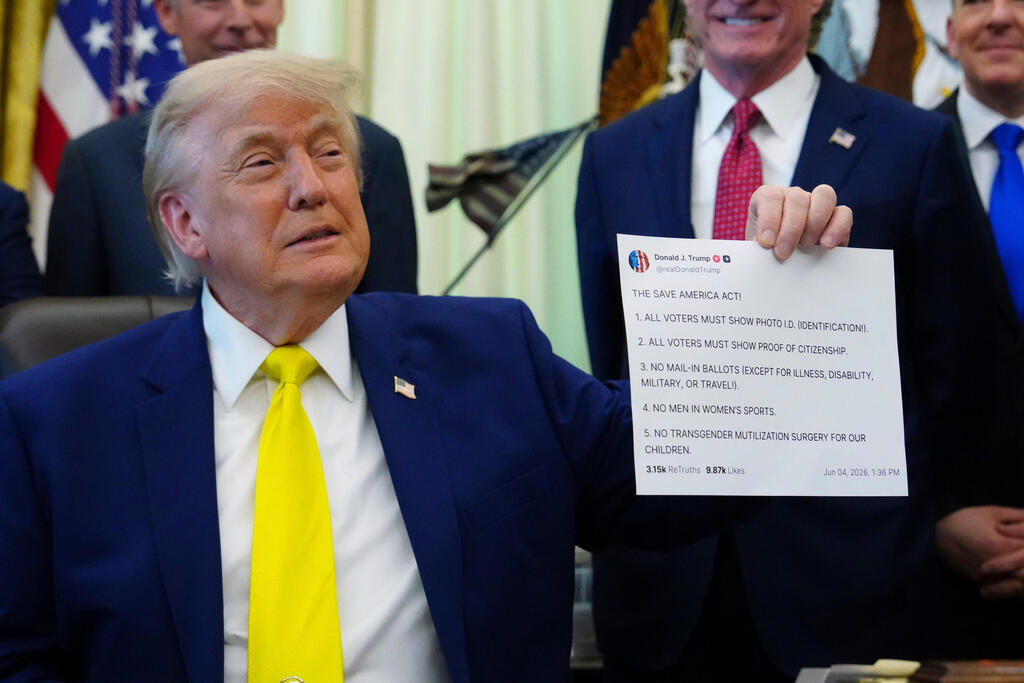
The first reason is that Trump has earned the mocking nickname TACO, an acronym for “Trump Always Chickens Out.” The phrase compares his tendency to retreat at the last moment with the softness of the Mexican food from which the nickname is derived.
An American financial commentator coined the term late last year to describe Trump’s negotiating style: He issues dramatic threats and then backs down once he receives some of what he wants, and sometimes even when the other side rejects his demands entirely.
That pattern appeared in his global tariff campaign. It appeared in the dispute over Greenland. It has now appeared repeatedly in the confrontation with Iran.
I have counted at least six occasions on which Trump threatened to send the Iranians “back to the Stone Age,” only to do nothing or order the U.S. military to carry out a largely symbolic action.
This negotiating method is known as brinkmanship, and Trump has turned it into the principal instrument of his foreign policy.
The problem is that brinkmanship requires precision and restraint. Threats must be calibrated carefully so that they do not rebound against the person making them, damaging the reputation and deterrence they were meant to create.
Trump does not know how to walk that line. He habitually overstates his intentions.
The first to recognize the bluff were Iran’s bazaar merchants, who know something about negotiation and brinkmanship themselves. They are also willing to take risks and absorb the consequences if their assessment proves wrong.
The recurring pattern in Trump’s conduct has already been identified in Tehran, and it is now causing real damage.
Iranian negotiators have learned how to help the president climb down from the tree after he has climbed too high. All they need to do is pass a few vague signals through Pakistani mediators suggesting a willingness to negotiate.
The threats from Washington are then replaced by a conciliatory post on Trump’s Truth Social account.
Why Trump did not strike Iran
Trump did not attack Iran this time because he probably never intended to strike the country’s energy infrastructure.
There were three well-known reasons.
First, he does not want to trigger a global economic crisis. Members of his own party are already accusing him of risking a worldwide recession comparable to the Great Depression of the 1930s, for which Republican President Herbert Hoover was blamed.
Second, Trump does not want U.S. energy prices to rise ahead of the midterm elections. Such an increase could cause Republicans to lose their majorities in both houses of Congress.
The third and most important reason is the Arab Gulf states.
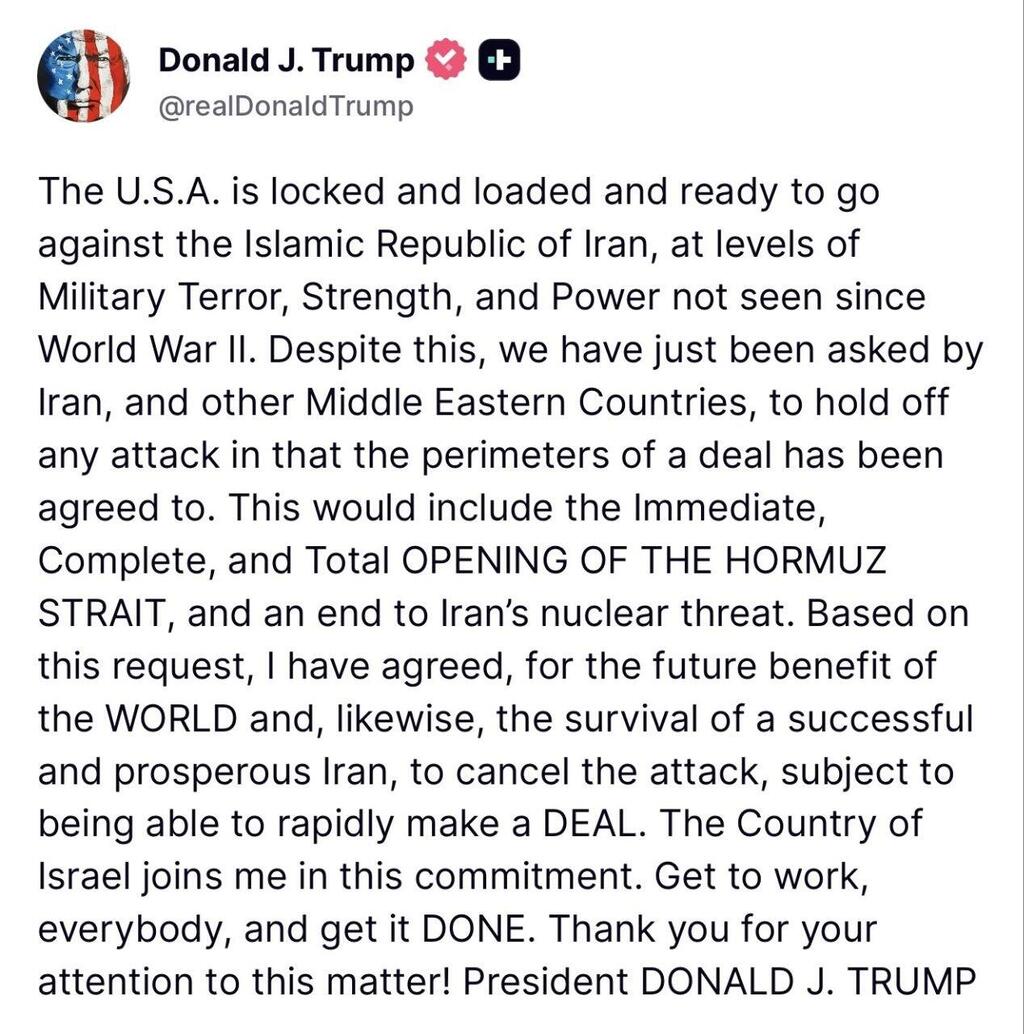
(Truth Social)
Iran has effectively turned them into hostages by threatening their energy installations. Their leaders pleaded with Trump not to act recklessly.
Trump himself said that a telephone call Friday from Saudi Crown Prince Mohammed bin Salman was among the factors that persuaded him to step back.
In doing so, he confirmed another familiar feature of his personality: The person who influences him most is often the last person to whisper in his ear.
All these facts were known before Trump withdrew from his belligerent declarations.
The Iranians also knew something else. While Trump was loudly threatening to attack Iranian infrastructure, his representatives were negotiating with Iran through Pakistani mediators.
Tehran understood that the military threats were primarily a negotiating tactic. To be safe, however, the Iranians issued threats of their own.
In short, Trump’s maneuver failed against Iran.
The actor that did enter a genuine state of alert was Israel.
Israel prepared because it had no reliable information
Israel did not raise its readiness because officials in Jerusalem or the defense establishment knew what Trump was going to do.
They did so because Israel had to be prepared, in intelligence, defensive and offensive terms, for the small possibility that Trump would carry out his threats.
If the United States had attacked, Iran could have launched missiles and drones at Israel. It might also have activated its regional proxies: Hezbollah in Lebanon, the Houthis in Yemen and Iranian-backed Shiite militias elsewhere in the Middle East.
Israel therefore had no choice but to prepare for a scenario it could neither confirm nor influence.
That is the central problem.
Trump does not consult Israel
Trump’s latest retreat once again exposed the fact that he does not include Israel, and particularly Prime Minister Benjamin Netanyahu, in consultations before taking significant steps.
Worse, he does not hesitate to require Israel to align itself with his decisions without first coordinating them with the prime minister.
In the post announcing that he would not proceed with the attack, Trump also declared that Israel was obliged not to strike Iran.
That demand had not been coordinated with Israel, not even indirectly.

Prime Minister Benjamin Netanyahu
(Photo: Ilia YEFIMOVICH / AFP)
Officials in Jerusalem learned that Trump had decided not to attack from the message published on his social network, at the same time as every other citizen anywhere in the world.
Israel has recently become the worst kind of U.S. satellite state.
That was not the situation at the beginning of this year. But since at least June, when the United States and Iran signed a memorandum of understanding, Israel has become a state that is no longer a full participant in senior political consultations.
At the military level, the picture is somewhat better.
The IDF maintains good coordination with the Pentagon and particularly with U.S. Central Command, which oversees American forces in the Middle East.
But the IDF was also operating in darkness, for two reasons.
The first is the relationship between Israel’s political leadership, meaning the prime minister and defense minister, and the IDF General Staff and chief of staff.
It is difficult to describe this as a functioning professional relationship. It is increasingly reduced to the phrase “I instructed the IDF,” repeated in statements issued by the prime minister and defense minister.
The second problem is the coordination channel between the Prime Minister’s Office and the military.
After the prime minister’s military secretary was replaced, Maj. Gen. Roman Gofman became head of the Mossad and Brig. Gen. Guy Markizeno entered the role.
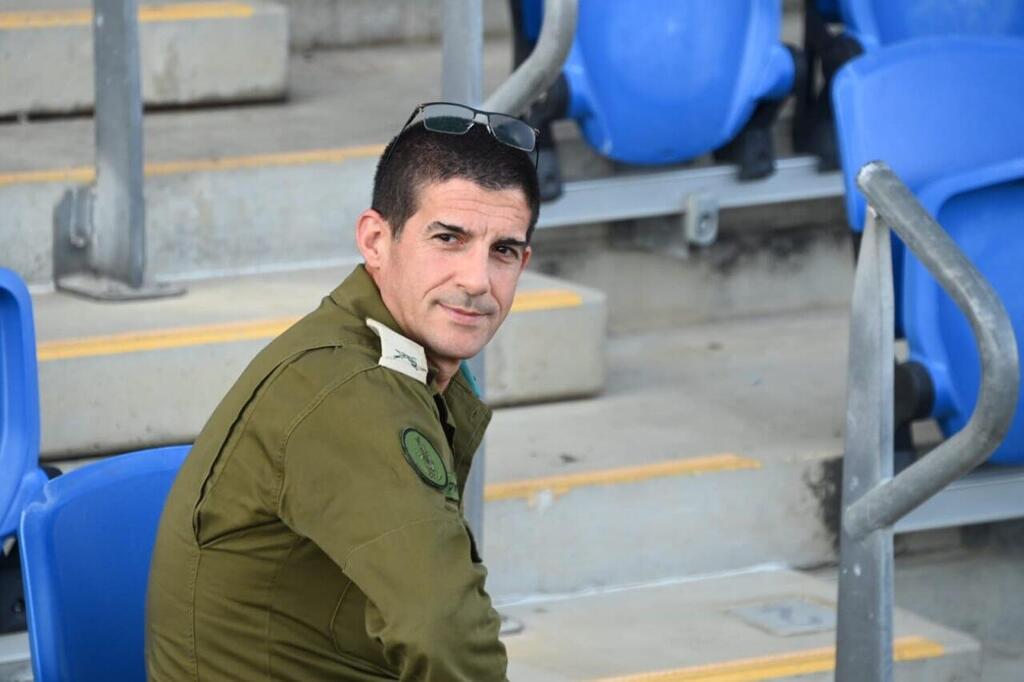
Brig. Gen. Guy Markizeno
(Photo: Yair Sagi)
Markizeno does not enjoy the same level of confidence within the General Staff that his predecessor once did.
As a result, when senior officers at IDF headquarters inside the Defense Ministry complex seek to understand what is happening, they must rely in part on the U.S. military.
That means depending on CENTCOM commander Adm. Brad Cooper and his officers, who share information with Israel if and when the president in Washington has bothered to share it with them.
Israel is paying for uncertainty
Israel has never before been in a position in which it is so unable to influence its own fate.
Because the military cannot afford to be caught unprepared, particularly when civilian defense is at stake, it repeatedly launches expensive preparations and readiness measures.
These include reserve mobilizations and operational activity that might have been avoided if reliable information existed and if coordination between the political and military levels were functioning properly.
The cost is not only financial.
Repeated alerts wear down troops, disrupt the economy and create uncertainty among the public. They also reveal the extent to which Israel is being forced to react to decisions made elsewhere.
The limited good news
In the specific confrontation with Iran, the picture is somewhat more optimistic.
As long as the United States maintains its naval blockade of Iran and keeps a large, threatening military force in the Middle East, the Islamic Republic’s economic and social distress will continue to deepen.
That increases the possibility that, at some point, perhaps in a year or more, the regime will be replaced or will break under pressure and accept American demands.
The danger for Israel in the ongoing war of attrition between Iran and the United States is that Trump will eventually lose patience, surrender to Iranian demands and lift the sanctions.
That is the outcome Israeli officials fear most.
For now, it is not happening. From Israel’s perspective, that is positive.
But the troubled relationship with the United States, and the fact that Israel must repeatedly guess what is passing through Trump’s mind, including on matters involving the Gaza Strip, has become a strategic problem.
Israel cannot accept that situation indefinitely without harming its national security and its sovereignty.