


The White House announcement of a written U.S. security guarantee to Qatar is far more than a diplomatic gesture. It is, in practice, a protective umbrella Washington has extended to the Gulf emirate, pledging to come to its defense if attacked.
For years, Qatari rulers have sought such an assurance from Washington, arguing that their support for American military and diplomatic initiatives in the region exposes them to threats. In return for hefty rental payments, Doha hosts Al-Udeid, the largest U.S. air base in the Middle East. Until now, however, presidents from both parties balked at providing a formal commitment, fearing similar demands from Saudi Arabia and the United Arab Emirates.
Trump and Netanyahu on the call with the Qatari PM
(Video: Reuters)


That caution stemmed from a consistent U.S. concern: that binding guarantees to Gulf partners could entangle Washington in regional conflicts with little to do with American strategic interests. The feud between Qatar and Saudi Arabia — which nearly escalated into open conflict about a decade ago — illustrated precisely the type of confrontation U.S. officials wanted to avoid.
Donald Trump had previously embodied that caution. When Saudi Arabia’s oil infrastructure was struck in 2019 by Iranian cruise missiles and drones, he declined to deploy U.S. troops or Patriot missile batteries to Riyadh’s defense, insisting instead that the Saudis pay for any such protection.
So why did Trump now agree to Qatar’s demand?
According to officials and regional observers, two events shifted the equation. The first was Iran’s attack at the close of the recent 12-day war, an operation coordinated in advance with the Qataris. The second was Israel’s strike in Doha against senior Hamas figures. That Israeli move, carried out in defiance of Qatari objections, was intended as a warning to the emirate’s leadership. By all accounts, the message was received: alarmed by the prospect of further escalation, Qatar sent a delegation to Washington seeking a unilateral written security guarantee.
Their argument was simple: supporting U.S. policy had turned them into a target, and Washington therefore had a responsibility to shield them.
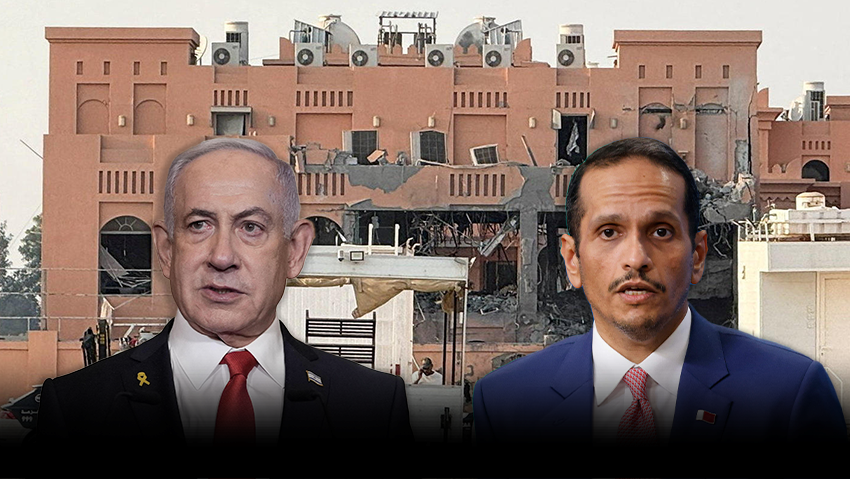
(Photo: REUTERS/Ibraheem Abu Mustafa, Ludovic MARIN / AFP, Oliver CONTRERAS)
Trump’s decision to depart from his earlier principles appears to have rested on more than Qatari arguments about vulnerability. Tens of billions of dollars in promised business deals from his recent visit to Doha, Qatar’s mediation efforts between the United States, Israel and Hamas, and Doha’s pledge to support a 20-point plan for ending the Gaza war and promoting regional stability all weighed heavily. That plan, if realized, could position Trump as a Nobel Peace Prize contender.
And then there was the personal gesture: the presidential jet presented to Trump by Qatar’s emir.
Taken together, these factors persuaded Trump to grant Qatar a U.S. security safety net no other Gulf state has been able to secure.
Seen from Israel, the episode carries additional significance. The highly public — and to some extent humiliating — apology that Trump pressed Prime Minister Benjamin Netanyahu to deliver to Qatar’s prime minister was only a prelude. The real prize for Doha was the written American commitment, which could reshape Gulf dynamics and limit Israel’s maneuvering room with a neighbor that continues to host Hamas leaders while deepening its security ties with Washington.