


The Hanukkah massacre in Sydney struck at one of the most iconic and familiar spots in the city — Bondi Beach — a place known the world over. The images beamed around the globe of thousands fleeing one of Australia’s top tourist destinations became an unintended bonus for the terrorists or those behind them. Not only did they attack, kill and wound Jews at a large public event, they did so at a site anyone who has visited or heard of Australia recognizes. In that sense, the attack evokes comparisons to major Islamic State attacks in Europe, such as the Bataclan in Paris.
“Things like this don’t happen here!” a friend in Australia told me during the attack. “I know people who have been shot, people who were killed!” Her shock was completely understandable. The Australian Jewish community did not turn a blind eye to rising antisemitism. Unlike some communities elsewhere, it articulated a firm, clear position to the government and repeatedly demanded that it not deny antisemitism, hatred or anti‑Israel sentiment. Still, amid all the warnings and deterioration — including an attempt to set fire to a synagogue with its congregants inside — they found it hard to believe that something like this could happen in Australia. “This country won’t be the same,” was a sentiment expressed by many.
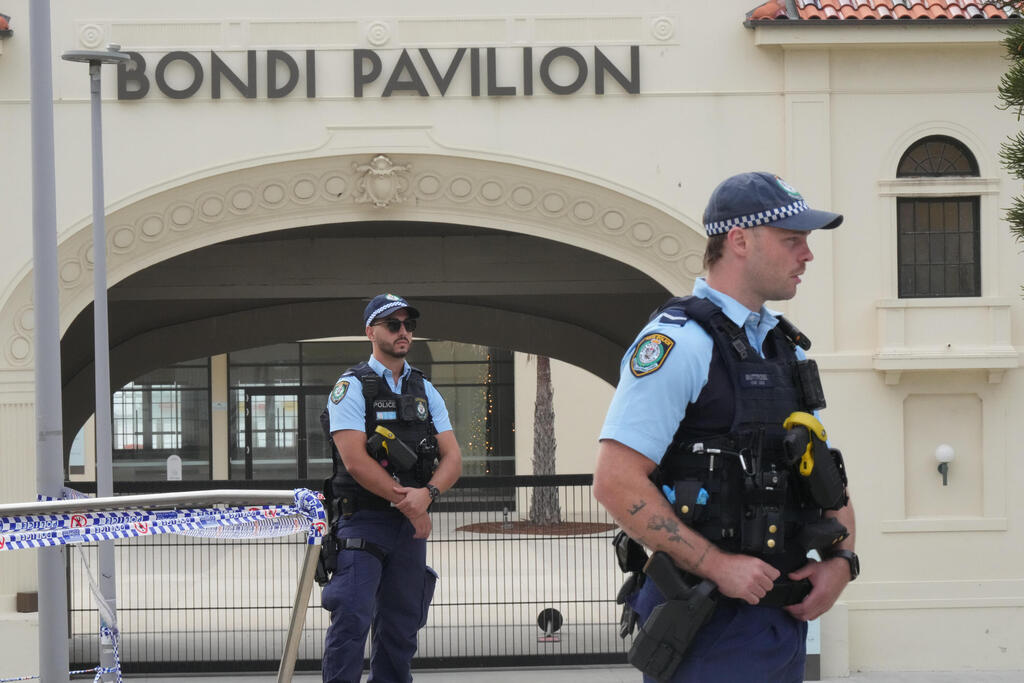
(Photo: AP Photo/Mark Baker)
About three months ago I had the opportunity to visit Jewish communities in Sydney and Melbourne to interview, on the occasion of his book launch, Eli Sharabi, a released hostage from Gaza. This is a warm, close community — small but proudly Zionist in a remarkable way. From synagogues to schools, we met Jews who felt an overwhelming duty to support the State of Israel and work for the return of captives. They invested time, energy and money in the effort, like many communities around the world, led by the Jewish community in the United States. They welcomed Sharabi — as he deserved — with genuine warmth and rare joy.
In Australia everything is smaller, and the political influence of Australian Jewry is limited compared with that of American Jewry. It was clear that the current government, with its sharp criticism of Israel, its disregard for rising antisemitism and its backing of anti‑Israel positions, was courting other demographics. Chief among them were minorities, including within the Muslim community, that view Israel as the root of all evil. This is why, for example, when the government established a task force to combat antisemitism, it also felt compelled to launch an initiative against Islamophobia. The attempt to equate the two is hollow: the Jewish community, far smaller and far more vulnerable, faces a significantly higher number of antisemitic incidents and online expressions of hatred. And it goes without saying that at Muslim holidays there is no need for armed security in the way there is for the Jewish community.
Israeli visitors who came to Australia to speak to the Jewish community have encountered difficulties at border control in the past; the government’s level of hostility has been such that Jewish institutions asked Israeli guests not to disclose the nature of their visit until after they left the country. Outside the Sydney Opera House protesters shouted, “Where are the Jews?” on Oct. 9, 2023, while in Israel officials were still searching for the bodies of victims of the Hamas attack. Three days ago, a rabbi in Melbourne reported that a woman on a tram told him to “go to the gas chambers.” He filmed her; the video was posted on Instagram. She appeared in it, a woman in her 60s, hiding her face next to a bag bearing a Palestinian flag.
When we were in Melbourne, a security guard accompanying our small delegation commented that someone wearing a kippah had walked into a nearby mall the day before. “He didn’t notice,” the guard said, “but a few young men saw his kippah and started making comments. It’s not that common, and he looked Israeli. Next time, come with me to the mall.” That request made me realize how much the situation had deteriorated.
That said, the Jewish community in Australia lives full lives, runs schools and community centers, and — as we saw — gathers for public Hanukkah celebrations on Bondi Beach. But yesterday’s massacre in Sydney is a turning point; there is no going back from it.
In August, the Australian government took the rare step of expelling Iran’s ambassador after intelligence — with Israel’s assistance — showed that Iranians were behind the arson attacks on synagogues. Yet the government’s reticence toward Israel and its attempts to flatter those who support Hamas have contributed to a neglect of the Jewish community’s security. Now much more investment in protection will be necessary.
Many Jews in Australia came from South Africa as security there deteriorated; I spoke with them often about their future in this country. Those conversations will now increase significantly.
And this is where Israel comes in. The first thing the State of Israel must do is support the Jewish community according to its needs — not dictate to them or exploit the attack for political or public relations purposes. For two years, Jewish communities around the world, stronger and weaker, have begun every event with prayers for the safety of IDF soldiers and for the hostages’ return, raised money, traveled to Israel repeatedly, and set aside parts of their lives to help Israelis in distress. Those communities are now in distress, and we must help them.
There are practical steps to take: pressure governments to enhance Jewish community security; if necessary, fund and send additional Israeli security personnel to assist — with the communities’ consent and in coordination with local authorities. And above all, the question we should ask is: What can we do for you, after you have done so much for us?