

A few days after October 7, 2023, when our hearts were bleeding and shock hung over everything we did, I walked into a local shop. The owner is a nice man. We've known each other for years, but our conversation left me stunned. It was the first time I had heard the "betrayal from within" conspiracy theory. The store owner and one of his employees explained to me at length that we had been sold out, that senior figures in the security establishment had known what was coming, betrayed us and collaborated with Hamas.
In the three years since, the betrayal-from-within theory has been relentlessly promoted in circles surrounding Prime Minister Benjamin Netanyahu, from social media to Channel 14, from anonymous bots to Yair Netanyahu and serving lawmakers. Accordingly, the number of Israelis who believe it has risen from 29% of coalition voters a month after the massacre to 46% in April 2026, according to Reichman University's Institute for Liberty and Responsibility. Nearly one in two coalition voters will head to the polls in a matter of days firmly believing that traitors among us sold out our security to undermine the prime minister's tenure.
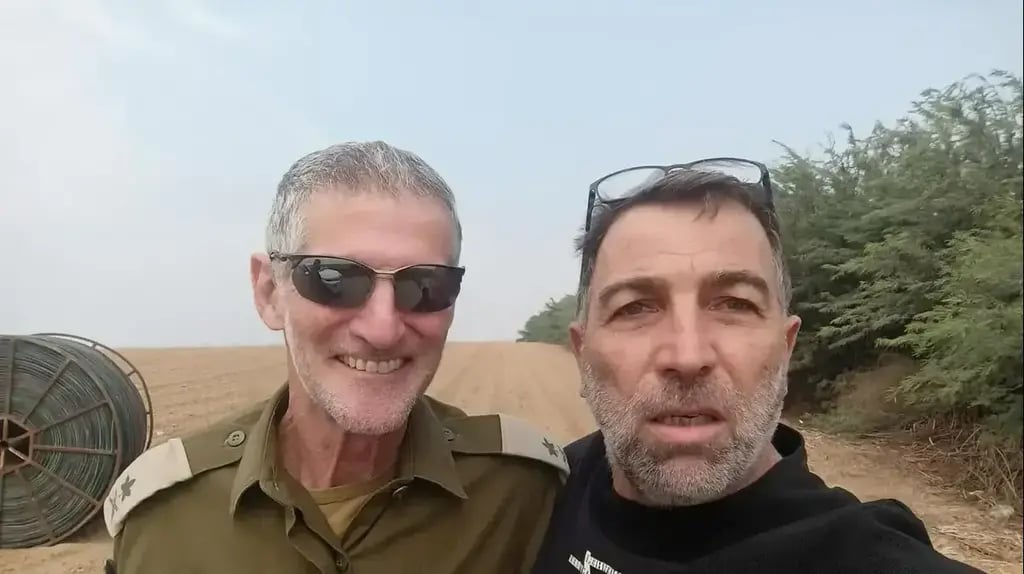
Yair Golan and Oz Davidian on Oct. 7, 2023. Baseless allegations have been leveled against Golan
The success of this conspiracy theory is surprising, particularly in Israel, where such theories have historically gained far less traction than in the United States. American public life has long been rife with speculation about who really assassinated President John F. Kennedy, whether the moon landing was faked, where the government is hiding extraterrestrial visitors and, more recently, Pizzagate.
In Israel, the most significant homegrown political conspiracy theory emerged after the assassination of Prime Minister Yitzhak Rabin and remained largely confined to the fringes of the far right. Deep state and COVID-19 conspiracy theories gained some traction among the Israeli public, but they were imported from abroad rather than homegrown. Above all, no political conspiracy theory has ever taken hold here on such a broad scale.
So what explains the toxic success of a conspiracy theory involving a sinister plot by senior security officials, along with equally bizarre offshoots of the central narrative, such as the claim that Yair Golan had his freshly pressed uniform ready in advance on October 7 and did not rescue anyone?
First, there are two obvious explanations. Social media encourages the spread of falsehoods. Its algorithms seem tailor-made to rapidly amplify fabricated theories that provoke emotion, outrage and controversy.
Second, Netanyahu and those around him had a clear interest in promoting a theory that absolves him of all responsibility and places the blame squarely on others. On the few occasions when he ostensibly distanced himself from the theory, he did so with unmistakable reluctance and only to the bare minimum.
The appeal of conspiracy
These two factors explain who has an interest in promoting the theory, but a more interesting question is why so many people have embraced it. What makes reasonable people believe such outlandish tales?
The answer appears to lie in the emotional difficulty of confronting what the greatest national tragedy we have experienced revealed about us.
On the morning of October 7, the national story we had proudly told ourselves did not merely crack. It shattered into pieces: the deeply held belief that when disaster strikes, someone will come to our aid. That we have a powerful military and security establishment capable of reaching any scene within a reasonable time. That our military is strong and the gap in strength between Israel and Hamas is insurmountable. That our intelligence is excellent and our security systems function exceptionally well.
Even three years later, when Israelis think or read about October 7, the first thought that comes to mind is, "I can't believe this happened to us." The second follows immediately: "How? How could something like this happen to us?" And still, there is no satisfying answer.
Our national self-image was shaken to its foundations, and confronting what happened raises existential questions: Could it happen again? Is our very existence truly at risk?
The conspiracy theory offers psychological comfort to terrified Israelis. Going down this rabbit hole provides an escape from existential fear, preserves our national self-image and dulls the sense of humiliation: The IDF did not actually fail on Oct. 7. The military did not lose that day. Israel was not exposed as vulnerable and did not fail to confront an invasion and massacre. Someone simply sold us out.
The conspiracy theory offers psychological comfort to terrified Israelis. Going down this rabbit hole provides an escape from existential fear, preserves our national self-image and dulls the sense of humiliation: The IDF did not actually fail on October 7. The military was not defeated that day. Israel was not exposed as vulnerable and did not fail to confront an invasion and massacre. Someone simply sold us out.
We never stood a chance because of the betrayal. Had that betrayal not occurred, the The IDF would surely have carried out its mission with courage, thwarted Hamas' plans, prevented the disaster and protected the communities.
The problem is not our capabilities as a country or the IDF’s professionalism, but a sinister, treacherous force. Betrayal is a horrifying explanation, but for those who believe it, it may be less frightening than the possibility that the state and its security institutions were simply incapable of protecting their citizens.
A decade ago, psychologists at the University of Kent identified three main motivations for believing in conspiracy theories. All three appear to apply to the Israeli case: the need to understand the world and impose order and meaning on a particularly confusing reality; the need for security and a sense of control, especially during periods of fear and uncertainty; and the need to preserve a positive individual and collective self-image by blaming failures on external, hostile forces.
 Tamar Ish-ShalomPhoto: Channel 13
The growing number of Israelis who believe the conspiracy theory leaves little room for optimism. One possible glimmer of hope emerges from another question in the survey, which examined how certain respondents were of their beliefs: 27% of coalition voters are convinced that a betrayal from within occurred, while another 33% believe there was a betrayal but are not certain.
Although this question reveals an even higher proportion of people inclined to believe the conspiracy theory, 60%, Dr. Omer Yair of Reichman University points to the second group, those who remain uncertain, as potentially open to changing their minds if presented with credible and convincing information.
That is yet another reason why it is so important to establish a state commission of inquiry after the elections to investigate the failures surrounding the October 7, 2023, Hamas attack. Some will dismiss it outright following Netanyahu's campaign to undermine its legitimacy. But for those who are still willing to listen to the facts, its findings could be significant.
Who knows? Perhaps even the store owner might be persuaded.
Tamar Ish-Shalom is a senior fellow at the Hartman Institute and the Jewish People Policy Institute (JPPI).