


This is a chronic and ongoing illness of democracies everywhere: they struggle to confront tyrannical regimes. Just a month ago, the Iranian regime carried out one of the worst massacres of its own citizens. And after countless threats against that reign of terror, Trump now grants legitimacy to Khamenei’s envoys with a smile-filled meeting. Iranians who took to the streets — those who survived — are watching in horror.
Neville Chamberlain was received like a king, hailed as a national hero, when he returned to London after the Munich Conference, at which Western powers ceded the Sudetenland in Czechoslovakia. His intentions were admirable, his rival Winston Churchill said at the time; he merely fell victim to "the most noble and benevolent instincts of the human heart—the love of peace, the toil for peace, the striving for peace, the eager desire for good relations with foreign powers.”
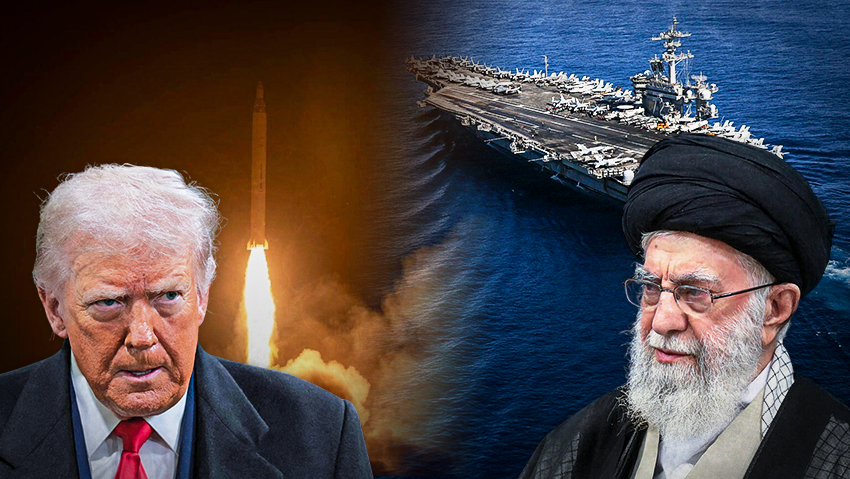
Trump, Khameini
(Photos: Anna Moneymaker/AFP, KHAMENEI.IR/AFP)
The problem is that the longing for peace and reconciliation almost always comes with blindness. Still, it is worth remembering that opponents of American intervention have strong arguments. The free world’s war against jihad failed. It began after the 2001 terror attacks and, in effect, has never ended. Every country that took part emerged battered.
The price is usually paid by civilians, even when many of them support jihad. About one million people were killed directly, another roughly 3.5 million indirectly. Some 38 million people became refugees. The warnings by antiwar voices about the cost are therefore real. We have seen this movie before. We have been living it for a quarter of a century. And globally, jihad today is stronger than it was on Sept. 11. So another war?
The point is that this is not 1938, nor is it 2001. The main lesson has already been learned. An invasion is not on the table. But appeasement leads to the strengthening of the axis of evil. So what is to be done with the monster? First, airstrikes against centers of power and military infrastructure are not an invasion. They are a necessary alternative, even if Iran follows through, to the extent it can, on its threat to respond forcefully.
There is another way to topple the regime
In 2018, Trump withdrew from the nuclear deal. Sanctions were reinstated. And forgive me all those who opposed the withdrawal — it worked. By late 2019, then-Iranian President Hassan Rouhani admitted that renewed sanctions had inflicted $200 billion in economic damage on Iran. By the end of 2020, the situation had worsened further, and then–Foreign Minister Javad Zarif acknowledged the damage had reached $250 billion. Per capita income fell by 14%, and inflation jumped from 9.6% to 40%. Iran was on the brink of bankruptcy. It was forced to slash its defense budget by 28%.
An invasion is not on the table. But appeasement leads to the strengthening of the axis of evil.
Then came a lifeline. On Feb. 19, 2021, less than a month after entering the White House, Joe Biden decided to renew talks with Iran and took a goodwill step — lifting sanctions. Iran was saved from bankruptcy. The talks did not lead to a new nuclear agreement. The sanctions were not reinstated. Biden’s appeasement led to the strengthening of the Houthis, Hezbollah and Hamas. Perhaps even to the October 7 attack.
What now? At the end of December, unrest erupted in Iran. It seemed the regime was on the brink of collapse. An oil-exporting country without sufficient electricity, declining revenues and a collapsing local currency, as well as natural conditions that added a drought, causing a severe water crisis. The regime was on a clear path toward collapse due to economic breakdown. Then Trump announced he was coming to help. The protests gained massive momentum. And the regime responded with a crackdown that amounted to a mass slaughter of protesters. Perhaps thousands. Perhaps tens of thousands.
 Ben-Dror YeminiPhoto: Avigail Uzi
The help did come. Trump promised, and Trump delivered. But at present, the talks themselves are helping the regime. Most commentators argue the gaps are wide and that an American strike is only a matter of time. One hopes they are right. But negotiations have a dynamic of their own. They drag on. Both sides project optimism. Domestic pressure in the United States against a strike will only grow stronger. Qatar and Turkey will continue to apply their own pressure. There should be no illusions: the coalition of opponents wields enormous influence. And instead of regime change, we may be headed toward regime reinforcement.
Biden has already been there — with admirable intentions. There is a very real concern that Trump is walking exactly down the same path.