

On the ninth floor of a building on Rothschild Boulevard lies one of the most visually striking living spaces in the city: the home of 47-year-old celebrity chef Assaf Granit.
The four-room apartment with a balcony is filled with colorful ethnic rugs, artworks, tableware, flowers, books and rare collections, so much that it’s almost dizzying.
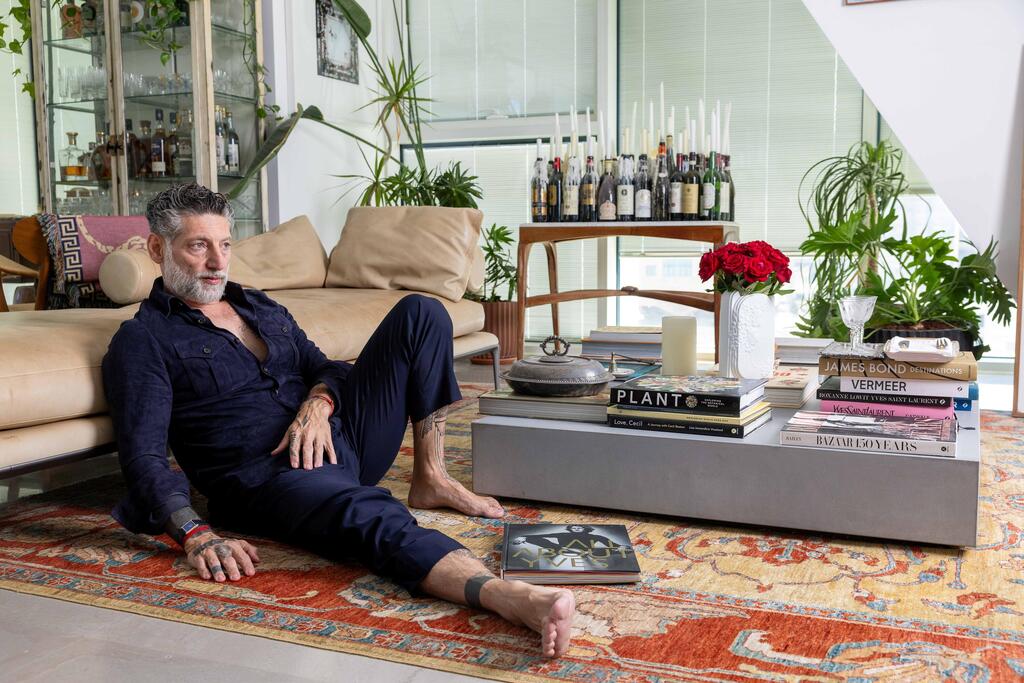
Everything is meticulously curated, drawing visitors into a narrative about Granit, a native of Jerusalem who brought his grandmother’s dishes to Machneyuda, his flagship restaurant, and who created a new culinary and design language, which found global success once he took it abroad.
This past March, his Paris restaurant Shabour earned a Michelin star for the fifth consecutive year.
“I’ve lived here for seven years, and at first it looked like a generic apartment, zero character,” Granit recalls. “My life moves fast, I travel every few days, and it felt like a dull hotel in gray tones.
"At first, it was just functional, somewhere comfortable for Leo, my son, and for me. At that point in my life, I wasn’t thinking about aesthetics; I was just thinking about survival. Then, during the COVID pandemic, I suddenly had time. I stopped flying because it was impossible, and I began shaping the apartment to reflect my personality and voice.
"That’s when it started to take on character and beauty. I started buying and collecting things, and even now, I could be sitting in the living room and suddenly get up to rearrange things."
The front door opens to a hallway that leads to a large central space. On the right is the guest bathroom, and straight ahead is an open area that includes a spotless kitchen with white cabinets, a dining area, a living room, and a small niche for writing.
The kitchen opens onto a balcony overlooking the city, where Granit set up a personal gym during the COVID pandemic. Though the lockdowns are long over, he still uses the equipment.

"Every item has a story"
(Photo: Tal Shahar)
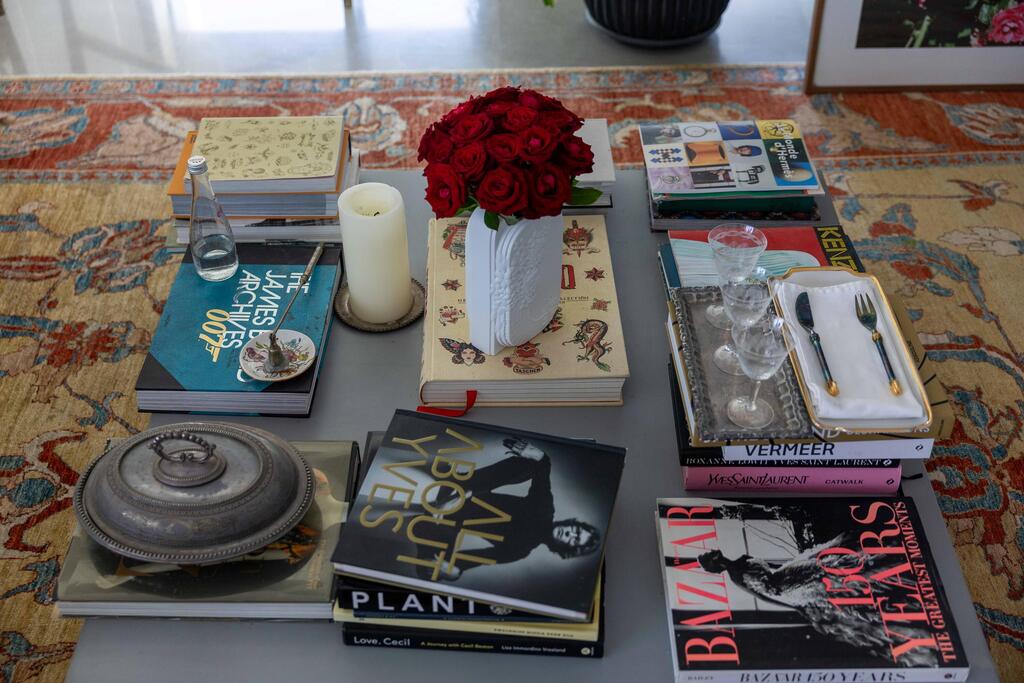
“Everyone knows, if you’re getting me a gift, it should be a book”
(Photo: Tal Shahar)
From the main living space, which is paved in gray stone and covered with many rugs, a hallway leads to the private rooms: Granit’s bedroom, his son Leo’s room, two bathrooms and a walk-in closet (which also serves as a reinforced security room).
Alongside tailored suits, the closet contains carefully selected everyday outfits. He chose not to have the private areas photographed.
“Everywhere you look, nearly every item has a story,” says Granit, who designed the apartment himself, “with a little help from Leo’s babysitter,” he adds with a smile. “At my core, I’m a storyteller, so it only makes sense that my home is made up entirely of stories."
How unique is the collection? Here is one example. During the interview, his first ever held in the apartment, Granit brews coffee in custom espresso cups made by a luxury brand, designed especially for him as a birthday gift by friends. Alongside the brand’s logo at the bottom, his name is printed. “It’s a hand-painted, numbered series, featuring the date of my birthday,” he says.
The kitchen isn’t for show
Chef Granit’s kitchen is lined with closed white cabinets, a refrigerator, and two ovens. Opposite them stands a large island with a sink at one end and stovetops at the other. A self-proclaimed neat freak, Granit stores all utensils, spices and ingredients out of sight. The "show", he says, is reserved for the rest of the apartment.
The only splashes of color in the white and clean kitchen come from a rectangular ethnic rug and a few heavy metal pots by Naaman, the Israeli cookware brand he has represented for eight years.
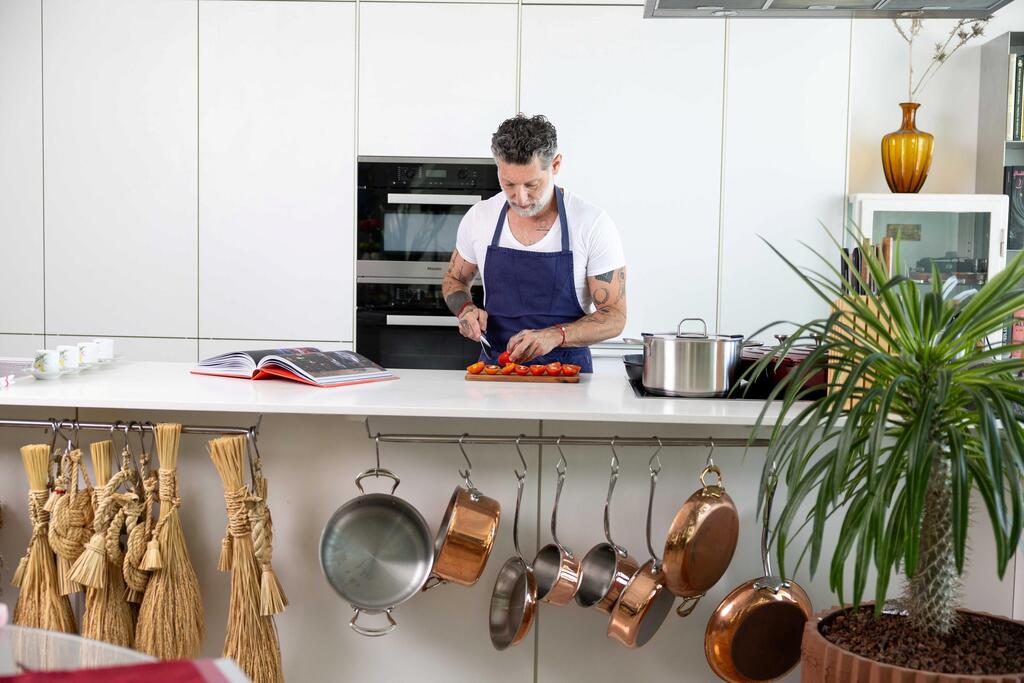
White kitchen and a few heavy metal pots for color
(Photo: Tal Shahar)

Chef Granit features in a Naaman cookware commercial
(Photo: Tammy Bar-Shay)
“I wanted a comfortable kitchen, because I hardly ever host at home,” he explains. “It had to be functional and easy to clean, in contrast to the rest of the apartment, which is very exposed. I didn’t want the dishes or raw ingredients on display. The kitchen here, in my personal life, isn’t for show."
What connects a Michelin-starred chef to a brand like Naaman?
“Right from the start, when I opened my first restaurant, I tried to break the rules, and everything was allowed. You could serve food on a mirror or in the pot it was cooked in. Made risotto? Serve it bubbling hot in a beautiful pot right at the table.
"I brought a lot of emotion into it. I’m glad the world has caught up. Kitchenware that used to be strictly utilitarian is now presentation-worthy. It’s nice to know I played a small role in that."
What’s the one thing you’d never give up in a kitchen?
“A dishwasher. I hate washing dishes.”
What is an essential utensil in your view?
“A good knife, heat-resistant placemats, because I serve pots at the table, and an immersion blender, for soups and sauces, to thicken and whip."
What stresses you out before guests come over?
“Wondering when they’ll leave, he says, laughing. Honestly, I don’t like hosting at home. Just go, don’t linger."
How do you manage hosting when you need to serve many dishes at once?
“As with anything: plan ahead. Prepare as much as you can in advance and avoid dishes that need last-minute plating. That way you can actually spend time hosting and talking. I recommend pre-plating and leaving the sauce in a bottle to be served as a final touch."
What’s the secret to dishes that look impressive but are easy to make?
“Stews never look great, but they’re always delicious. I like garnishing with fresh herbs because they add color, freshness and texture. If I’m serving meatballs or a slow-cooked stew, I’d top it with a salad of fresh herbs, olive oil and lemon. It also lightens the dish."
Describe your holiday table in one word.
“Packed. I’d rather host at the restaurant."
When you’re a guest, what do you bring?
“Wine.”
Any hosting disasters? How did you recover?
“Recently, I cooked for Leo and some guests, but I was in a terrible mood and everything turned out so awful that Leo wouldn’t touch it. I made an omelet and rice, and honestly, when I tasted it, it was disgusting. How did I fix it? Wolt,” he laughs, referring to the food delivery app.
Wine bottles turned candleholders
Next to the kitchen stands a dining nook with a round glass table on wooden legs, surrounded by six wood-and-rattan chairs. Around the table are stacks of books, tableware, candles, and fruit.
“My son always complains when we sit down to eat, because we have to clear stuff off the table and put it back afterward,” Granit says. “I define my home as organized chaos. My body too, with all the tattoos, is a kind of organized chaos."
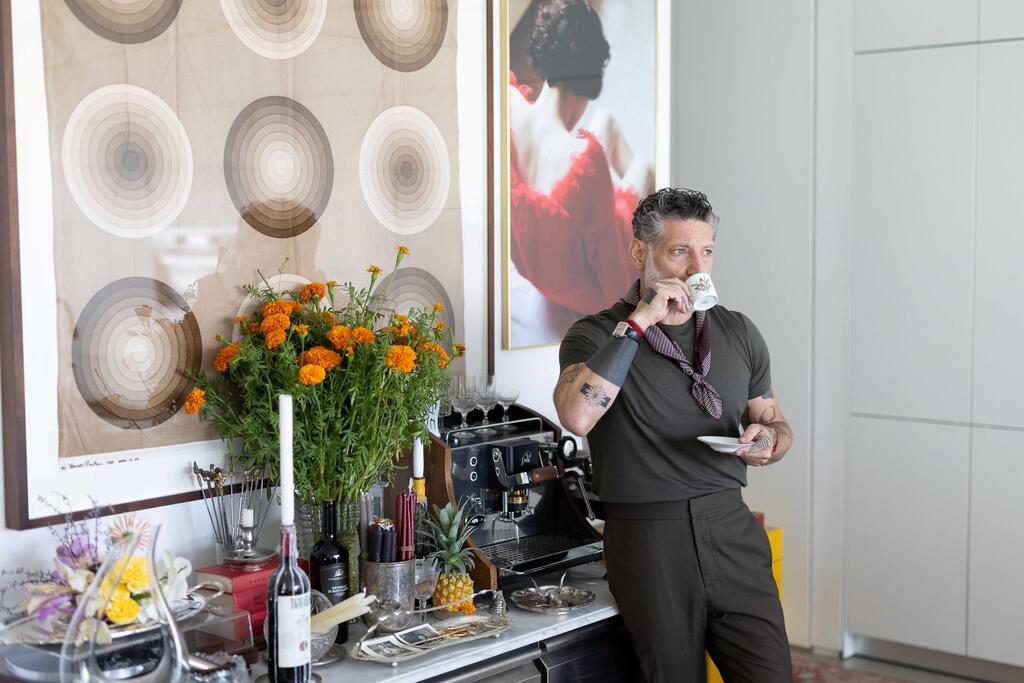
Coffee corner
(Photo: Tal Shahar)
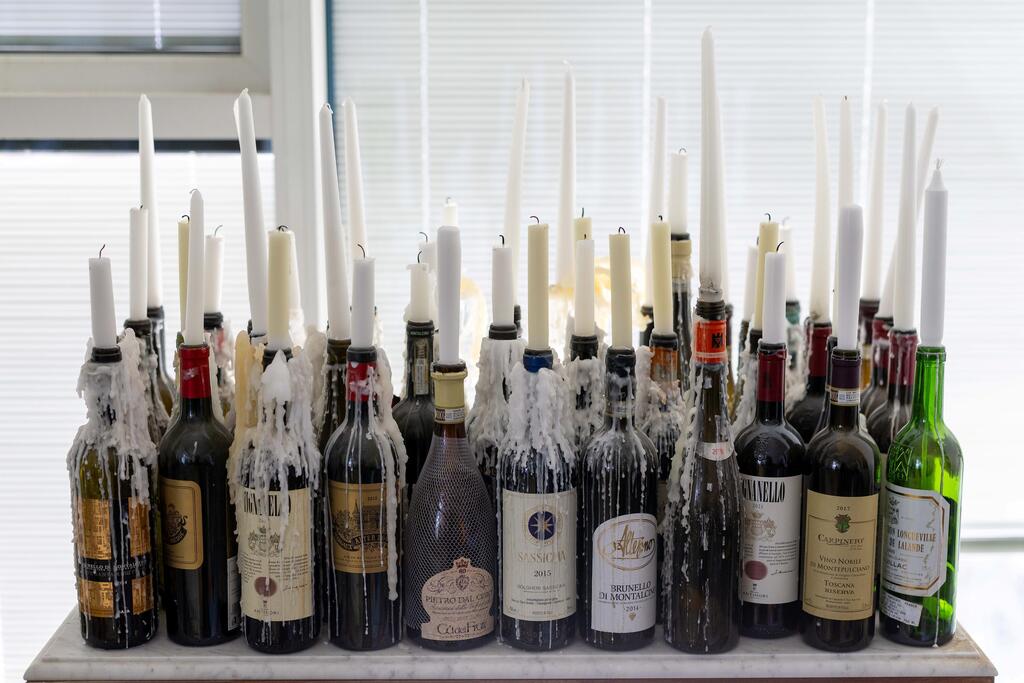
Wine bottles turned into candleholders
(Photo: Tal Shahar)

The living room
(Photo: Tal Shahar)
On the wall beside the kitchen, Granit set up a station that resembles an industrial metal kitchen, topped with patterned gray stone, where he also created an eclectic coffee corner. To the right is a second-hand cabinet filled with vintage kettles, and a mustard-colored chest of drawers for personal items.
Together, they serve as storage for his coffee machine, record player, and the red Michelin Guides. The walls are adorned with artworks Granit has collected and curated over the years.
The living room features a cream-colored leather chaise-longue sofa, where he watches TV, a square white table piled with art books (“Everyone knows, if you’re getting me a gift, it should be a book”), a large television, and a corner filled with empty wine bottles that now serve as candleholders. A nearby wall displays his prized copper cookware collection.
When did you start collecting copper pots?
“When I was a young cook in Michelin-starred kitchens, they always had copper pots, but they were too expensive for me then, so I bought just one. When I ‘made it,’ I said, ‘Alright, now I’m going to start a collection to make up for that."
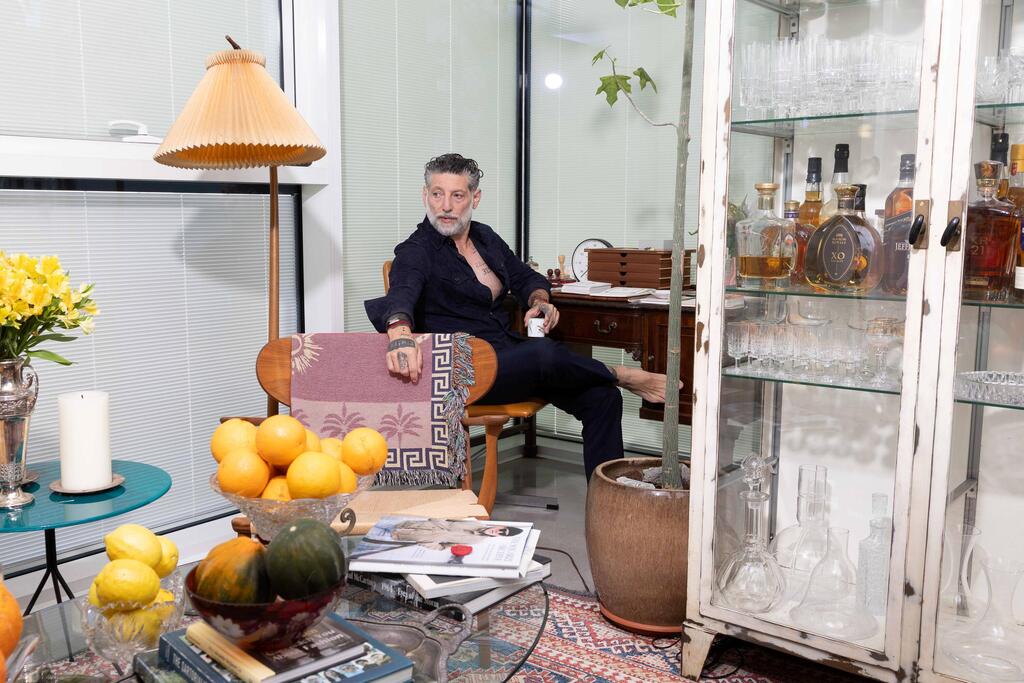
Granit's workspace: an antique secretary desk
(Photo: Tal Shahar)
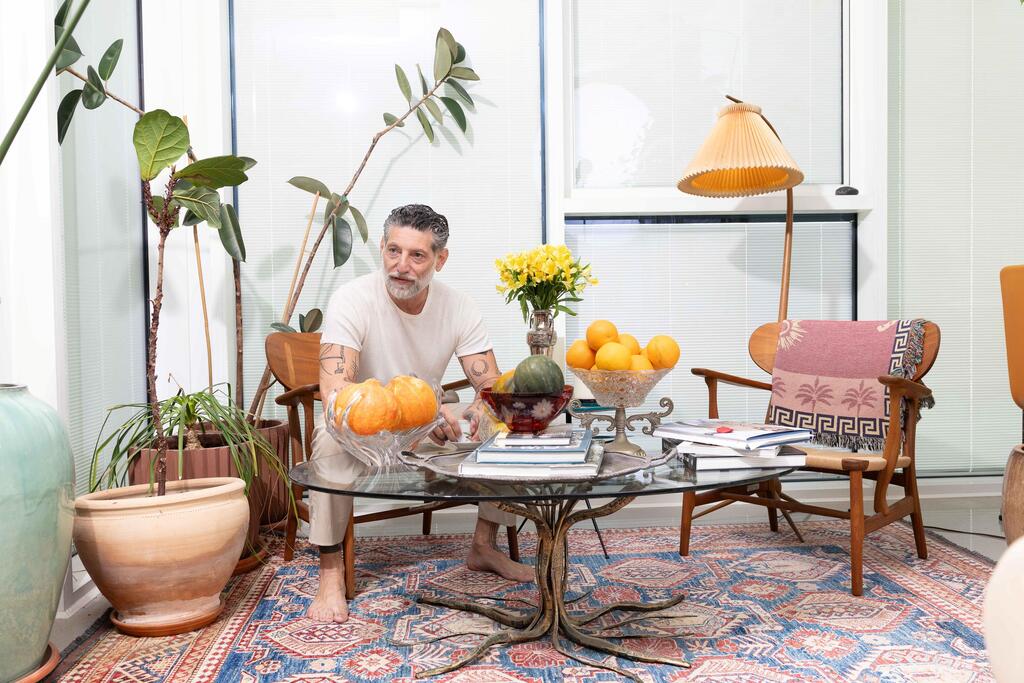
Glass table with metal legs shaped like roots
(Photo: Tal Shahar)
Why use empty wine bottles as candleholders?
“Every wine bottle here is a vivid reminiscence of a meal I had. One was a gift from friends, another was from the night we got our first Michelin star. I decided to keep them all so they’d remind me of those moments I don’t want to forget."
A memory of Alber Elbaz
Few people know that Granit is an art collector. Above the TV in his living room hang black-and-white pieces by Merav Ben Loulou, who documented the behind-the-scenes of the late Alber Elbaz’s major exhibition during his time as creative director at Lanvin.
“Alber became a friend of mine in Paris,” Granit recalls. “When Stella McCartney received a lifetime achievement award, I was invited to cook the dinner. Elbaz was there and took me by the hand like an uncle. We went from table to table and he introduced me: ‘This is the Israeli chef.’
"I have beautiful memories with him, and also a few sad ones. During the COVID pandemic, he was afraid to leave the house and asked us to cook simple home food. Every Sunday, he’d tell us what he wanted to eat that week. We’d bring him meatballs, rice and peas, or whatever he asked for.
"When he finally got vaccinated and allowed himself to get out of the house, he caught COVID and sadly died in April 2021. When they announced his death, we still had containers in the restaurant in Paris, ready to be delivered to him.
"I attended the tribute exhibition for him in September 2022 at the Design Museum in Holon, and his family told me that every week he’d call them for advice on what to order from me, and how much it meant to him to get those meals during the pandemic. These artworks are my memory of him.”
Just off the living room, Granit created a cozy seating corner featuring a glass table with metal legs shaped like roots, two chairs, a small elevated candle table, and a reading lamp. Like the rest of the apartment, it’s surrounded by large potted plants. When Granit is abroad, someone is tasked with watering them regularly.
Nearby stands a glass cabinet filled with fine spirits and crystal glasses for a stylish drink.
The home is full of vintage dishes and crystal. What did you bring from your parents’ and grandmother’s homes?
“Everything I brought from my parents and grandmother, I took to Machneyuda to use as the restaurant’s dinnerware. Over the years, it all broke. The crystal and dishes I have now I bought at flea markets around the world. They’re very similar to my grandmother’s."

Personal gym in the balcony
(Photo: Tal Shahar)
What’s the story behind the liquor cabinet?
“After I mentioned in an interview that I brought my German grandmother’s beautiful dishes to Machneyuda, someone sent me a letter and a collection of glasses for the restaurant. He said his grandmother had left it to him, but he didn’t know what to do with them, and he thought the right thing was to give them to me. They’re stunning glasses. I was very touched by this incredible gesture."
There are also embroidered napkins here with your name on them.
“A good friend of mine is Hélène Darroze, a famous chef and one of the few women in the world with three Michelin stars. I recently had dinner at her restaurant. We sat down, and when the waiter set the napkins, he brought me one with my initials embroidered on it. That was nice."
“Breaking the cold in the apartment”
One particularly personal corner of Granit’s home is his workspace: an antique secretary desk and a brandy-colored leather chair tucked against the wall. There, he keeps a collection of leather notebooks, some monogrammed with his initials, along with poetry books, envelopes, stationery, stamps, and pens. “One of the first things Chen Rabi, my manager, did was buy beautiful envelopes in Paris because she knew I love writing notes,” he says.
What mattered most to you in designing your home?
“To have a space for working out on the balcony, a large central living area because Leo and I spend most of our time there, and a functional kitchen."
The apartment is full of plants. Why is that important to you?
“This is a tower, a building of glass and steel. It’s easy for it to feel cold. I wanted to break that, to create warmth in contrast to the urban vibe. That’s why the apartment is full of greenery.
"And I hate to admit how many people help me with it. My driver loves watering the plants; it’s his hobby. We rotate the flowers weekly, and there are fruits and vegetables everywhere. We eat them, but they’re also there to create a pleasant atmosphere."
“On October 7, 2023, I was in Rome. On October 8, I was in Paris. I returned to Israel for reserve duty on October 10. Seeing this greenery, especially in today’s reality, with all the death, the fighting, the hostages, and my chaotic schedule, it’s healing. Most of what I do these days is solve problems, not create. Waking up in the morning and seeing this, it helps.”
Six months ago, you released your French-language cookbook, Boire. Manger. Vivre: 100 Recettes Venues D'Israël ("Drink. Eat. Live: 100 Recipes from Israel"). The project took a year to complete and includes intimate family photos alongside the recipes.
“We haven’t launched the book in Israel yet, because there’s still no English edition, and the timing isn’t right,” Granit explains. “The editor-author Catherine Roig spent a year with me, along with photographer Emanuela Cino. The concept was that each chapter represents an emotion, and within that emotion there are stories, and each story connects to a dish."
Among the personal moments captured is a photo of Granit’s mother at Berta, the Berlin restaurant he named after her mother, his grandmother. “The logo is my grandmother’s face. She fled Berlin before the war and never returned. I made it a point to one day open a restaurant there.”
Recipes in the book include dishes like “Eggplant, My Love,” accompanied by unconventional photography.
“We traveled the world together for a year. I called them (Roig and Cino) Phileas Fogg and Passepartout,” he says, referencing Around the World in 80 Days. “Wherever I landed, they’d show up with a camera and a bag, capturing me with Leo, or in the kitchen, or working out. She interviewed me constantly. That’s how the book was written, on the move.”
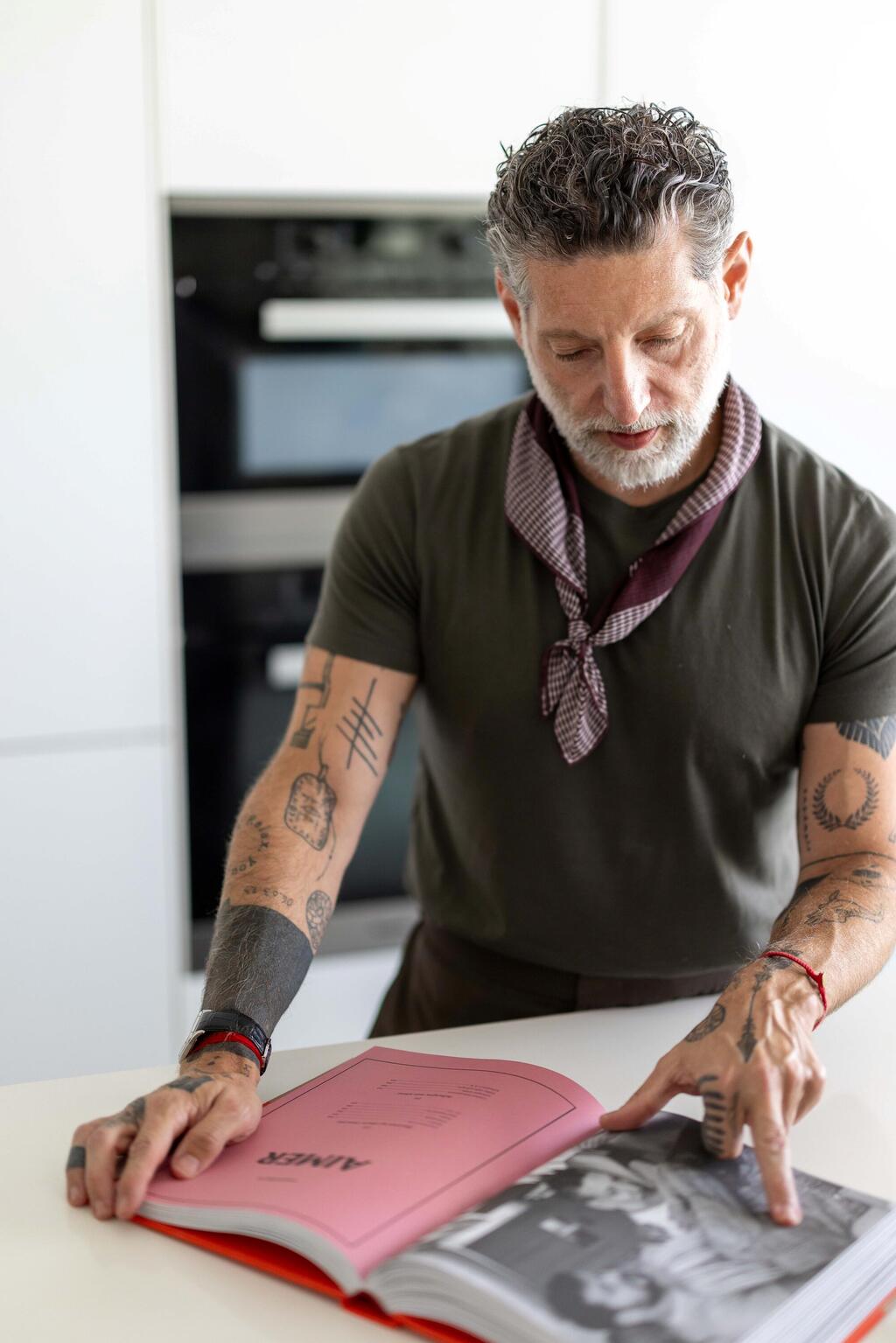
Granit's book
(Photo: Tal Shahar)
One story, he says, stands out: “I took her (Roig) to Azura, my restaurant in Jerusalem. Uri, my partner, brought me a lung stew. I started eating, and she looked at me, saying, ‘You’re eating lung? In France, we feed that to animals.’
"She quoted a French saying: Ce n’est pas des poumons pour les chats, ‘That’s not lungs for cats.’ It basically means ‘lungs are trash eaten by cats.’ I loved the phrase. The next day, I got a tattoo of its initials. They photographed the moment. I told the author, ‘This tattoo is for you, because I had an amazing year with you and I don’t want to forget it'."
Publishing a cookbook in France wasn’t easy, especially now, in such an antisemitic climate, he says. “But for me, food is a bridge. That made it even more important to speak out and proudly share our culture."
How do you balance travel and army reserve duty?
“I jump between reserve duty in Israel and restaurants around the world. It can be surreal, cooking for a crowd, some of whom might not even support me. But I choose to bring Israel with me everywhere I go, standing tall, with food that speaks for itself."
Assaf Granit's tip for holiday hosting:
“Serve dishes in the pots you cooked them in. These days, cookware is beautiful; it’s trendy to serve food straight from the pot. So plan your menu around stews and meatballs. That way, you’re not stuck in the kitchen on the holiday evening. Prepare in advance, heat, and serve. Plus, fewer dishes to wash."