

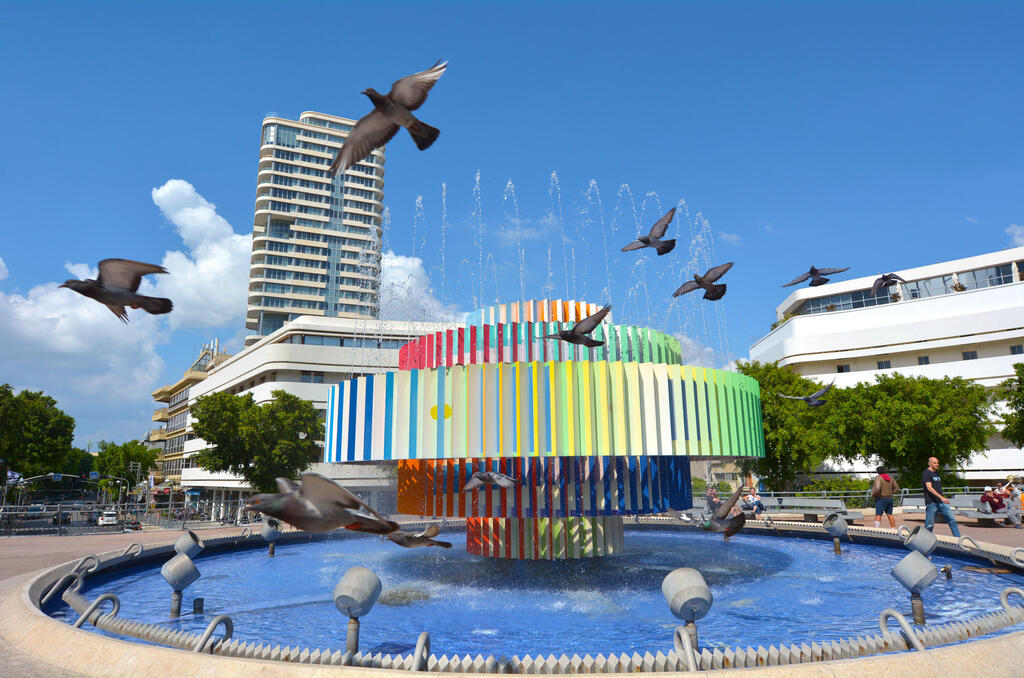
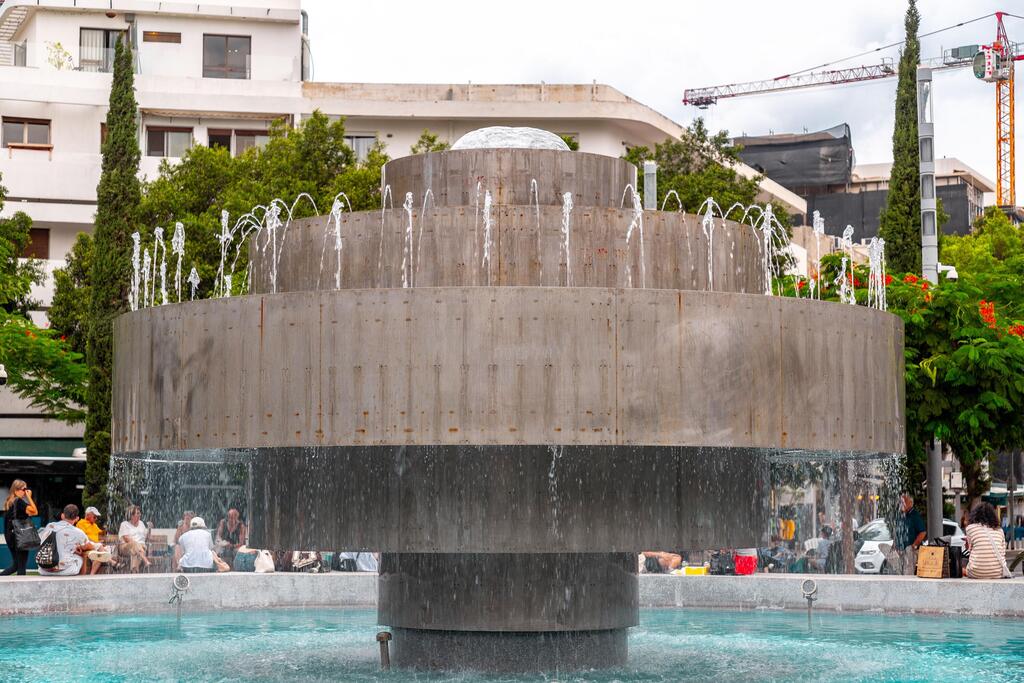
Few works in Israel’s public space have stirred as much debate over the years as “Fire and Water,” the kinetic fountain in Tel Aviv’s Dizengoff Square created by artist and sculptor Yaacov Agam, who died this week.
Since its inauguration in the 1980s, the fountain has become one of the city’s most recognizable symbols, but also a long-running source of public, professional and cultural dispute. Questions of preservation, maintenance costs, urban design, the changing identity of Dizengoff Square and the role of art in public space have surrounded the fountain almost from the moment it was installed.
Over the years, it also stood at the center of disputes between Agam and planners, among them the late architect Israel Goodovitch, who also died recently, over the fountain’s place and function in the urban landscape.
Now, with Agam’s death at 98, shortly after Goodovitch’s death, it is an appropriate moment to revisit the complex story of the iconic work, the passionate battles waged around it and the question of what may happen to it next.
A clash of worldviews
Within one month, Israeli culture lost two creators who left a deep mark on art, architecture and public space. Last month, Israel Goodovitch died at 92. He was one of the most influential and prominent figures in Israel’s architectural and urban debate, particularly in Tel Aviv, and served as Tel Aviv city engineer from 1999 to 2000 and as chief architect at the Housing Ministry.
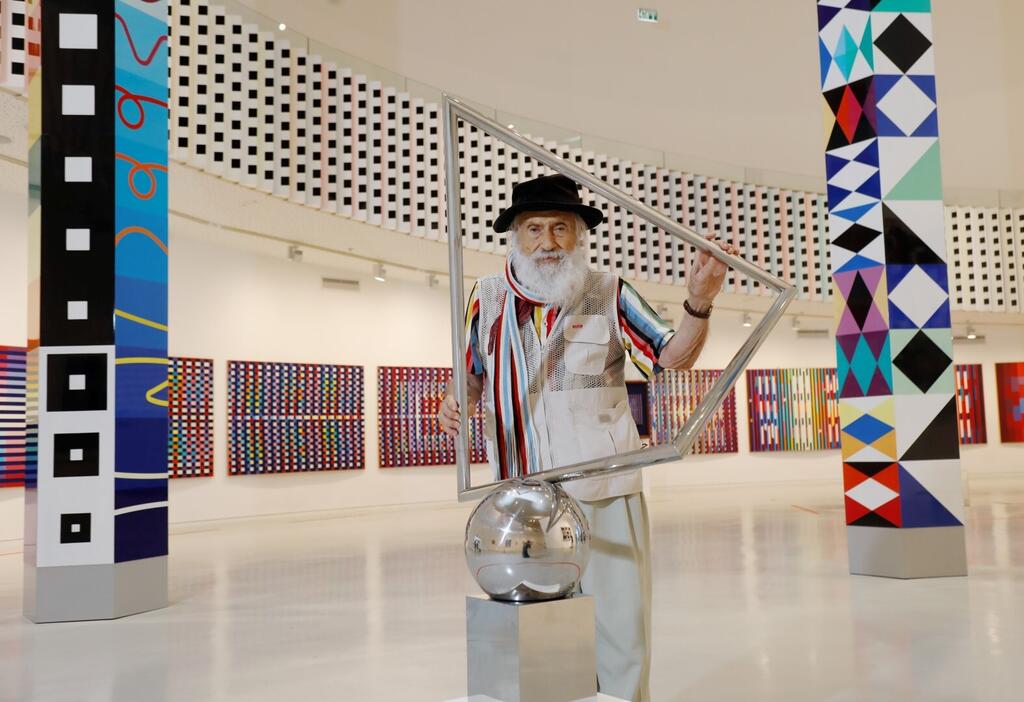
This week, Agam died at 98. He was a pioneer of kinetic art and one of Israel’s best-known and most successful artists internationally. This year, he was also chosen to receive the Israel Prize in art and design.
Alongside their impressive professional achievements, the two men shared striking traits. Both had a powerful public presence, and both were charismatic, opinionated and uncompromising figures who did not hesitate to state their views forcefully and fight for their worldview, whether on their art, the design of public space or almost any issue on the public agenda.
Beyond their broader contribution to Israeli culture and the urban landscape, the two were also linked by one of the most publicized disputes over public art in Israel. At the center of the disagreement was Agam’s “Fire and Water,” which over the years became both an urban symbol and an ideological battlefield between different approaches to preservation, planning and the design of public space.
Agam saw the fountain as a complete work that could not be separated from the square. Goodovitch argued that the changes Dizengoff Square had undergone over the years required a new examination of its place and role.
Fire, color and arguments
“Fire and Water,” inaugurated in 1986 at the center of Zina Dizengoff Square in the presence of then-prime minister Shimon Peres, was one of Agam’s most ambitious public-space projects.
Like many of his works, it sought to challenge the idea of art as a static, fixed object. Combining water, fire, light, color and movement, Agam created a changing kinetic display in which rotating rings and colored panels constantly produced new shapes and compositions.
The work expressed one of the central ideas in Agam’s art: Art is not something fixed and absolute, but an experience that changes according to time, place and the viewer’s perspective.
Today, it is difficult to separate the fountain from the fierce arguments it provoked over the years. But according to Agam’s family, it was greeted with great public enthusiasm at the beginning.
“On opening day, there were thousands of people there from all over the country,” Ron Agam, Yaacov Agam’s son, said in an interview with ynet. “People came to him, hugged him and told him how beautiful it was.”
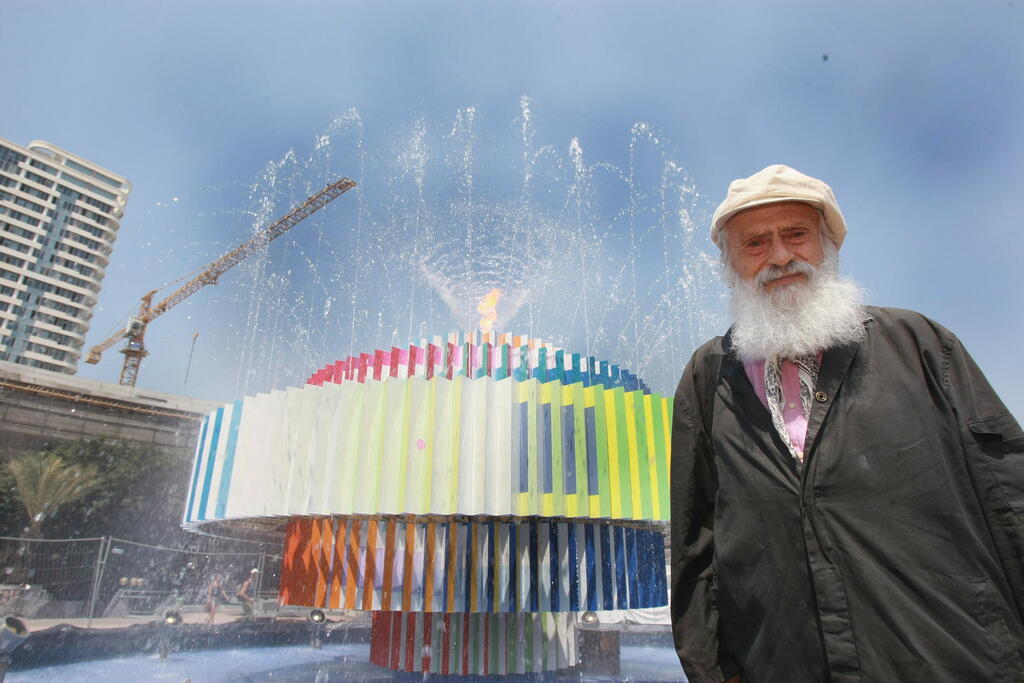
Agam by the fountain
(Photo: Shaul Golan)
According to him, “at least 90% of the public, maybe more, admired that work.” Only later did critical voices begin to emerge, mainly from professionals and art critics. Over time, the debate around the fountain widened and turned it into one of Israel’s most discussed and controversial works of public art.
The criticism did not focus only on artistic questions. Alongside appreciation for its innovation and its status as one of Tel Aviv’s most prominent symbols, critics pointed to its high maintenance costs and technical complexity, which included movement mechanisms, lighting, water and fire.
Over the years, the debate expanded to include the question of its place in the public realm: Did its dominant presence enrich the square, or did it harm the function of the space as an open and accessible urban area? Another recurring question was whether Dizengoff Square was the right place for such a large and prominent work, or whether it might have fit better in another urban context.
Almost no one remained indifferent to it. Some saw it as an urban masterpiece. Others believed it had no place at the heart of the square.
The dispute took a significant turn during the project to return Dizengoff Square to street level after years in which it stood on an elevated platform above the road. As part of that project, the fountain was moved into temporary storage, reopening the debate over its future, location and preservation.
Earlier, in 2011, the fountain underwent extensive restoration and upgrading work at a cost of about 2 million shekels. The colored panels were repainted, and technical changes were made, including the cancellation of the original rotating mechanism of the rings.
When the renovation of the square was completed in 2018, the fountain was placed back in the center, but the colored elements were never reinstalled because of a dispute between Agam and the municipality, which led to a prolonged public confrontation.
Agam argued that the changes damaged the integrity of the work and his artistic vision, and that the fountain had been returned to the public in a partial version that did not reflect his original intentions.
“I dedicated 10 years to creating ‘Fire and Water’ for the city of Tel Aviv, and they turned it into a shameful piece of junk. They turned my most important work into junk,” Agam once said in an interview with Yedioth Ahronoth’s “7 Days” weekend suplemental.
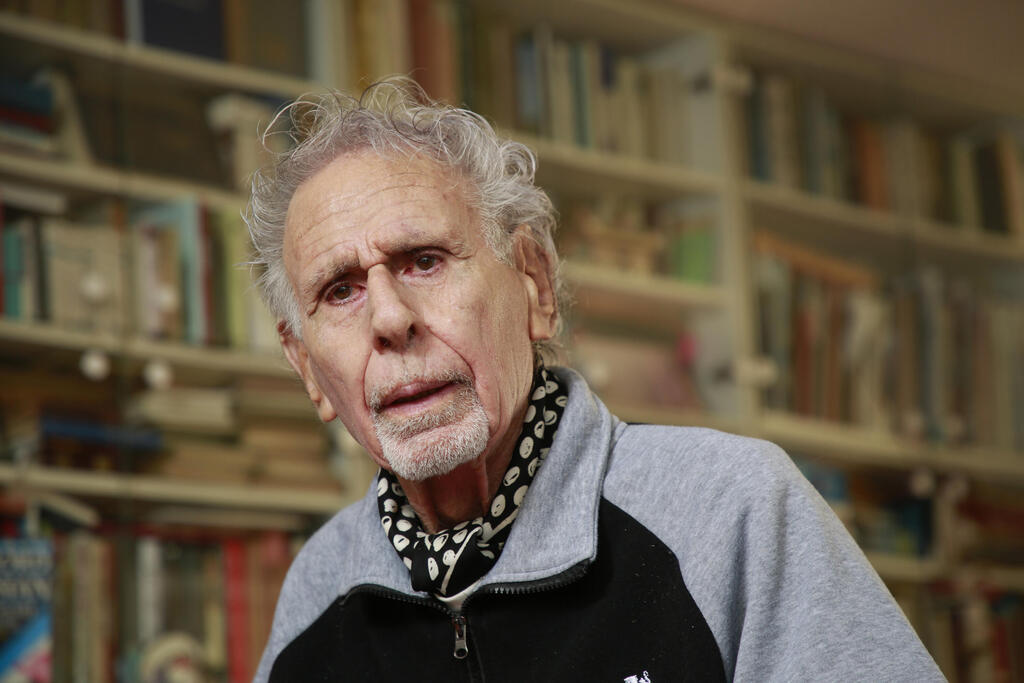
Goodovitch
(Photo: Ryan Frois)
The municipality, for its part, said the decisions were made for reasons of safety, maintenance and budget.
Goodovitch was among the fiercest critics of the decision to place the fountain back in the center of the square after Dizengoff Square was returned to ground level. While Agam insisted that the work return to its original location and in colors he would personally approve, Goodovitch believed the square’s transformation required a fresh look at the issue.
In one interview, Goodovitch even called the fountain “the world’s largest washing machine” and argued that the renewed square should prioritize pedestrians and diverse urban uses, not a central and dominant sculpture.
Still, in an interview with ynet, his son, architect Dekel Goodovitch, said his father’s position was more complex than it sometimes appeared. On the one hand, he wanted to restore the square to its historical state and kept in his office a photograph of the original square from the 1930s. On the other hand, he also attached great importance to the square’s traffic function.
“I don’t think he fully resolved it within himself,” Dekel said.
When Agam gave Goodovitch a work as a gift
Behind the public confrontation, however, stood a more complex and respectful relationship than it seemed from the outside. The younger Goodovitch said the disagreement between the two men was never personal.
“It was entirely professional,” he said.
According to him, at the beginning his father believed that if Dizengoff Square was being returned to its original design, it should be restored fully to its historical state, a period in which Agam’s work did not stand at its center at all.
The fountain following its makeover
(Photo: ColorMaker, shutterstock)
But during his tenure as city engineer, Goodovitch met Agam, and the two reached understandings that allowed the project to move forward.
“I think that after he met Agam, and they had a good conversation, my father became a little more forgiving toward him,” he said.
Later, a certain personal connection even developed between them. “Agam even gave him one of his works, and I think that gesture created a different kind of bond between them,” he added.
In retrospect, he remembers two older artists, colorful and immensely productive, who, alongside their professional disagreements, maintained mutual respect.
Ron Agam offers another angle on the relationship between the two men. According to him, Goodovitch’s initial opposition to the fountain was not unusual.
“Anything revolutionary also has opposition,” he said. “Forty years ago, placing such an innovative and different work in Tel Aviv was not something obvious.”
Over the years, he said, the argument over the fountain became part of a broader discussion about contemporary art in public space. But he emphasized that his father saw it as a professional disagreement, not a personal one.
Late recognition and an unfinished debate
After Agam’s death, the future of the fountain remains an open question. The work currently stands in the center of the renewed Dizengoff Square, but it is still far from the version Agam wanted to see.
The colored panels, one of the work’s most recognizable features, have not been returned to this day because of a prolonged dispute between the artist and the municipality over their precise shades.
Ron Agam hopes his father’s death may allow a new chapter to open.
“There were confrontations between my father and the mayor, Ron Huldai, two very stubborn people,” he said. “I hope a proper solution will be found soon.”
According to him, the issue does not concern only the family, but also the wider public. “It is a matter for all the children who came there in the thousands and looked at that work. It gave them an incentive to look at the world differently.”
(Photo: Shaul Golan)
If an agreed solution is found between the municipality and the artist’s family, it may be possible to restore the fountain’s original components and ensure its preservation for years to come.
The continuing debate around the fountain is also part of the broader question of how Agam’s legacy will be remembered in Israel. Months before his death, the artist was informed that he had been chosen to receive the Israel Prize in art and design. According to his son, that carried deep emotional meaning for him.
“It was very, very important to him,” Ron Agam said. “All his life he moved around the world as an Israeli artist. No matter where he was or what he did, he was always first and foremost an Israeli artist.”
According to him, Agam saw the prize as late but meaningful recognition from the state and the Israeli public.
“The prize came a little late, but it came,” his son said. “Suddenly, the younger generation was also exposed again to his work and to the influence he had on Israeli and world art.”
Even after the deaths of Agam and Goodovitch, the debate over “Fire and Water” is far from over. Four decades after it was inaugurated, the fountain continues to stand at the center of Dizengoff Square, and no less than that, at the center of an ongoing argument over art, memory and public space in Israel.
Asked about the fountain’s future, the Tel Aviv-Yafo Municipality said: “We share in the grief of the Agam family. The fountain is maintained by the municipality on an ongoing basis, and any decision regarding its future will be examined and made under its authority and responsibility.”