

Flexing his muscles, sticking out his tongue, flashing smiles. It was impossible to miss Tomer Shuster at the European Swimming Championships, which wrapped up Sunday in Paris. He maintained the complete focus that comes with stepping onto the blocks for a race, but also knew how to add plenty of fun and joie de vivre that made him stand out among the Israeli delegation.
And it wasn't as if his professional performance suffered as a result — Shuster broke two Israeli records that had stood for nearly a decade, in the 50-meter and 100-meter backstroke, and in the first event he also finished fifth in the final. By every measure, he was the star of the Israeli team at the competition.
Gallery
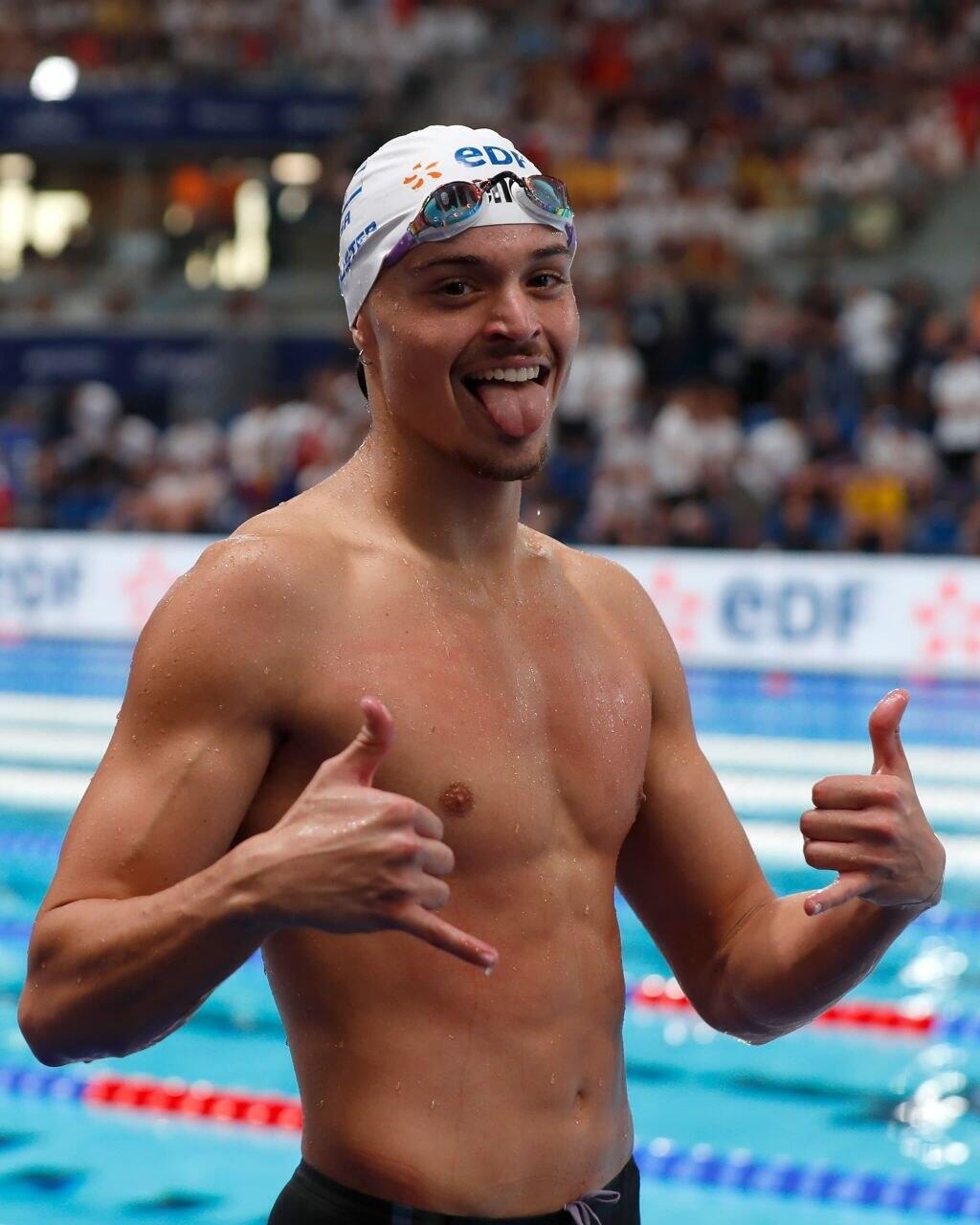
'At first I smile, but the camera doesn't go away, so you change your expression and I do something funny'
(Photo: Simone Castrovillari)
"I'm a happy person, I'm joyful," he says, explaining his poses for the cameras. "At first I smile, but the camera doesn't go away, so you change your expression and I do something funny." In a special interview from Paris, moments before returning to Israel, he talks about the championships that went his way, the competition that brought him back from the brink of retirement and how Oct. 7 affected his career.
'I've given everything my whole life'
Shuster, 22, is enjoying a late breakout. As a young swimmer from the moshav of Talmei Yaffe in the Gaza border region, he never made any of Israel's cadet or youth national teams. Now he is getting used to suddenly becoming a household name among sports fans in Israel, with times of 24.36 seconds in the 50-meter backstroke and 53.39 seconds in the 100.
"I always strive to reach the highest level, and where do you do that? On the international stage," Shuster says. "That's where the level is highest, that's where you show what you can do. At one of the practices I asked national team coach Leonid Kaufman what separates 16th place from a final. He said it's executing a complex task. I thought of it as a challenge, not a difficulty. My work in training was right. In the water I felt exhausted, my body hurt after every weightlifting session. Nobody really understands that. I've given everything my whole life, including in the record-breaking performances."
Everything pales in comparison to the moment when you raise your head and see that you've broken a national record. And then another one. "National teams director Yaakov Tomarkin had been waiting for someone to break his record in the 100 (Adam Maraana had previously equaled it, S.I.), and when it happened he gave me a hug and a high-five. The picture of the whole team cheering me on in the 50-meter backstroke semifinal will stay with me. It warmed my heart."
How do you sum up your performance at the championships?
"Somewhere between satisfaction, happiness and fun. I don't know if I surprised myself. I don't like talking about times before a race. It distracts you and takes you out of focus. I think about finals and swimming fast. I knew that to reach the final I had to be faster than the Israeli record, right? The level is crazy. It gives you drive. Suddenly you're not watching from the sidelines — you know you're there too."
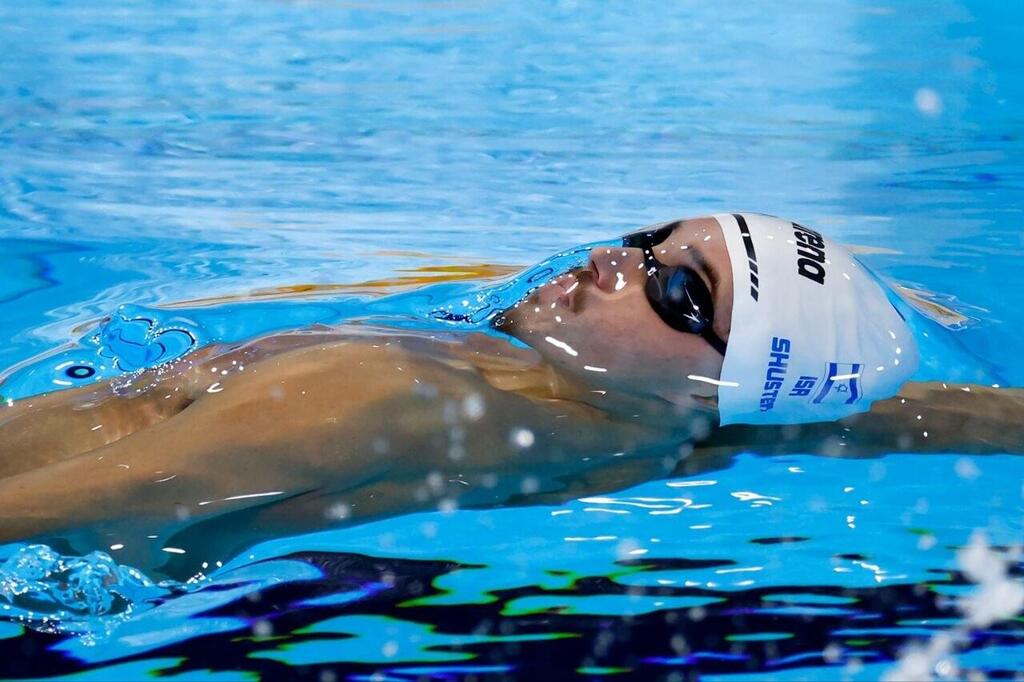
'I always strive to reach the highest level, and where do you do that?' Tomer Shuster
(Photo: Simone Castrovillari)
The last chance
Three years ago at this time, Shuster was still training with the Negev Swimmers club under coach Amir "Fish" Cohen in the Sdot Negev Regional Council, near the entrance to Sderot, no more than 20 minutes from Talmei Yafeh. He didn't stand out, but decided to keep training even though he had already mentally prepared himself for that chapter of his life to end.
"I was already in the mindset that this was it," he recalls. "I came to a competition at the Wingate Institute knowing it was my final race. I came to enjoy myself. I was happy, I sang. I jumped into the water and touched the wall after 57.16 seconds in the 100-meter backstroke. That's a time worth international points and it earned me outstanding athlete status in the military."
You didn't think that would happen?
"First of all, I grabbed my head. I didn't know I could get times like that, especially when I came in such a relaxed mood. My military service was supposed to be ordinary, something at a base. I was assigned to the Air Force's technical corps. I thought it over: Should I focus on swimming or continue on the regular path? Luckily, my enlistment was late and I had time to think. I said, 'Maybe something will come of swimming.' Well, something big came of it, lots of good things."
Before that, what led you to consider retirement?
"Until that point I felt I was at the end of my career because I wasn't at the top and my times weren't amazing. All my friends around me were doing meaningful military service, and at home they talked to me about combat service. It was a dilemma for an 18-year-old kid who knew nothing except swimming. I believe in God, I believe He guided me toward this from the moment I was born."
Swim despite everything
"On Oct. 7, the terrorists didn't reach us, thank God. We're far from the border," Shuster says. "We weren't evacuated, but the Sdot Negev area was hit hard. Coach Fish lives in Kibbutz Mefalsim, which terrorists did enter. I know people from Nahal Oz, Be'eri and Kfar Aza. There was a lot of shock and uncertainty at first."
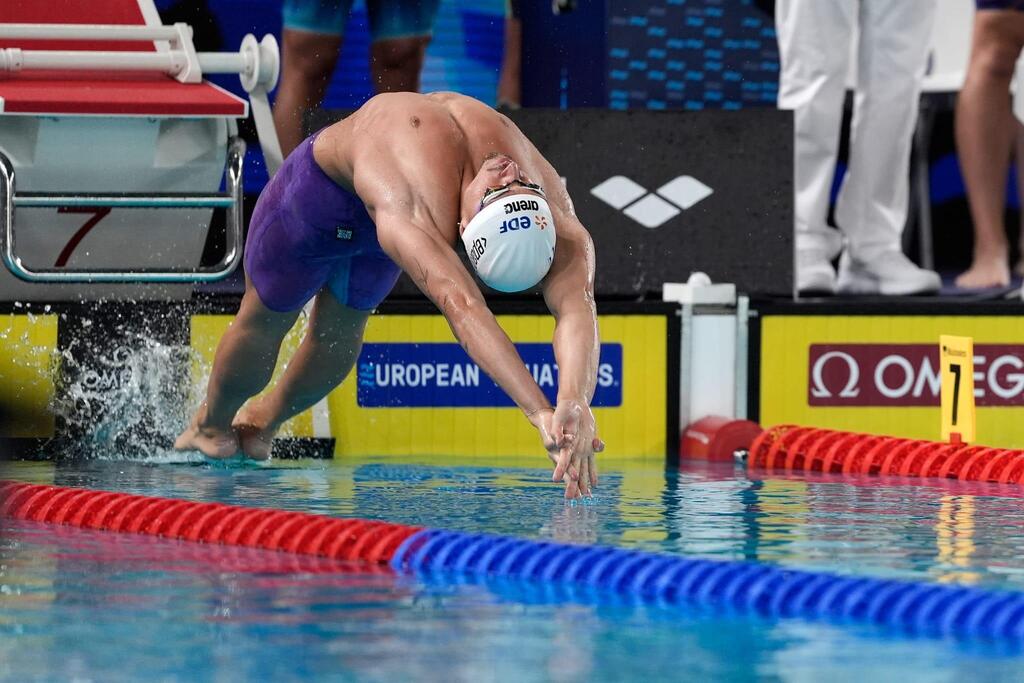
'I said, 'Maybe something will come of swimming.' Well, something big came of it, lots of good things.'
(Photo: Simone Castrovillari)
How do you even get back to swimming?
"My father, Alon, didn't like seeing everything come to a standstill. He looked for a good club for me in the area. Maccabi Rishon LeZion was the closest, an hour away, and he spoke there with Yael Ashkenazi, my coach, and told her everything was shut down. They welcomed me with open arms. The first week of training made me understand what swim training was really about, and it was different: the drills, the level. I was very excited and decided to stay there even when the south began to return to normal. We found an apartment close to the pool so swimming could become the purpose of my life. That move did wonders for me. It developed me as a person. I moved out on my own and became independent. Later that year I met the qualifying standard for the 2024 European Championships, and I really enjoyed it there. I remember the excitement of the first time."
Did you try to go to college?
"I started talking to a college in Kentucky last year and it didn't work out. I wanted the experience of living abroad, but less so the studying. I see the guys coming back here now with assignments, homework and pressure. Everything is scheduled. The feeling that I was missing out has passed. I'm responsible for my own choices, and I'm different anyway. I don't like frameworks or following the regular path. Even leaving home at 19 and working as a lifeguard at the same time to pay for everything was an experience. Now Speedo supports me with equipment."
Next year's World Championships in Budapest will be Shuster's second, and this time his preparation is expected to be more optimal. Did we mention he's not exactly conventional? Last May, he decided to jump off a cliff at Palmachim Beach.
"There was a huge rock and I landed on it," he recalls. "All my toes bent backward. I came out bleeding, on one leg. At the hospital they discovered a fracture in a metatarsal bone and dislocations in three toes. I wasn't supposed to put weight on the foot for three months. I told the doctor, 'In three months I'm supposed to be on the starting block in Singapore.' I worked very purposefully. I swam using only my arms. I kept looking at the glass as half full and didn't give up."
This time, take care of yourself, because in Budapest you can already qualify for the 2028 Los Angeles Olympics.
"I'm aiming for that, but there's still time. Let's not talk about it. Don't tempt fate."