

One of the well-known rules for a professional marathoner is the need to rest for several months between races, for an obvious reason: the immense physical strain, greater than in almost any other sport. There are rare cases, like Israeli runner Maru Teferi’s two marathons a month apart in the 2022 World and European Championships (he wanted to compete in Munich to mark 50 years since the Munich Olympics massacre), but such examples fall far outside normal standards.
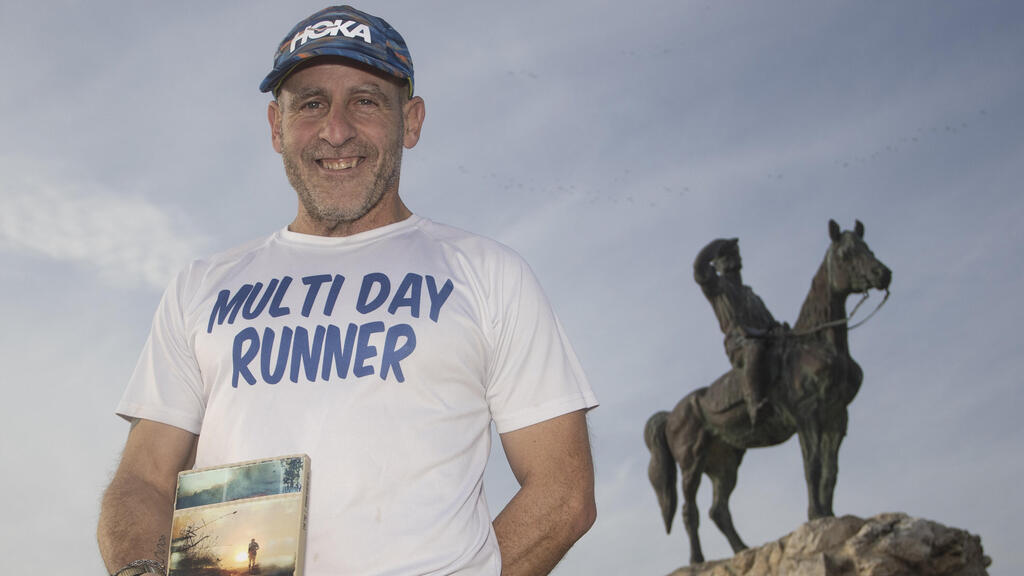
Kobi Oren is anything but standard. The 53-year-old clinical psychologist from Kiryat Tivon respects the “short” marathons of a little over 42 kilometers (26.2 miles), but as an ultra-marathoner, he considers them only the opening course. In a multi-day race recently held at Lake Garda in Italy, Oren ran 5,500 kilometers (3,417 miles) — roughly the distance from Tel Aviv to Bangladesh. It is so extreme that it barely qualifies as a fantasy, yet Oren’s legs carry him any distance. This is the longest run in the ultra-marathon world, and Oren says he wanted to test the boundaries of human capacity. It amounted to two and a half marathons (65.6 miles) a day for nearly two straight months.

It took him 1,297:24:08 hours. After decades of covering sports, I have never typed a number like that. It represents 54 full days of running, about 20 hours each day — all to prove that results once seen as impossible can, in fact, be achieved. And when I ask Oren for clarification about the dizzying string of digits, he responds, “What don’t you understand?”
Running in circles
Oren describes the Italian race, aptly named “What Is the Limit”: “The organizer wanted a place where significant records could be broken. He created an event where you could run 5,500 kilometers (3,417 miles), like completing 10 Ironman competitions back to back.” Oren was one of five runners who took on the challenge and arrived at the course — but the only one who completed it. No one else in history has achieved this in an official race, and it is safe to assume that, even unofficially, no one has run about 102 kilometers (63.4 miles) a day for 54 consecutive days. “It’s unbelievable I accomplished this — hard to grasp,” he says.
How did you reach distances on this scale?
“In the beginning, I ran 5-kilometer races, and later marathons during my army service. Running has been part of my life since high school. It allowed me to grow as a combat soldier and as an active person. At the same time, it offered mental space for thought and release, which helped me develop in areas like family and work. In the early years I was constantly injured, so I switched to trail running and started going beyond the marathon distance. Since then I’ve grown and developed while running, and thanks to hard training outdoors I’m injury-free today.”
There’s a difference between a ‘normal’ long run and nearly two months without a break. Was there a moment in life when you realized you could do this?
“My breakthrough came in a race at the Athens airport. I injured my foot from running in the wrong shoe, but when I switched to a Hoka shoe, I moved into the lead and won — 768 kilometers in six days. It was the first time an Israeli won an international multi-day race, and afterward, Hoka sponsored me. Those shoes have carried me through the 42,000 kilometers I’ve run in my life.”
(Photo: Gil Nehushtan)
To endure such an unreasonable physical load, the runner disconnects from the world. He covers the equivalent of two and a half marathons a day in a circular course, spending about 20 hours running every 24-hour period, supported by a professional crew helping him survive the task. In the remaining four “lost” hours, he tries to rest in a tent on-site, and Oren admits he does not always sleep well before the next day. Of course, there are no cheering crowds on the course; it is just him and the open space, in endless loops. As far as is known, only one other Israeli regularly competes in these events abroad — Galit Birenboim-Navon, 48, Israel’s champion and a world silver medalist in ultra-marathon. Not surprisingly, Oren is her coach.
Don’t you go crazy during such a long period of running?
“One of the biggest dangers in a race like this is slipping into a bad mood. The task is always hard, and to get through it, you must stay optimistic. Your thoughts are always running. When you feel difficulty, you talk to yourself and try to break the goal into parts. The most important condition is to run with a quiet mind; otherwise, it’s very hard to complete the mission.”
His son came to cook
Records are eventually broken. Now that Oren has shattered the mental barrier of 5,500 kilometers (3,417 miles) for the ultra-running world, it is likely that runners across the globe are already thinking about how to push the boundary further — the next human, or superhuman, challenge. For now, Oren leads the way.

(Photo: Gil Nehushtan)
But for those wondering, Oren himself probably won’t be the one to take it farther. “I’m 53 now, and I assume I won’t be able to run like this at 70,” he says. “So I focus on the here and now. It’s total disconnection — from work, from my wife, from my kids. You switch your whole way of living and devote yourself entirely to it.”
And about the kids — in his last race, Oren’s son Ilay, 25, came to visit. The son, a student of accounting, helped with cooking and saved his father time. “I invited him, and I was very happy he came. He fit into the team quickly and made food that I was missing. The logistics in such a long race are one of the decisive factors in whether you succeed.”
I imagine many readers reach this point and ask themselves: what do you get out of it?
“What I get is an encounter with myself as I face hardship, and I see how I deal with it. And beyond that, a sense of being the first. I’m the one who broke a boundary of human ability.”