

Israelis are exposed to foreign influence campaigns in the digital sphere, especially on social media, without an adequate government response, creating a threat that could have devastating consequences for society during crises, war and elections, State Comptroller Matanyahu Englman warned Tuesday in a special report.
The report found that the government’s response does not match the severity of the threat or the risks it poses, and that major flaws in Israel’s handling of the issue have gone unaddressed for years. According to the comptroller, Israel has no official guiding framework, no organized national policy and no government body leading the interagency response to foreign influence campaigns. Efforts launched over the years to create such coordination were abandoned.
The report says key posts went unfilled and core issues were neglected. The position of head of foreign influence at the Intelligence Ministry remained vacant for months, while a 2023 security assessment that included major policy recommendations on the issue was never discussed by the Cabinet. In August 2024, the head of the Israel National Cyber Directorate submitted a proposed national interministerial action plan to the prime minister, but the plan was not reviewed by the prime minister or anyone on his behalf. Only after the comptroller’s office intervened was it transferred in July 2025 to the National Security Council for examination.
At one stage, after the Cyber Directorate entered the field, the National Security Council decided not to advance its handling of the issue. But in August 2025, the head of the Cyber Directorate decided to focus its foreign influence efforts only on cases stemming from cyberattacks leveraged for influence gains. As a result, the comptroller found, both bodies effectively stopped dealing with the broader threat.
Foreign influence is defined in the report as a set of covert actions by a foreign actor intended to harm a state’s interests, potentially even its sovereignty. Countries and organizations around the world have identified it as a strategic risk. The main arena for such activity is social media, where local and foreign actors exploit social rifts in Israel, including to undermine public trust in democratic institutions.
Englman found that as of March 2026, Israel still lacked even a clear situational picture of foreign influence efforts in its digital space. Most preparations to counter the threat take place only near elections, while Education Ministry lesson plans on disinformation and the blurring of boundaries between truth and fiction are offered only as optional content. No government body is responsible for public information or raising awareness of the threat. In practice, the report says, no authority is currently responsible for foreign influence in the digital sphere, including public awareness.
The comptroller said the National Security Council, in line with its legal role, should present the prime minister with a framework for activity against foreign influence that can serve as the basis for a government decision. The NSC’s position, included in the report, is that a government decision is needed to establish a dedicated headquarters body to counter the threat, coordinate policy and synchronize the work of all relevant ministries and agencies.
The report also says the Shin Bet should continue efforts to improve detection of foreign influence attempts online. The Education Ministry, meanwhile, should define content on disinformation and critical thinking in the digital space as mandatory material in all streams of the education system from an early age.
Englman also warned the Central Elections Committee that elections are a particularly sensitive period in which the potential damage from foreign influence attempts online increases significantly. He called on the committee to formulate ways to respond to different scenarios and examine whether it can create a channel for receiving reports on suspected incidents, so that information can be transferred to the relevant authorities and allow for a rapid response when needed.
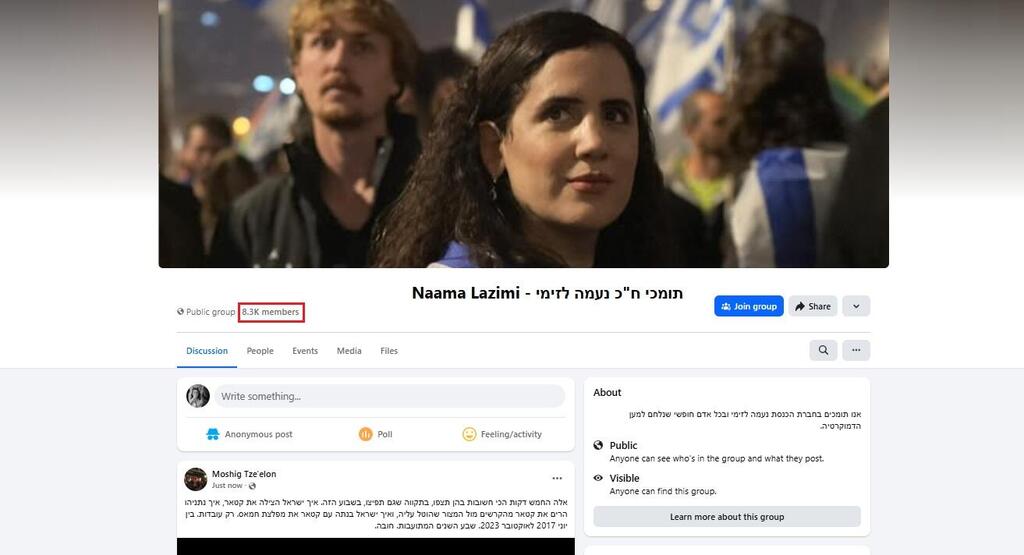
Support page for MK Naama Lazimi identified as an Iranian influence operation
The report says threats to election integrity through the exploitation of the internet, including foreign influence attempts, led the Justice Ministry in 2019 to draft guiding principles for handling such phenomena, as well as ways to respond to scenarios such as bot activity or fake accounts linked to a foreign state. Six years later, despite technological developments including the rise of artificial intelligence tools, those principles had not been updated.
“Hostile actors, including Iran, are exploiting social media covertly and systematically to deepen divisions, sow panic and engineer the Israeli public’s perception of reality,” Englman said. “We found that Israel’s national preparedness is materially deficient: nine years after the threat was first identified in the country, there is still no national policy and no government body leading the response.”
He added that international organizations and other countries have already identified foreign influence online as a strategic risk, and that the World Economic Forum ranked disinformation and false information at the top of its list of short-term risks.
“The threat becomes sharper ahead of the 2026 election,” Englman said. “An election campaign is a particularly sensitive period and fertile ground for malicious activity by foreign actors, to the point of concern over influencing election results and undermining public trust in them. Without immediate and organized government preparedness, attempts to intervene in domestic discourse could even harm state sovereignty and undermine public trust in the democratic process.”
FakeReporter, a research organization specializing in monitoring and countering foreign influence networks, said after the report’s publication that it confirmed warnings the group has raised for years. “Foreign influence networks are a national-strategic threat that endangers all Israeli citizens,” the organization said, adding that its research shows a steady and significant increase in foreign network activity in Israel in recent years.
According to FakeReporter, foreign influence networks from Iran, Russia, the Arab world and elsewhere operate in Israel with a range of goals: spreading demoralizing messages, injecting despair, fear and hatred, stirring chaos, dividing Israeli society, deepening social rifts and even recruiting agents and collaborators.
“Despite the clear and immediate danger, Israel’s residents are abandoned twice, both by the state, which does not operate a mechanism or official body to which civil society organizations and the public can report suspicions of foreign influence attempts, and by the social networks, which do not operate an organized mechanism to address the dangerous phenomenon taking place on their platforms,” the organization said. “After years in which no organized policy was formulated, the government must act without delay.”
(Photo: Getty Images)
Idan Ring, vice president for community and society at the Israel Internet Association, said the report reflects data showing that Israel’s information environment and internet users are especially exposed and vulnerable to foreign influence and interference attempts by malicious actors online.
He attributed that vulnerability to high social media use, low information literacy, insufficient preparedness by authorities and the absence of legislation and regulation to address such threats.
“Especially in light of the ongoing security situation and the approaching election, there is an urgent need to advance state preparedness and response, both in monitoring, reporting and removal, and in public education, awareness and the ability to identify suspicious activity online,” Ring said. “Israel, precisely because of its heavy internet use and many external and internal threats, lags behind Western countries in the tools it gives its citizens to defend themselves online.”
Ring said the situation urgently needs correction, adding that Israeli civil society has gained extensive experience in dealing with online interference and influence attempts that the state can learn from and implement.