

While tech giants such as Google, OpenAI and Anthropic are investing hundreds of billions of dollars in the artificial intelligence race, a particularly unexpected player has entered the arena: Felix Kjellberg, better known as PewDiePie.
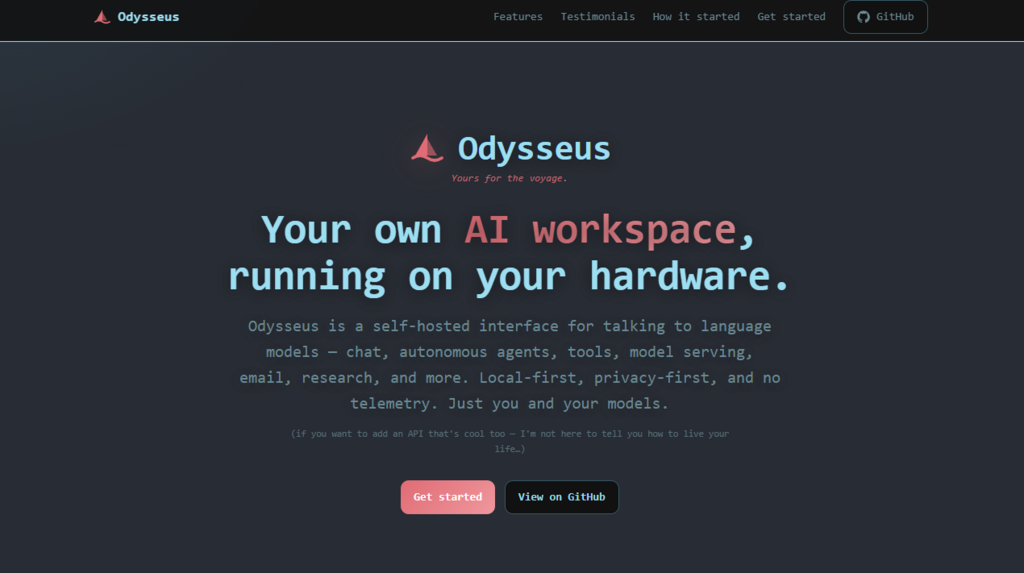
The Swedish YouTuber, who for years was the world’s most-subscribed content creator, has unveiled a new AI project called Odysseus, which aims to offer a private, local alternative to services such as ChatGPT and Claude.
Unlike most popular AI services today, which rely on remote servers operated by major technology companies, Odysseus is designed to run primarily on the user’s own computer. The concept is simple: Instead of sending every question, document or piece of personal information to the cloud for processing in distant data centers, the system runs AI models locally and keeps data on the user’s device.
“The more you share about yourself with AI, the better it becomes,” Kjellberg said in a video announcing the project. “The more it understands you, your preferences, your past experiences, your workflow, your work, your documents, your computer. The more you give it access, the better it works. The more you do that, the more you’re handing over a huge piece of yourself to these giant tech companies.”
According to Kjellberg, the system protects user privacy, does not track users, includes no paid subscriptions and has no business model based on collecting data. Users can still connect external services such as ChatGPT, Claude and other commercial models through APIs if they choose.
An AI agent that performs tasks on its own
Reflecting one of the hottest trends in artificial intelligence, Odysseus also includes an autonomous AI agent capable of carrying out tasks independently. The agent, based on the open-source OpenCode project, can handle basic office tasks, search files on a computer, analyze documents and even operate software tools.
In one demonstration, Kjellberg asked the system to transcribe an audio file. The agent independently located the file, processed it through the WhisperTranscribe transcription engine and returned the results without further intervention.
Alongside the agent, the system includes an advanced research capability similar to Deep Research, allowing it to gather information from multiple sources, process it and present the results visually. The feature has become one of the most sought-after capabilities in advanced AI tools over the past year.
A 'copy-and-paste' of popular tools
Notably, Kjellberg has not hidden the fact that the platform is essentially built by combining existing open-source projects. He even joked in the launch video that some of its features were “stolen.”
Among them is a search engine powered by SearXNG, a search platform that aggregates results from hundreds of search engines and databases. The system also includes a document editor that closely resembles Claude, a notes and journaling app that Kjellberg described as a “copy-pasted Google Keep,” and an image-editing tool reminiscent of Photoshop.
The platform also includes several AI characters that users can interact with in private or group conversations. The feature builds on an earlier project by Kjellberg called the “AI Council,” in which he created a collection of artificial personalities designed to help him make decisions.
Not for every computer
Despite the ambitious vision, the project faces significant questions. One of the main concerns is its demanding hardware requirements.

Felix Kjellberg AKA PewDiePie
(Photo: GettyImages)
Kjellberg himself runs the system on a high-end computer equipped with eight graphics cards, hardware estimated to cost about $20,000.
For most users, many of whom run AI models on far more modest machines, the experience could be very different.
Early reactions online have been mixed. Some users report strong performance when using commercial AI models through APIs, while others say running local models depends heavily on a computer’s specific hardware configuration. One Reddit user even reported that attempting to install a DeepSeek model through the system caused their computer to crash.
Another open-source dream or the next big thing?
Odysseus joins a growing wave of projects seeking to return control of artificial intelligence to users. In recent years, criticism has mounted over the fact that virtually every interaction with commercial AI services passes through servers owned by large corporations that hold unprecedented amounts of sensitive personal information.
At the same time, the open-source AI world has already seen numerous ambitious projects promising privacy and complete control over user data. One prominent example is OpenClaw, a platform that attracted significant attention within the AI community for its ability to run intelligent agents locally.
Despite the initial enthusiasm, many users found that setting up and maintaining such systems required substantial technical expertise and, in some cases, expensive hardware. Odysseus aims to address those challenges with a simpler interface and a more accessible installation process.
The key question is whether the platform can evolve into a practical tool for a broad user base, or whether it will become another intriguing experiment that enjoys a few weeks of attention before fading into the constant noise of the AI industry.