

Anthropic released Claude Fable 5 for the public while keeping Claude Mythos 5, described as “too dangerous for the public,” limited to selected security and critical infrastructure partners.
The launch marks a significant milestone in the race toward autonomous AI systems. Rather than simply answering questions or generating content on demand, the new models are designed to carry out complex tasks over extended periods with limited human involvement.
At the center of the announcement is Claude Fable 5, a model built on the same foundation as Claude Mythos 5, a restricted version available only to selected cybersecurity firms and critical infrastructure providers working with the U.S. government.
According to Anthropic, the new system delivers major gains across software engineering, scientific research and advanced visual reasoning. Early users report dramatic improvements in productivity, particularly on long-running projects that require memory, planning and the ability to correct mistakes over time.
One example came from fintech giant Stripe, which said the model completed a migration involving roughly 50 million lines of code in a single day, a task that would normally require months of work by a team of engineers.
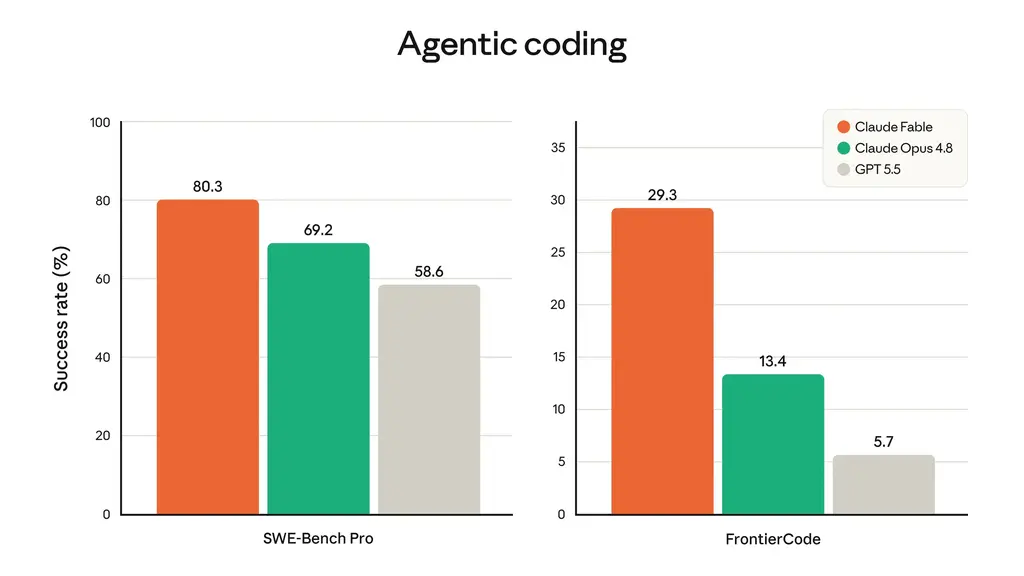
Anthropic is pricing the model at $10 per million input tokens and $50 per million output tokens, a move likely to intensify competition with OpenAI and its flagship GPT-5.5 model.
The release is already drawing attention well beyond Silicon Valley. Researchers and technology companies in China and Europe are closely watching performance data that suggests Fable 5 may have a significant advantage in long-duration tasks where current AI systems often struggle to remain consistent.
(Graphic: Anthropic)
The model also introduces more advanced multimodal capabilities. Anthropic says it can rebuild the source code of a web application from screenshots alone and complete complex video games using only visual input, without relying on the external navigation tools required by previous generations.
Alongside the public release, Anthropic revealed new details about Claude Mythos 5, the unrestricted version that remains unavailable to ordinary users.
The company says Mythos 5 recently completed an autonomous genomics research project that lasted more than a week, during which it built and trained a machine-learning system that outperformed several recently published academic models while using only a fraction of the computing resources.
Those capabilities are precisely why Anthropic chose not to release the model publicly.
Instead, the company built aggressive safety controls into Claude Fable 5 to prevent misuse in areas such as offensive cyber operations and biological research. When the system detects potentially dangerous requests, it automatically transfers the conversation to the older and more limited Claude Opus 4.8 model.
Anthropic says those safeguards are activated in fewer than 5% of interactions. Still, some professional users have already criticized the restrictions, arguing that legitimate requests can be blocked.
The debate highlights a growing challenge facing the AI industry as models become increasingly capable. Companies are racing to push the boundaries of what artificial intelligence can do, while governments and researchers warn that the same advances could create new security risks if released without limits.
With the launch of Fable 5 and Mythos 5, Anthropic has made clear where it stands: build more powerful AI systems, but keep the most capable versions behind locked doors.