

Apple is continuing the rapid upgrade cycle for its chip lineup, this time turning to the Mac mini. The company unveiled a new generation of its compact desktop computer, available with the new M6 chip or, for users who need more power, the M5 Pro. But alongside a significant performance boost, particularly in artificial intelligence, Apple is also raising the price.
The biggest change is under the hood. The new M6 chip features a 12-core CPU and 12-core GPU, compared with 10 cores in each on the M5. Memory bandwidth has also increased, reaching up to 170GB/s.

The focus: Artificial intelligence
A large share of the M6 upgrades is devoted to AI. For the first time, the chip includes a dual 16-core Neural Engine, which Apple says delivers performance up to twice as fast as the previous generation. Apple has also added Neural Accelerators to every GPU core in the Mac mini for the first time, both in M6 models and those powered by the M5 Pro.
According to Apple, the result is a significantly faster computer. The M6 model delivers CPU performance up to 40% faster, graphics performance up to twice as fast and storage speeds up to twice as fast as the M4 model. In AI workloads, Apple claims an even bigger leap, with performance up to four times faster.
Those figures should be treated with caution until independent benchmarks are available, as Apple bases them on comparisons involving specific configurations and workloads. The company also claims that the M6 offers the world’s fastest single-core CPU performance, continuing to emphasize the performance-per-watt advantage of its Apple Silicon chips.
The powerful M5 Pro chip
(Photo: Apple)
The age of AI agents arrives
Apple’s emphasis on AI is no accident. The company is positioning the new Mac mini not simply as a compact desktop computer, but as a machine capable of running AI models and AI agents locally and continuously.
In practice, that means Apple is preparing its hardware for a world in which more AI tasks can be performed directly on the computer rather than relying exclusively on cloud servers. That is particularly relevant for running local language models and AI agents that operate in the background for extended periods.
For users who need more power, Apple is also offering the Mac mini with the M5 Pro chip, featuring up to an 18-core CPU and 20-core GPU. It also includes a dual 16-core Neural Engine and the same Neural Accelerators built into the GPU cores, with memory bandwidth of 307GB/s.
Memory and storage options also differ between the two models. M6 versions come with 16GB of unified memory as standard and can be configured with up to 32GB, along with up to 2TB of storage. M5 Pro versions support up to 64GB of memory and 8TB of storage.
Almost nothing has changed on the outside
Anyone hoping for a new design will have to keep waiting. The Mac mini looks almost identical to the previous generation and remains available only in silver.
The port layout is also unchanged: two USB-C ports and a headphone jack on the front, and three Thunderbolt ports, HDMI and Ethernet on the back. M6 models come with Thunderbolt 4, while M5 Pro versions feature Thunderbolt 5.
The wired network connection has been upgraded and now offers 2.5-gigabit Ethernet as standard, up from 1 gigabit on the previous generation, with an option to upgrade to 10 gigabits. Wireless connectivity has also been improved, with Wi-Fi 7 and Bluetooth 6 replacing Wi-Fi 6E and Bluetooth 5.3 on the 2024 models. All configurations continue to support up to three external displays.
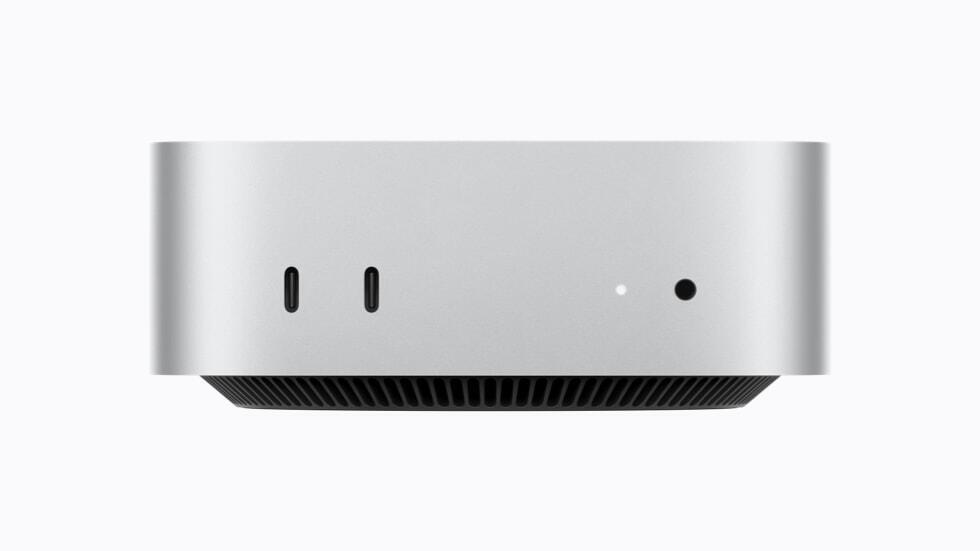
(Photo: Apple)
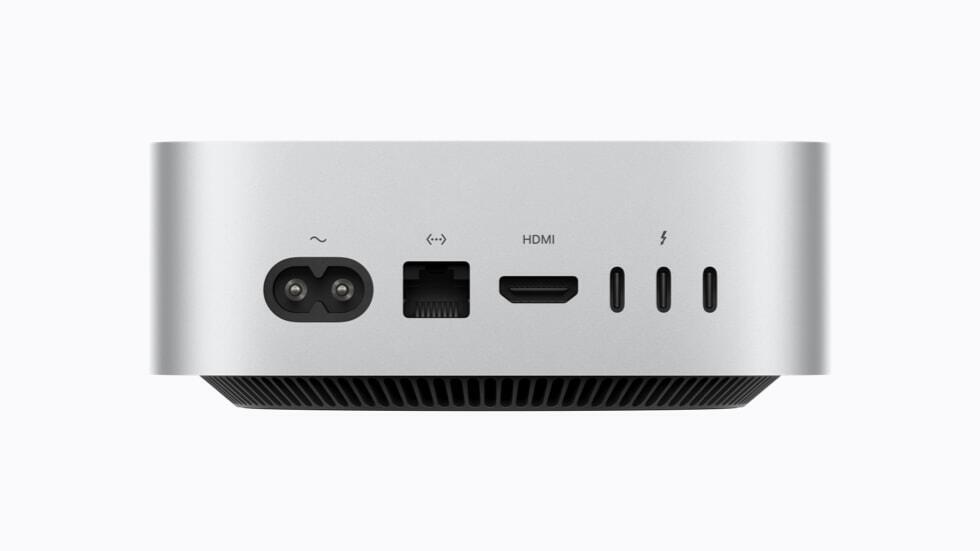
(Photo: Apple)
More powerful, but also more expensive
For years, the Mac mini was one of the relatively affordable ways to enter the Mac ecosystem, but that entry price is rising. In the U.S., the new M6 model starts at $899, while the M5 Pro version starts at $1,699.
The base model comes with 16GB of unified memory and 256GB of SSD storage. By comparison, the Mac mini with the M4 chip launched at $599 for a configuration with 16GB of memory and 256GB of storage. Its price later rose to $799 as part of a broader round of Apple price increases, and the equivalent M6 model now starts at $899.
That means the Mac mini’s starting price is now $300 higher than the launch price of the previous generation. Buyers get a new chip, stronger performance and a significant upgrade in AI capabilities, but the compact computer that served for years as one of the most accessible entry points into Apple’s ecosystem has become considerably less affordable.
Mac Studio also gets an upgrade
Alongside the new Mac mini, Apple unveiled a new generation of the Mac Studio, the desktop computer aimed at professional users who need substantially more computing power. The new model will be available with the M5 Max and the new M5 Ultra, which Apple describes as the most powerful Mac it has ever made.
The M5 Ultra version features up to a 36-core CPU and 80-core GPU, with a Neural Accelerator built into every GPU core for AI workloads. The chip also includes a 32-core Neural Engine and memory bandwidth of 1.2TB/s, 50% higher than the previous generation.
One of the most striking specifications is the amount of memory. A Mac Studio with the M5 Ultra can be configured with up to 512GB of unified memory, which Apple says allows it to run exceptionally large language models directly on the computer. The company is targeting AI developers, researchers, data scientists and creative professionals working with demanding models and workloads.
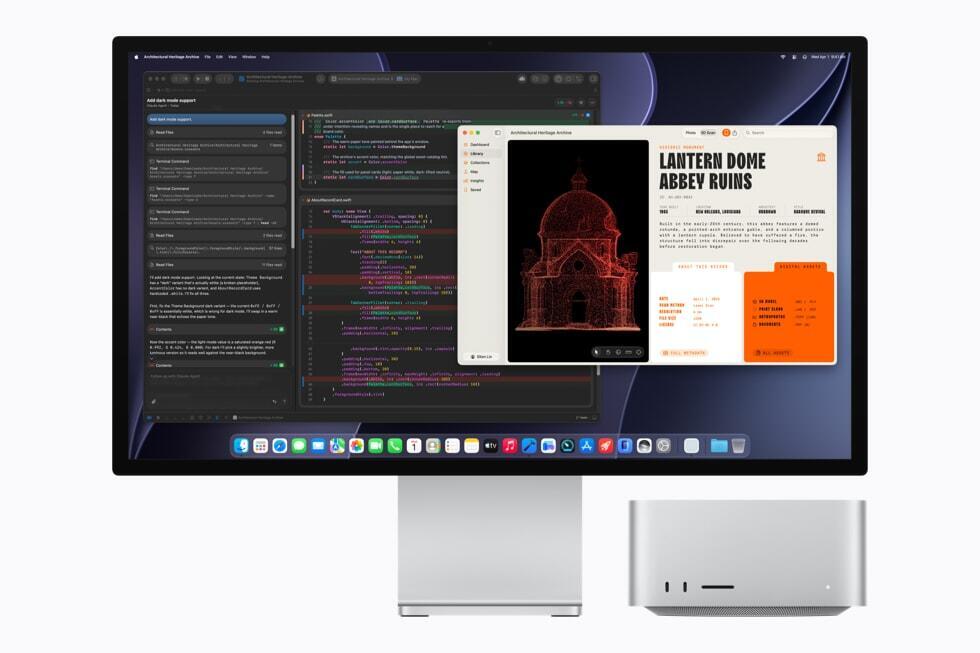
The new Mac Studio
(Photo: Apple)
Apple says the M5 Ultra delivers up to 4.3 times the peak AI computing performance of the M3 Ultra and up to 9.8 times that of the M1 Ultra. The company also claims graphics performance up to 1.8 times faster and CPU performance up to 1.3 times faster than the M3 Ultra.
For users who do not need that level of power, the Mac Studio is also available with the M5 Max, featuring an 18-core CPU, up to a 40-core GPU and up to 128GB of unified memory. Neural Accelerators are also integrated into every GPU core.
On the outside, the Mac Studio retains its familiar compact design, with several smaller upgrades. It now includes Wi-Fi 7 and Bluetooth 6 for the first time, along with Thunderbolt 5. Apple also allows multiple Mac Studio computers to be linked through Thunderbolt 5 and RDMA, which it says can provide performance up to three times faster for distributed AI workloads than a single machine.
In terms of pricing, the new Mac Studio remains aimed primarily at users willing to pay a substantial premium for performance. In the U.S., the base M5 Max version starts at $2,499, while the M5 Ultra version starts at $5,499.