
In 2013, the world’s first lab-grown hamburger was served in London. Made from cattle cells, it cost around €250,000 at the time and was more a proof of concept than a lunch. The idea seemed almost like science fiction: producing real meat without raising and slaughtering an entire animal. A little more than a decade later, one of the companies at the forefront of efforts to turn that idea into a commercial product is Israel’s Aleph Farms, which is attempting something particularly complex: not a burger or a nugget, but a cut of beef resembling a steak.
The Israeli story began at the Technion – Israel Institute of Technology. Prof. Shulamit Levenberg of the Faculty of Biomedical Engineering had spent years working in tissue engineering: studying how to make cells grow and organize themselves into three-dimensional tissue, for example to repair muscle or create blood vessels. In 2016, she began conducting experiments growing cattle cells on a plant-based protein scaffold. A year later, The Kitchen, the food-tech incubator of the Strauss Group, entrepreneur Didier Toubia and Dr. Neta Lavon joined the research. From that meeting of tissue engineering and food technology, Aleph Farms was born. Levenberg is a co-founder and the company’s chief scientific adviser, while Toubia serves as CEO.

The principle sounds simpler than it is in practice. The process begins with a small number of cells originating from cattle, which are grown in a controlled environment that provides the nutrients and conditions they need to multiply and differentiate into muscle cells and other types of tissue. But to create a cut of meat rather than simply a mass of cells, those cells also need a structure on which they can grow and organize themselves in a way that resembles natural tissue. This is where Levenberg’s expertise in tissue engineering comes into play.
The company’s first commercial product is not made entirely from cultivated cells. It combines muscle cells and collagen originating from cattle with plant-based ingredients to achieve the texture, flavor and structure of a cut of meat.
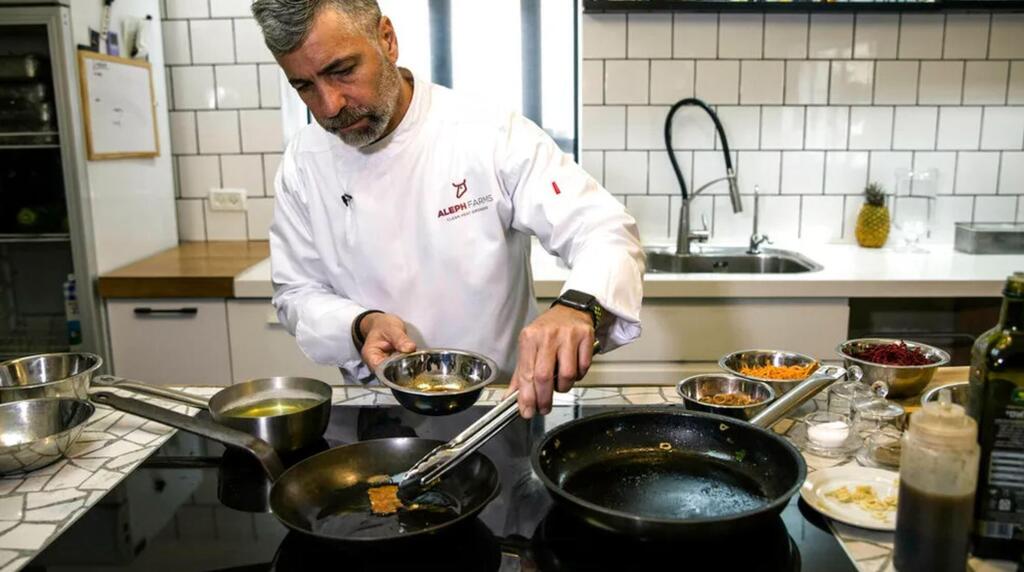
Chef Amir Ilan prepares a lab-grown steak during a presentation by the Israeli company Aleph Farms, in Jaffa, Israel
(Photo: AP, Tsafrir Abayov)
As early as 2018, Aleph Farms unveiled what it described as the world’s first cultivated beef steak. In 2021, together with the Technion, it also presented a prototype of a thicker cultivated ribeye steak produced using 3D bioprinting. In a 2022 interview with ynet, Toubia explained that the company was not trying to create an exact replica of an existing cut of meat.
“Just as a Tesla is not identical to a gasoline-powered car,” he said at the time, emphasizing that the goal was to create a product with characteristics of its own, aimed first and foremost at people who eat meat.
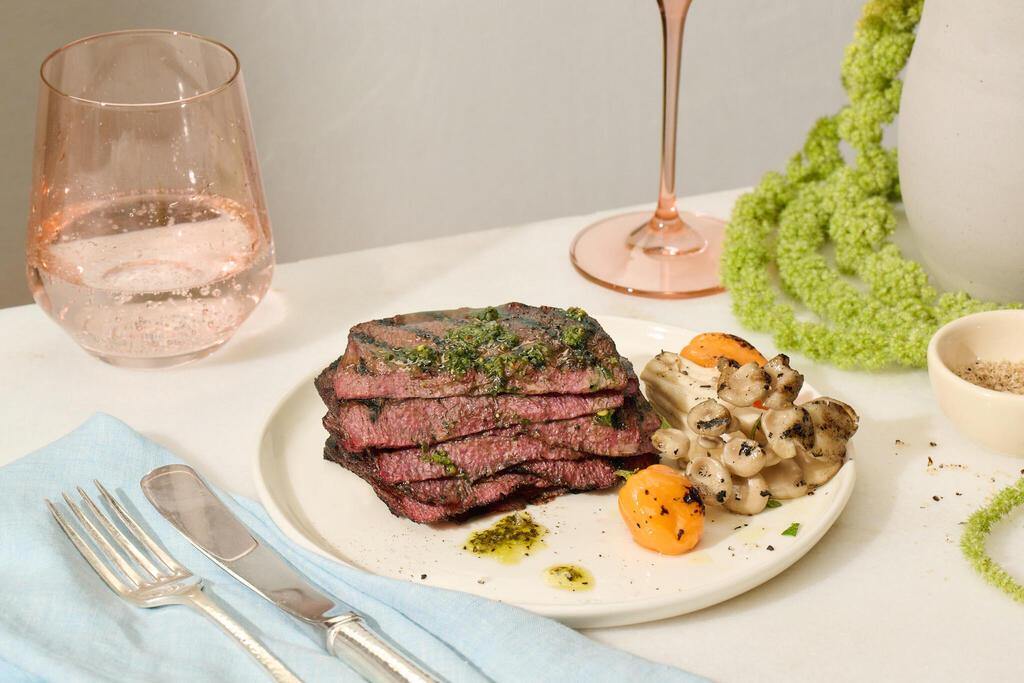
From lab experiment to steak
(Photo: Alpeh Farms)
The journey from scientific demonstration to the dinner plate has proven, as it has for much of the cultivated meat industry, far more difficult than early forecasts suggested. Cost, the ability to grow cells at large scale and the construction of manufacturing infrastructure have emerged as major challenges. In recent years, Aleph Farms has also had to significantly reduce its workforce and shift toward a model that relies on external manufacturing partners. Although it received a first-of-its-kind regulatory approval in Israel for cultivated beef at the end of 2023, its planned commercial launch was postponed, and the steak has yet to become a regular product on supermarket shelves.
But in August 2026, the company reached a new milestone: the Singapore Food Agency approved Aleph Farms’ cultivated steak for sale. It is the company’s second regulatory approval, following Israel, making Aleph Farms the only company currently approved to sell cultivated beef in two markets. The Singapore launch is planned for the first half of 2027, initially at selected restaurants, alongside preparations for a launch in Israel and regulatory processes in additional markets.
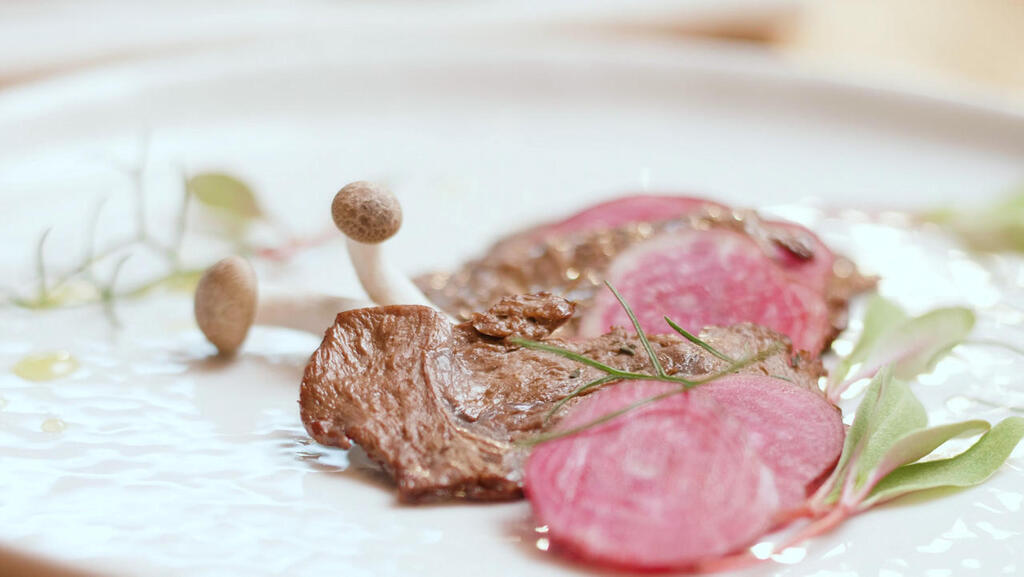
Israeli startup Aleph Farms wins Singapore approval to sell its cultivated beef
(Photo: Aleph farms)
The significance of Aleph Farms extends beyond its first product. If cultivated meat can eventually overcome the challenges of cost and large-scale production, it could make it possible to produce real beef with less dependence on grazing land, raising herds and slaughter. In countries that rely heavily on imported meat, it could also provide an additional layer of local food security.
The road ahead is still long. But an Israeli company born out of medical research at the Technion has already managed to take an idea that looked like a laboratory experiment just over a decade ago, turn it into a steak—and bring it remarkably close to the plate.