


Quantum computers promise to one day solve problems that conventional computers could struggle with for years. But there is a fundamental obstacle standing in the way: they make mistakes.
Qubits, the basic units of information in a quantum computer, are extremely sensitive to even tiny disturbances from their surroundings. As calculations become longer and more complex, errors accumulate and can eventually obscure the result.

Israeli company Qedma decided not to wait for the perfect quantum computer. Instead of changing the hardware, it developed a software layer designed to understand the noise, suppress it and extract more accurate results from the quantum computers that already exist.
The story began in 2020, almost by chance. Prof. Netanel Lindner of the Technion’s Faculty of Physics, whose research includes the physics of quantum computing, was having lunch with Dr. Asif Sinay, a physicist, graduate of Israel’s elite Talpiot program and holder of a master’s degree from the Technion.
The two were discussing one of the field’s biggest challenges when Lindner raised an idea: If every quantum computer has its own distinctive “fingerprint” of noise and errors, perhaps that fingerprint could be learned — and the computation adapted accordingly.
At the same time, Prof. Dorit Aharonov of the Hebrew University of Jerusalem, a pioneer in global quantum computing research who helped lay the theoretical foundations for fault-tolerant quantum computing in the 1990s, had shared a similar direction with Sinay.
Sinay brought the two researchers together. Their meetings became weekly, and the three founded Qedma. Sinay serves as CEO, Lindner as chief technology officer and Aharonov as chief scientist.
The company’s core solution is called QESEM, short for Quantum Error Suppression and Error Mitigation.
Before a quantum algorithm runs, the software learns the noise characteristics of the specific quantum computer on which the calculation will be performed. It then modifies the way the computation is executed to suppress some errors before they occur, and after the calculation it reduces the impact of errors that remain.
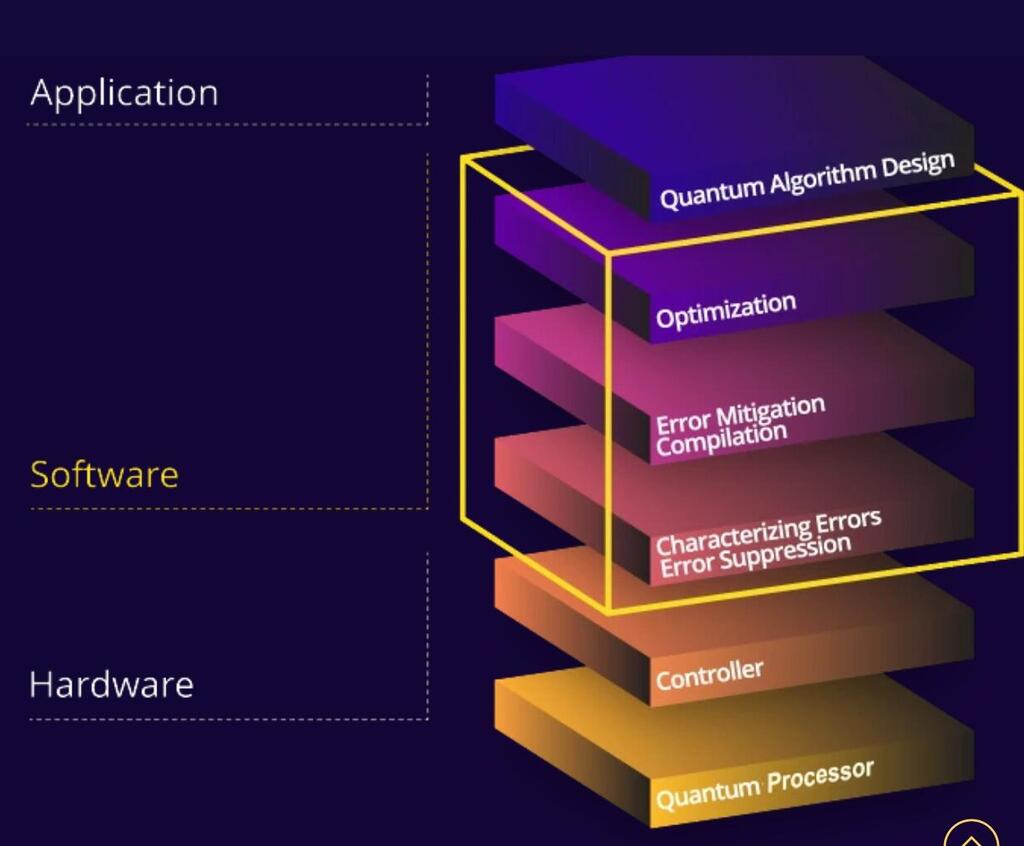
Qedma’s software stack uses error characterization, suppression and mitigation to improve the accuracy of quantum-computing applications
(Illustration: Qedma)
In other words, Qedma is not building a new quantum computer. It is trying to make an existing one operate more closely to the way it is supposed to work in theory.
According to the company, its approach can enable quantum computations up to 1,000 times larger than those that could be performed on the same hardware without its tools.
Qedma’s path into the heart of the quantum computing industry was remarkably fast.
In 2024, QESEM became one of the first tools integrated into IBM’s Qiskit Functions, allowing customers of the computing giant’s quantum platform to access the Israeli company’s technology directly through the cloud.
“When I founded the company four years ago, everyone told me, ‘Asif, you’re dreaming if you think they’re going to integrate with you,’” Sinay recalled at the time. “And now, finally, it’s happening.”
A year later, IBM joined as an investor in Qedma’s $26 million funding round, bringing the company’s total funding to more than $30 million. Qedma’s technology has since also been integrated into Quantinuum’s quantum computing platform.
But the most significant milestone came in July 2026.
Qedma and IBM announced that combining QESEM with a quantum computer powered by IBM’s Heron processor had successfully simulated the complex behavior of a physical system involving as many as 74 qubits.
As the system grew larger and more complex, several of the most advanced classical methods tested were no longer able to produce consistent and reliable answers.
IBM described the result as a demonstration of “quantum advantage” — a point at which a quantum computer can perform a computation that lies beyond the practical capabilities of leading classical methods. According to IBM, it marked the first time such an achievement had been demonstrated using commercially available hardware and software.
That does not mean quantum computers are about to replace home computers, nor does it mean that every problem can suddenly be solved faster.
The achievement relates to a specific scientific task, and the race between quantum and classical computing is far from over. But it marks an important point along the way: today’s noisy, imperfect quantum computers can already, with the right software layer, reach computational territory where even advanced classical tools begin to struggle.
For Qedma, it also represents a full-circle moment.
An Israeli company founded around the question of how to address one of quantum computing’s greatest weaknesses has, within just a few years, become a partner to one of the industry’s biggest players, with its technology already running on some of the world’s most advanced quantum platforms.
If quantum computing ultimately makes the transition from an experimental tool to a practical technology, one of the milestones along the way may not be another new qubit — but Israeli software that knows how to make the qubits we already have make fewer mistakes.