

The IDF acknowledged Wednesday that tens of millions of dollars were raised and transferred to Hamas’ military wing over the past year, more than two years after the war began.
The admission came in a statement announcing the killing of a Hamas operative from the terrorist group’s financial apparatus, who was killed in the same strike that eliminated Raad Saad, the second-in-command of Hamas in the Gaza Strip.
The assassination of Hamas second-in-command Raad Saad
(Video: IDF)


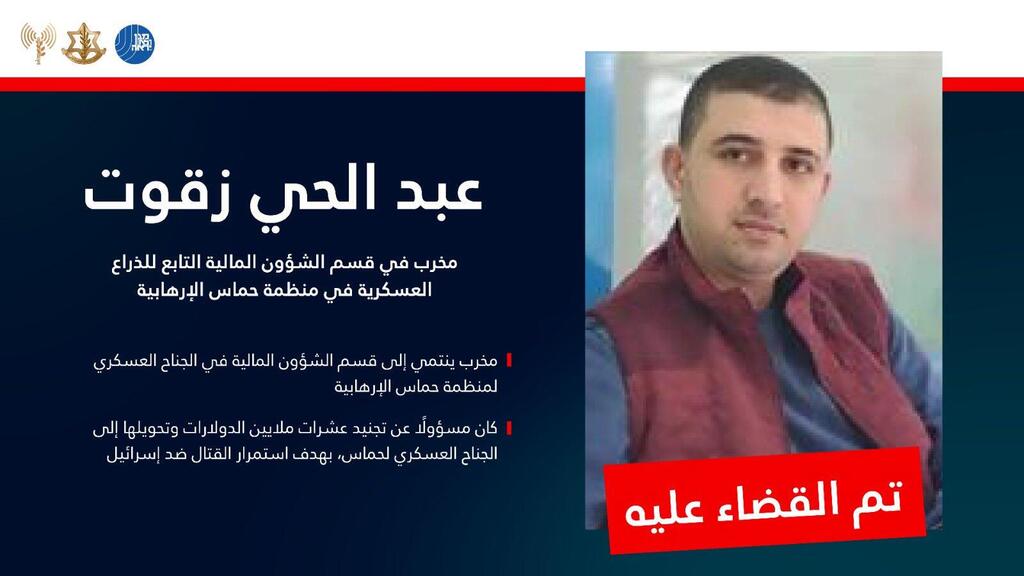
According to a statement by IDF Arabic-language spokesman Avichay Adraee, the strike was carried out in a joint operation by the IDF and the Shin Bet security agency earlier this month. The operation killed Abd al-Hai Zakout, a Hamas operative from Gaza City who belonged to the finance department of Hamas’ military wing.
“Over the past year, Zakout was responsible for raising tens of millions of dollars and transferring them to Hamas’ military wing to continue the fighting against Israel,” the statement said.
Against the backdrop of U.S. pressure to move to the next phase of the ceasefire agreement, Israeli officials say they have identified a shift in Hamas’ conduct inside Gaza. Senior Hamas figures are operating as fugitives and directing the organization from underground tunnel networks, while lower-ranking operatives are increasingly active above ground under civilian cover and in more internal roles.
Israeli assessments indicate that Hamas has expanded its visible presence across large areas under its control, from Jabaliya in the north to parts of Rafah in the south. Hamas police patrol daily to project governance, while additional municipal departments in the Gaza Strip have resumed operations, despite the extensive damage to infrastructure caused by the war.
Hamas has also begun channeling significant sums of money, tens to hundreds of thousands of shekels per day, into its recovering treasury, Israeli officials say. The funds are generated in part through increased humanitarian aid that Israel allows into Gaza, amounting to about 4,200 truckloads per week, or between 600 and 800 trucks a day, some from the private sector.
The aid includes a wide range of goods and food products, which Hamas exploits through private trade by taxing merchants and collecting payments from the public, according to Israeli assessments.
Earlier this month, the IDF and Shin Bet revealed what they described as a Hamas money-changing network operating from the heart of Turkey, run by Gaza-based operatives who exploit Turkey’s financial infrastructure for terrorist financing under the direction of Iran.
According to Israeli security officials, the money changers work in full cooperation with Iran and transfer hundreds of millions of dollars directly to Hamas and its senior leadership. The network conducts extensive financial activity inside Turkey, including receiving, storing and transferring Iranian funds to the terrorist group.
Documents showed portions of the transfers, some amounting to hundreds of thousands of dollars. Turkey is one of the main Muslim-majority countries that maintains open ties with Hamas, and several attacks linked to Hamas operatives were foiled in recent years after being planned from Turkish territory. Some of those operatives were deported to Turkey as part of the 2011 prisoner exchange for captured IDF soldier Gilad Shalit.
In August, the BBC reported that Hamas has continued to pay salaries to its personnel despite the war. According to the report, Hamas managed to pay about 30,000 members of its so-called civilian apparatus an estimated $7 million over the course of the war, using a cash-based payment system.
The report said that with financial institutions in Gaza largely nonfunctional, and after Israeli strikes targeted locations used by Hamas to distribute funds, the payment process became increasingly complex. Under the alternative system, Hamas members received messages on their own phones or those of relatives, inviting them to “meet a friend for tea” at a specific location. Upon arrival, they were approached by a stranger, sometimes a woman, who discreetly handed them an envelope containing cash.