


Despite ministers' complaints over operational restrictions in Lebanon, Israeli forces operating deep inside Lebanese territory have been instructed by the political leadership to remain in a defensive posture rather than carry out offensive operations. Following U.S. pressure that led to the ceasefire, troops are awaiting decisions from the political echelon regarding their future deployment in the area.
At the same time, security officials stressed that Hezbollah is using the ceasefire to regroup. The terrorist organization is collecting intelligence, repositioning across the area, and attempting to determine the locations of IDF forces and the methods they are using. The IDF is aware of these efforts and is adjusting its operations accordingly.
IDF distributes warning leaflets to Lebanese residents


The IDF on Thursday dropped warning leaflets over the area of the village of Al-Mansouri in southern Lebanon, urging residents to stay away. The move was not a new evacuation order but was intended to prevent friction between civilians seeking to return to their homes and Israeli troops still operating in the area.
Under the current conditions, Israeli soldiers remain deployed at various positions, and the military has developed plans to improve their protection while ensuring they do not remain stationary for extended periods. Earlier in the day, the Israeli Air Force, acting on intelligence provided by the Egoz commando unit, killed seven Hezbollah operatives who were transporting weapons near the security zone where IDF forces are operating in southern Lebanon. The operatives had moved the weapons into a building in the Al-Manzala area that served as a combat and observation post overlooking Israeli forces. According to the IDF, they were using the building to prepare an attack.
Although the troops are not currently engaged in offensive operations, they are attempting to blend into the terrain by occupying dominant positions and using deceptive movement patterns to make it more difficult for Hezbollah to identify their locations or understand their operational methods.
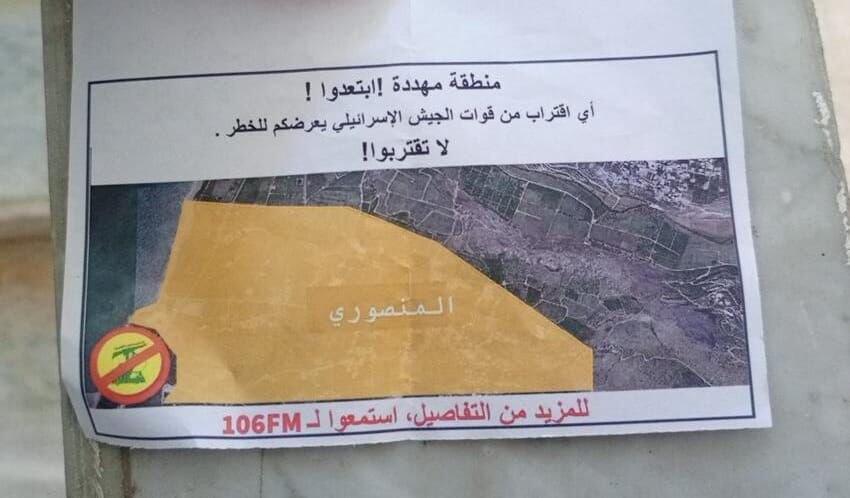
Warning leaflets over the area of the village of Al-Mansouri in southern Lebanon, urging residents to stay away
Israeli forces have recently uncovered additional terrorist infrastructure in the area. The IDF's 36th Division, which captured the Beaufort Ridge, is now deployed at several positions along the Ali al-Taher Ridge. There, troops discovered a major underground complex built over more than a decade with Iranian funding and direction. According to the IDF, Hezbollah operatives trapped inside have attempted to emerge from the tunnels, while others have tried unsuccessfully to move near the tunnel shafts.
Division forces have killed more than 10 Hezbollah operatives in the past 24 hours alone and continue to operate in the area. Any further action regarding the underground infrastructure will require approval from Israel's political leadership. It is also possible that responsibility for dealing with the site will be transferred to the Lebanese Army as part of the implementation of a U.S.-supervised pilot plan.
Another underground facility was discovered in the western sector, where the IDF's 91st Division is operating. Troops working in the village of Majdal Zoun uncovered an underground site containing a cache of drones that has not yet been destroyed.
After assessing the situation, Northern Command recommended to the political leadership which positions should be maintained and which should be vacated to improve security for residents of northern Israel while reducing the exposure of Israeli troops. Defense officials noted that the IDF is operating deep inside Lebanese territory and that it is clear the forces will not remain there indefinitely if there is no intention to resume offensive operations.
Meanwhile, the IDF is using the ceasefire to deploy additional drone detection and early-warning systems, including the proper installation of protective netting. Senior security officials said these measures have already led to a decline in successful drone strikes.