

A young man leans against a tree, wearing a combat vest. The camera rapidly closes in on him, but he is unaware of what is happening. By the time he realizes, it will be too late. In the final second of his life, the man notices the drone diving toward him like a bird of prey. Then, instinctively, he covers his face with his hands. A bright flash fills the screen. The brief video clip ends.
It happened on April 13 of this year in the town of Bint Jbeil. The man in the video is a Hezbollah operative. The suicide drone that killed him was operated by fighters from Egoz’s drone team, officially known as Team 33.
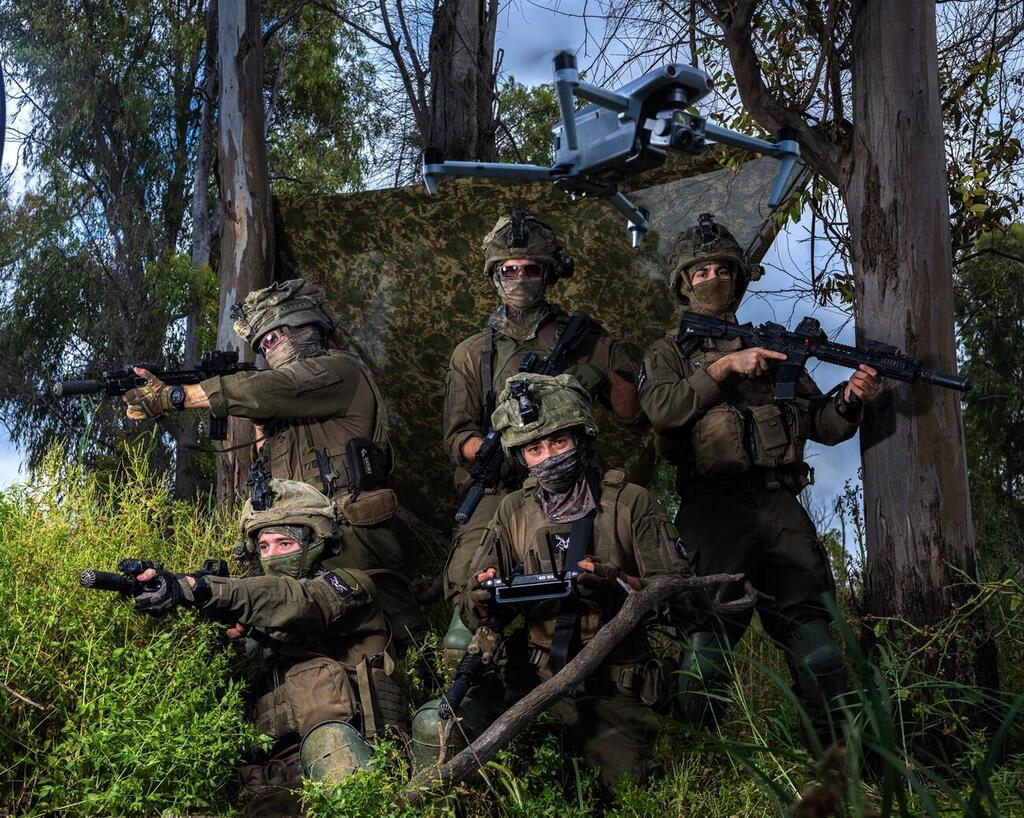
Lieutenant David (all names of interviewees in this article are pseudonyms) takes pride in the capabilities displayed by the team under his command during combat in southern Lebanon, and elsewhere as well, but he does not fall into arrogance and is careful not to underestimate the enemy. When asked what grade he would give his rivals, Hezbollah’s drone teams, he replied: “Very high marks. They do not have capabilities like ours, but unfortunately their guys do professional work — in intelligence gathering, in attack operations and in documentation.”
Perhaps it was a chilling prophecy, perhaps a sober reading of reality. Either way, the remarks were made several days before the severe incident in which Staff Sergeant Idan Fox, a fighter Battalion 77 of the 7th "Storm of the Golan" Brigade, was killed in a Hezbollah explosive drone attack in southern Lebanon. His death brought renewed public attention to a threat for which no real solution has yet been found.
After him came the deaths of Amer Hujirat of Shefa-Amr, a Defense Ministry contractor, Sergeant Staff Sergeant Liem Ben Hamo from Herzliya, a fighter in Battalion 13 of the Golani Brigade Battalion 13, Master Sergeant (res.) Alexander Globniov and Captain Maoz Israel Recanati, a commander in Golani's 12th Battalion. Dozens more were wounded, as of publication deadline.
Egoz’s drone team was also targeted by enemy drones. In their case, it ended without casualties.
“A Hezbollah attack drone reached our position in southern Lebanon,” says Major General Ran, one of the team’s fighters.
Did you manage to shoot it down?
“No,” David, the team commander, admits. “It managed to explode, but it missed.”
Luck was on their side in that incident, but in many others they succeeded in preventing harm to soldiers or civilians.
“Egoz entered a certain fortified stronghold to clear it,” Staff Sergeant Eyal, another team member, recounts about an incident that took place in Bint Jbeil several days earlier. “Before the entry, we scanned the area to make sure there were no ambushes or explosives waiting for our forces. Then we spotted two terrorists with Kalashnikovs. They started firing at our drones. We directed a guided munition toward them, along with one of our attack drones, and took both of them out. In the end, you kill two terrorists who could have created a massive incident for your unit and caused many casualties.”
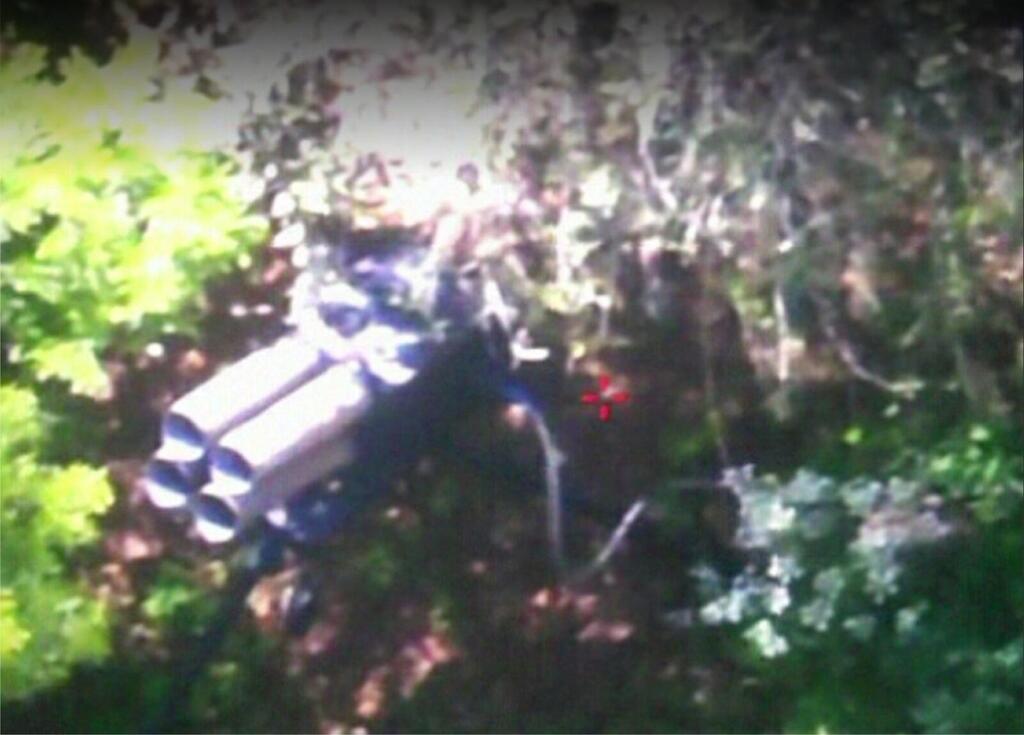
A rocket launcher hidden in the bushes, seconds before its destruction
(Photo: IDF Spokesperson)
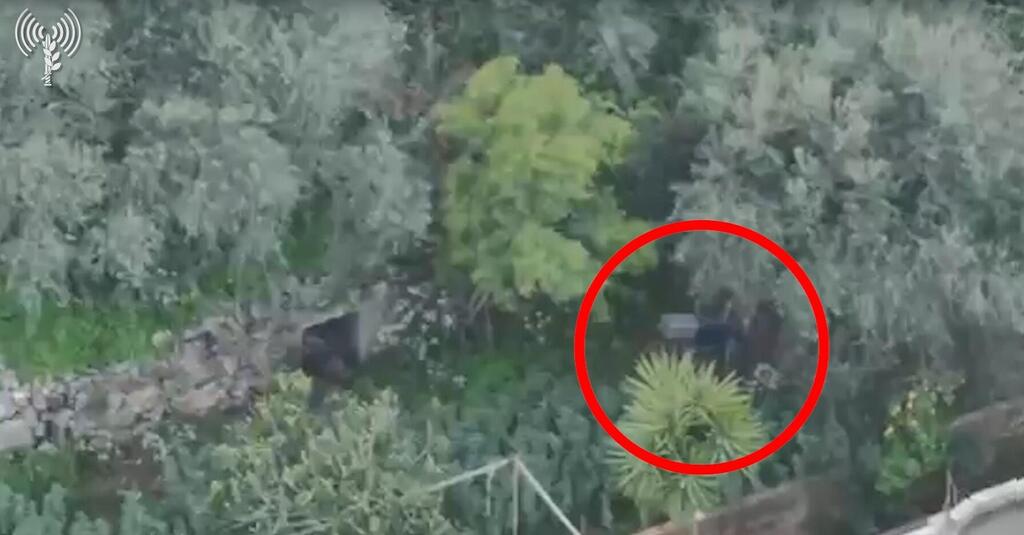
A rocket launcher hidden in the bushes
(Photo: IDF Spokesperson)
“In another incident,” Ran continues, “we launch a drone and start scanning for something, and suddenly spot a multi-barrel rocket launcher hidden beneath a bush, in a way that you would not notice even if you were standing five meters away. Hezbollah know how to camouflage. We zoom out from the launcher — because if we move away from it we will not find it again — and launch an attack drone that can reach within a millimeter of the launcher after a four-and-a-half-kilometer flight. We detonate it on the launcher and disable it.”
“At the same time, we try to analyze the launcher’s angle and realize it is aimed directly at Kibbutz Malkia. Targeted, loaded, ready,” Lieutenant David says. “It is an incredible feeling, knowing you prevented fire on an Israeli community.”
We met them a day after they left Bint Jbeil for a brief reset, just before they were due to return to Lebanon. When we arrived at Shraga Camp, the soldier at the gate checkpoint approached our vehicle to inspect the entry permits. Something about the scene seemed strange, and then I noticed: he was wearing red boots, and a red beret peeked out beneath his vest.
Veterans of Golani would never have imagined such a breach: a red beret at the entrance to the brown brigade’s legendary base? It was almost sacrilege.
But after two and a half years of hard fighting, during which soldiers wearing berets of every color fought shoulder to shoulder and together filled the graves of their comrades in military cemeteries, the traditional rivalry appears to have faded somewhat.
Besides, Shraga Camp also serves as the home base of Egoz Unit. Before the establishment of the Commando Brigade, Egoz was an integral part of Golani, and its officers can still find themselves commanding Golani soldiers as part of their career progression.
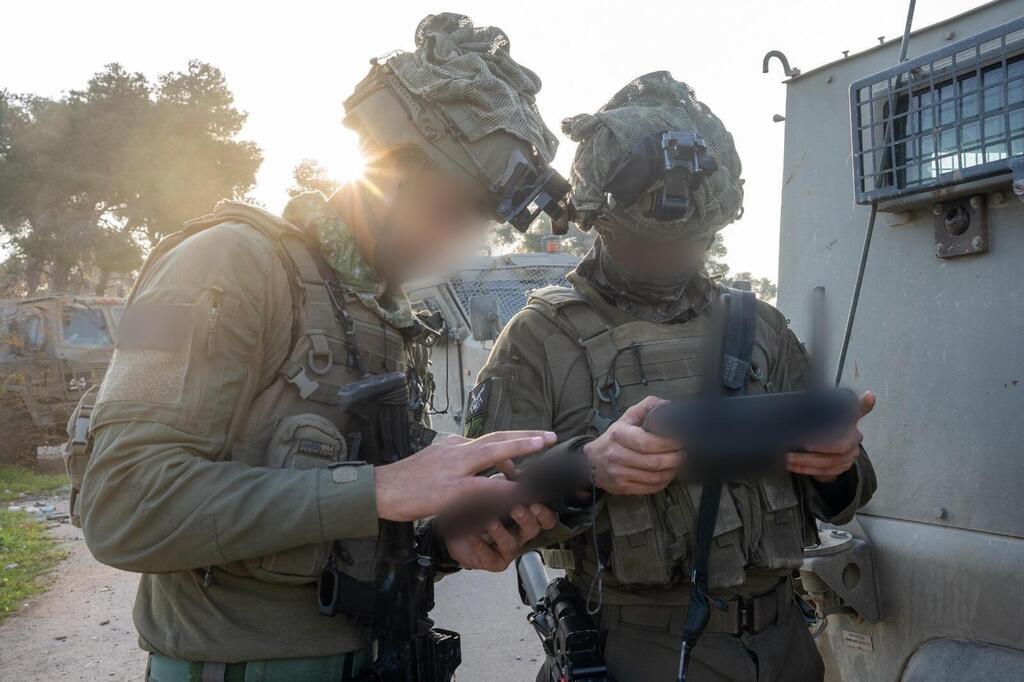
Fighters from the Egoz drone team in Bint Jbeil
(Photo: IDF Spokesperson)
Take Lieutenant David, for example, a resident of central Israel. David enlisted in Egoz about four years ago, and on October 7 he was nearing the end of training. After completing the training track, he was assigned as a squad commander in one of the unit’s combat teams.
At the start of the Gaza ground maneuver, he was wounded in an explosive blast in the Al-Shati refugee camp.
“But it was a relatively light injury,” he clarifies. “My team kept fighting, and I returned to them after two months of rehabilitation.”
The IDF received intelligence suggesting a hostage had managed to escape and was trying to send distress signals.
“We immediately launched a drone based on that intelligence and began scanning until we identified on the ground two square window frames placed one on top of the other in a shape resembling a Star of David,” Yuval recounts. “It is an incredible feeling.”
After completing officers’ training, David was sent to command a platoon in Golani’s Battalion 13. About six months ago, he returned to Egoz and was appointed commander of the drone team, which he has led for the past three months in combat in Lebanon.
Together with him in Egoz’s lounge at Shraga Camp sat five members of the team. Sergeant First Class Noam from Ra’anana and Sergeant First Class Ran, who lives in the Haifa area, enlisted in August 2023, two months before the war broke out, and are among the team’s veterans. Staff Sergeant Eyal from Gedera, Staff Sergeant Yuval, who lives in a southern moshav, and Staff Sergeant Natan, from a moshav in the Jerusalem hills, enlisted in November of that year, directly into wartime service.
Since the current round began on February 28, their team has been stationed in the north alongside the rest of Egoz.
“In the first weeks we mainly carried out short, pinpoint operations and took part in the unit’s raids in Lebanon,” Natan says, “and as the Bint Jbeil maneuver approached, we began carrying out actions that would make that possible.”
What does that mean in practice?
David: “Two days before the unit began working on a specific target in the Bint Jbeil area, we as the drone team entered a dominant village — I will not mention its name — established a rear position inside one of the houses and began operating in the area Egoz was preparing to enter. During those two days, we identified quite a bit of enemy activity and closed targeting loops on it.”
Ran: “We know how to operate both as an organic team, independently, and by sending pairs to join other Egoz teams raiding the actual sites. Before the force breaks into a house or another target location, we send drones inside to make sure there is no enemy there. And if there is — we eliminate them.”
Natan: “It can be anything that could endanger the force, such as explosives or security cameras.”
Since the start of the current round in Lebanon, the team has been responsible for the elimination of dozens of Hezbollah operatives — directly or indirectly.
“In most cases, we close the targeting loop with the Air Force,” the team commander says. “If, for example, we identify three terrorists entering a building and we want to collapse it, we let the Air Force do the job, because we do not have drones that can bring down a building. There were also terrorists we took out using our attack drones, but those were isolated cases.”
David: “Hezbollah do not have capabilities like ours, but unfortunately their people do professional work — in intelligence gathering, in attacks and in documentation.”
The drone team was established in 2017 as part of Egoz’s Exposure and Strike Company.
“The other teams in the company are horizontal, meaning they operate in the ground dimension. We are a vertical team, looking from above,” David says.
The team currently operates seven main types of drones — ranging from massive drones to ones the size of a fist — and those too are divided into subtypes. Some can drop munitions on the enemy, others explode themselves (“they’re our kamikazes,” Natan says), and naturally there are drones used for intelligence gathering and surveillance.
“A decade ago, hardly anyone knew what a drone was,” Ran says. “The team is based on weapon systems, and in the early stages there were no special technologies. Over time the field developed dramatically, and the war gave it a serious boost. Today the IDF understands that drones are the next big thing.”
As seen on October 7, when Hamas dropped grenades from drones to disable observation posts, and as seen in recent weeks in Lebanon, the enemy understands that very well too.
Recruitment to Team 33 begins already during training.
“In every cycle we pull out guys who fit us after screenings and tests,” David says.
Upon joining the team they undergo about three months of training and certification.
“Besides the fact that everyone here is an Egoz fighter, they also have another profession and a specific purpose. The crown jewel is drone warfare.”
What qualities do you look for in a team fighter? Does it have to be someone who played with drones before enlistment?
“Absolutely not. First and foremost, I’m looking for high-quality people willing to work hard and over time, because the drone team is constantly operational — in routine security missions and in war. Beyond that, precision and attention to the smallest details matter to me — in mission planning, in safeguarding equipment and maintaining it. There are drones built from 1,200 small parts. In the end, every Egoz fighter has to know how to charge forward in the best possible way. But drone warfare is a world of its own.”
Like the rest of the unit, they have operated in nearly every combat arena.
“The nature of the team, and of Egoz in general, is very multi-front,” David explains. “We can spend a week in Gaza, by the end of that week be in a special operation in Lebanon, then on Sunday be rushed to Syria. And even within the team, I can place one squad operating in the West Bank carrying out overnight missions, another pair doing preliminary intelligence gathering and strikes against a cross-border outpost in the north, while I myself as team commander might be part of a squad on a mission in Gaza.”
One of the most significant incidents involved locating a murdered hostage in Gaza after signs of life had already emerged in the form of a video.
“It started with intelligence reaching the team: an indication that the hostage had been buried beneath a red car in a certain area,” David recalls. “For two and a half days the team scanned the area with drones until one of the fighters located the vehicle. I was not yet in the drone team then, but I was in the Egoz company that raided the site and recovered the body. It is a very meaningful feeling — in the end, you fight for the hostages, and thanks to the drone team’s guidance, it was possible to bring him to burial in Israel and give his family some certainty and a grave to visit.”
In another incident, which ended without results, the IDF received intelligence suggesting a hostage had managed to escape and was trying to send distress signals.
“We immediately launched a drone based on that intelligence and began scanning until we identified on the ground two square window frames placed one atop the other in a shape resembling a Star of David,” Yuval says. “It is an incredible feeling, seeing that and thinking maybe you are about to save a living hostage.”
David: “At the same time as our scans, an entire battalion was rushed to the area and simply surged forward with all the tanks and Namer APCs, but in the end they found nothing. To this day, it is still unclear who placed those frames there.”
During the Gaza ground operation, they say, the team was responsible for the deaths of hundreds of terrorists, directly or through directing the Air Force, and repeatedly managed to prevent harm to IDF troops.
“You see terrorists with an anti-tank launcher standing on a rooftop,” Ran says, “and suddenly they notice the drone and start running from it in circles. Then we eliminate them from the air. In Gaza we had many identifications of terrorists literally 200 meters from IDF forces. If you wait even three minutes, there’s a chance one of our forces gets hit. So we carry out a targeted strike in cooperation with the Air Force, or operate an attack drone ourselves.”
On February 13, 2025, during Operation "Iron Wall" in Judea and Samaria, Shin Bet intelligence reported a car bomb ready for deployment in one of Jenin’s neighborhoods. Egoz’s drone team received the mission of locating it.
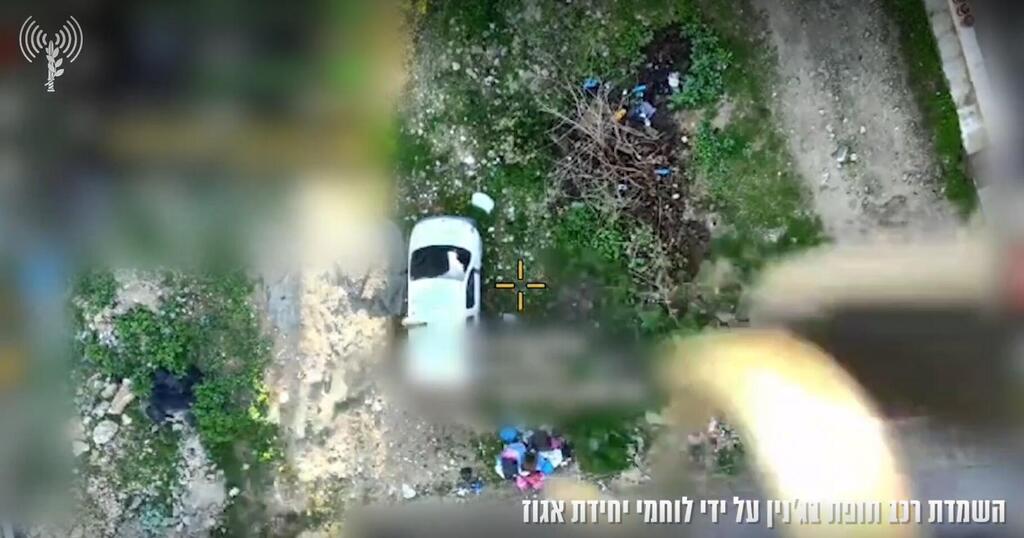
Destroying a car bomb in Jenin by fighters from the Egoz unit
(Photo: IDF Spokesperson)
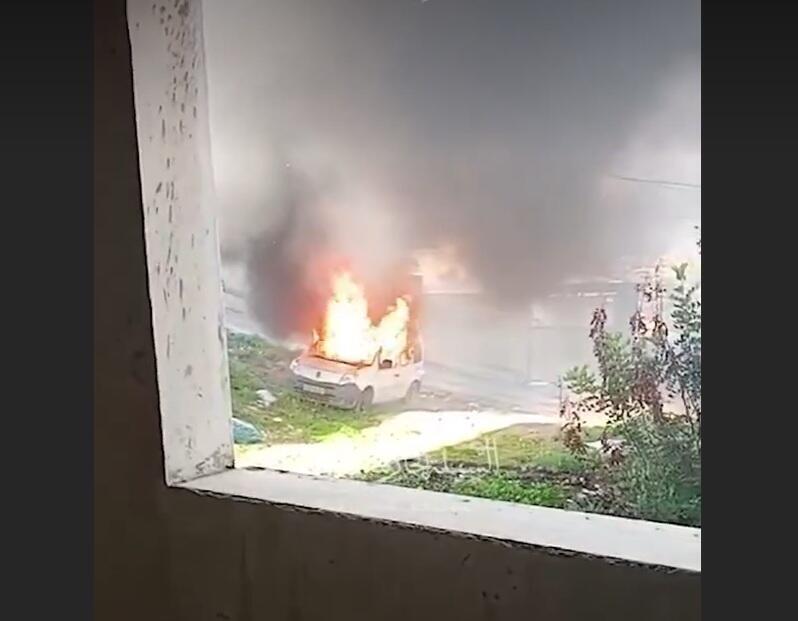
Destroying a car bomb in Jenin by fighters from the Egoz unit
(Photo: IDF Spokesperson)
“We began scans in the polygon they gave us,” Ran recalls. “Suddenly we spotted a vehicle that looked suspicious. We scanned it from above, below and the sides and concluded it was probably the car. The window was open, so we inserted an exploding drone through it. It triggered the explosive charge and you see the vehicle literally fly into the air, with multiple secondary explosions. We realized it was indeed the car bomb they were looking for.”
When Assad’s regime fell in Damascus in December 2024, the team was rushed to the Golan Heights sector.
“On the day the IDF entered Syria, we were tasked with finding an operative who worked with the Iranians,” Ran continues. “Intelligence gave us a search polygon and photos of the man, each showing him in different clothes. In some of them he is holding a Kalashnikov. We begin focused scans and suddenly a sergeant from my team and I spot a man wearing the same jacket that appeared in one of the photos. We incriminate him and begin surveillance. For a week we learn everything we can about him: where he lives, his brother’s name, who lives next door, what hours he leaves the house and when he comes back. Eventually they launch an operation called ‘The Magic Flute.’ He was arrested inside his home and taken to Israel.”
During the surveillance, did you send drones inside his house?
Ran: “Let’s just say we knew what the inside of his house looked like.”
The interview with Egoz’s drone team fighters took place on the eve of Memorial Day, especially meaningful timing for people who lost friends and commanders.
“When we were in training at the Commando School, we entered Gaza,” Ran says. “We carried out a raid and two terrorists hiding inside a destroyed house surprised the force. Four friends from my team were killed.”
In the incident, which occurred in southern Gaza on April 6, 2024, team commander Staff Sergeant Ido Baruch, Sergeant Reef Harush, Sergeant Ilai Tzair and Sergeant Amitai Even Shoshan, were killed.
One of the hardest incidents in the unit’s history took place on October 2, 2024 in the village of Al-Aadaissah in southern Lebanon during Operation Northern Arrows.
In the battle, which according to several reports involved numerous failures — it should be noted that Egoz’s commander has since changed, unrelated to the event — six officers and soldiers were killed.
“I knew all of them. There were guys from my intake in the unit there,” Lieutenant David says.
He himself was in officers’ training at the time.
“I hear about the incident, and from my perspective I want to walk out of Bahad 1 and drive straight from Mitzpe Ramon to Lebanon.”
Did you ask to leave?
“Of course we asked — me and the other Egoz cadets. But you’re not two days into the army. You know that’s not how it works. We’re not in the Palmach.”
Ran was already in the drone team during the incident.
“Half our team evacuated wounded soldiers and the other half managed the battle from above — closing targeting loops with the Air Force and the forces on the ground, and also operating attack drones. In the end 32 terrorists were killed there, most of them because of our work. Suddenly you see a Hezbollah ambulance arriving to evacuate their wounded and dead. That’s something nobody thought about at all. In Gaza, when a terrorist is dead, nobody in Hamas cares about him.”
Yuval: “In the end, everything comes down to the courage of the fighter at the edge. People evacuated their friends on their backs. Friends died in their hands and they kept managing the battle. That’s something very important for me to emphasize.”
Your team’s performance in the incident truly deserves praise, but aren’t drones supposed to prevent an ambush like that in advance?
“Our goal is indeed to prepare the ground before the unit enters and eliminate enemy forces in areas where Egoz operates,” David says. “Specifically, this was Hezbollah’s most complex ambush. It was built around extensive underground infrastructure and a very significant area-wide deployment. An entire activated village that was part of a system of eight villages spread across ranges of up to 15 kilometers. Those villages provided the ambush with direct support through ground reinforcements and indirect support through anti-tank fire and artillery.”
Natan: “Today we already have drones that could have prevented that incident, or at least dramatically reduced it, that we did not have at the time. The drone world is evolving at a crazy pace.”
Does that include drones operating inside tunnels?
David: “We also have systems that operate underground.”
Ran: “We had several special operations in Lebanon in which we inserted systems for underground scanning.”