



Iran has threatened a "severe punishment" in response to Israel’s massive opening strike in Operation Rising Lion aimed at neutralizing the nuclear threat. Israeli authorities are now preparing for a broad retaliatory attack by the Islamic Republic, which has already warned that its response could include hundreds of ballistic missiles.
In the wake of the initial strike, a special emergency status was declared early Friday morning across all of Israel. Under Home Front Command's Level 4 defense protocol, all schools have been closed and public gatherings— including synagogue services—have been banned. Workplaces are shuttered except for essential sectors.

The Home Front Command outlined the following civilian alert procedures: citizens will first be instructed to remain near protected spaces, followed by a preliminary alert approximately 10 minutes before missile fire and finally a directive to enter shelters at the necessary time.
The alert sequence and publication method are expected to follow this order:
- An initial readiness alert via media outlets (timing not guaranteed).
- An alert identifying launches en route to Israel, sent through the Home Front Command mobile app (approximately 10 minutes’ notice).
- A shelter alert via the same app and nationwide sirens, with timing based on location.
A ballistic missile launched from Iran would take about 10 minutes to reach Israeli territory. Cruise missiles would take around two and a half hours, and drones launched from Iran require roughly nine hours. However, shorter-range threats may originate from closer regions, rendering these timelines less relevant for the public, which is expected to follow all Home Front Command instructions.
Get the Ynetnews app on your smartphone: Google Play: https://bit.ly/4eJ37pE | Apple App Store: https://bit.ly/3ZL7iNv
The primary concern at this stage is the type and quantity of explosives that may be fired at Israel—payloads capable of causing significant shockwaves. Civilians are therefore instructed to take cover only in reinforced protected spaces and not in substandard locations such as stairwells.
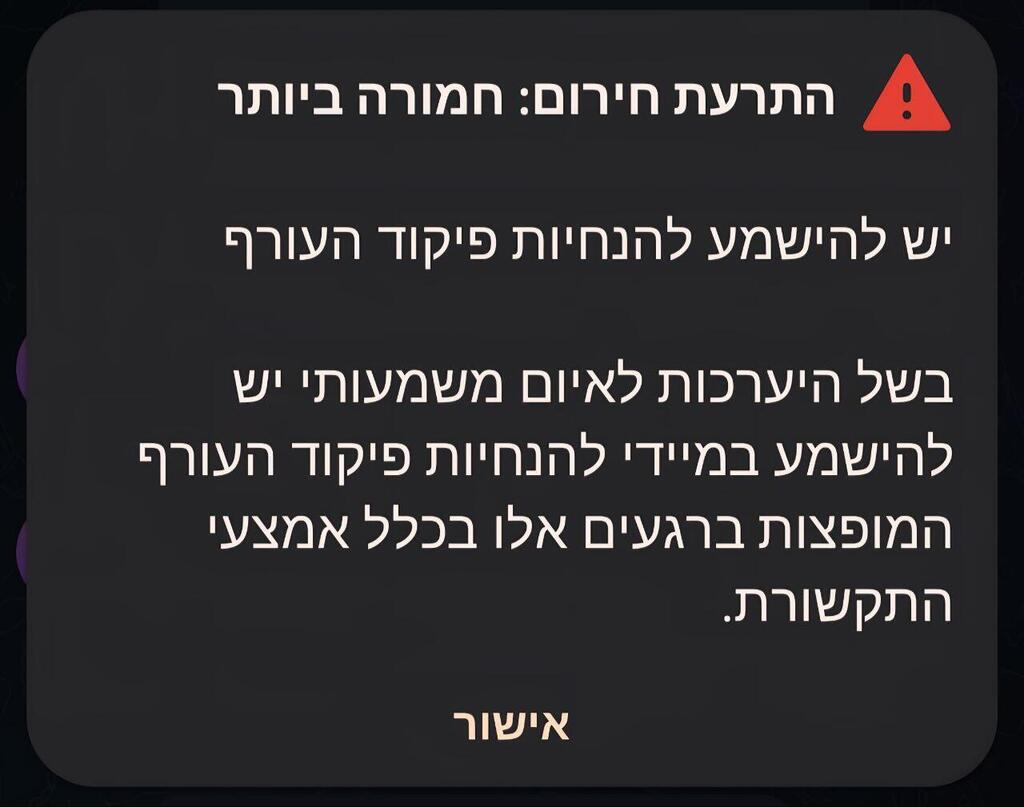
The warning sent to mobile phones in the event of an attack
Preparations have been ongoing for an extended period, with emphasis on coordination with national and local authorities. This includes readiness for civilian sheltering in public spaces.
Regarding the overnight strike, the IDF prioritized operational secrecy over public readiness, recognizing the critical value of surprise in achieving mission success.
The IDF has established a detailed sequence of actions to immediately shift the civilian population into a heightened emergency mode. At 3:00 a.m., nationwide sirens were activated, followed one minute later by emergency push alerts to mobile phones. The objective was to wake the population and ensure full attention to new Home Front Command directives. The instruction for Israelis to remain near protected spaces was lifted later in the morning.