

Outgoing Mossad chief David Barnea has openly opposed the appointment of Maj. Gen. Roman Gofman, arguing he lacks the intelligence background needed to lead the agency during wartime
The Mossad is preparing for a change-of-command ceremony for its next director, regardless of the High Court of Justice’s pending decision on petitions against the appointment of Maj. Gen. Roman Gofman.
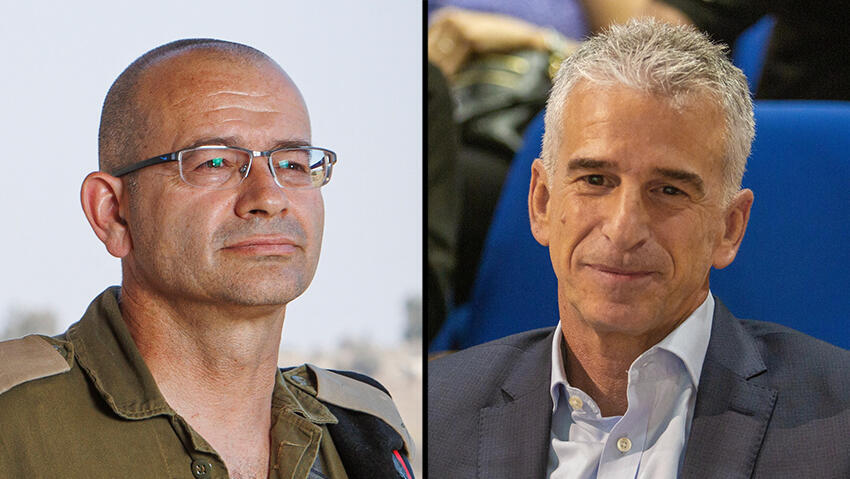
Roman Gofman, David Barnea
(Photo: Ido Erez, Gil Nachoshtan)
The ceremony is scheduled for June 2, and officials say preparations must continue in case the justices approve the appointment.
The identity of the next Mossad chief has become the central topic of conversation inside the agency, where personnel are closely following reports and developments surrounding the nomination. Outgoing director David Barnea has openly opposed Gofman’s appointment, saying he does not believe he is suited for the role. Barnea had pushed for his deputy, identified only as A., to succeed him, but his recommendation was not accepted.
Officials familiar with the situation estimate that if Gofman’s appointment is approved, senior Mossad figures may leave the agency for several reasons. The first is concern that the decision was based not on his qualifications, but on his loyalty to Prime Minister Benjamin Netanyahu.
Opposition to the appointment also stems mainly from the fact that Gofman has never dealt with the operation of intelligence systems.
“He has not held any position that gives him the experience and depth needed to run a body like the Mossad,” one official said. “We are not in the period between wars, but in the middle of a war, and there is no way to give him time to learn. In addition, Gofman does not speak fluent English and will need to use an interpreter.”
Critics also point to Gofman’s conduct in the various offshoots of the affair involving the handling of teenager Uri Almakias, during Gofman’s time as commander of an IDF division in the north. His appointment may be affected by the contents of an affidavit submitted Sunday to the High Court by the attorney general from a former head of the IDF Military Intelligence Directorate’s operations division, identified only as Brig. Gen. G. The affidavit is expected to bear on whether Gofman lied regarding the handling of Almakias.
Because the affidavit is classified as top secret, it will not be handed over to the parties — including Gofman himself, who is expected to respond to it. Attorney General Gali Baharav-Miara also submitted additional material to the High Court, including documents she had passed to retired judge Asher Grunis behind the backs of the other members of the senior appointments committee, who were unaware of the contacts between Baharav-Miara and Grunis.
Regarding the document’s classification, Baharav-Miara said that “shortly after receiving the affidavit, an urgent request was made to the army to remove the classification as soon as possible, so that the affidavit can be made public and transferred to all parties.”
Although the High Court has already rejected the request, the attorney general also again asked the court to include a strongly worded letter from Barnea, in which he details his opposition to Gofman’s appointment.
Netanyahu responded sharply, writing “read it and you won’t believe it” in reference to Baharav-Miara’s transfer of documents to Grunis and her refusal to allow him access to classified materials she is seeking to submit to the High Court.
“The freedom the attorney general is taking for herself is incomprehensible and scandalous,” Netanyahu wrote. “This is procedural audacity of the highest order, with the attorney general seeking to submit materials that have not yet been submitted to the committee.”
Brig. Gen. G., who is currently posted in the Mossad, is expected to end his role in the organization following a finding that he bore command responsibility for failures on October 7. It has now emerged that Gofman and G. recently met, and that the designated Mossad chief conveyed messages indicating he wanted to keep him in the agency — something that could constitute a conflict of interest.
Senior IDF officials have recently claimed that Brig. Gen. G. said several times over the past year and a half that Gofman was aware of Almakias’ handling and lied to him during an inquiry into the matter.