

U.S. President Donald Trump issued mixed messages overnight Tuesday about the future of the war with Iran, suggesting the conflict could end “very soon” while simultaneously threatening a dramatic escalation.
Speaking late Monday night and early Tuesday, Trump said he believed the war might conclude in the near future — though not within the week. At the same time, he warned that the United States would respond with overwhelming force if Iran attempted to halt oil shipments through the strategic Strait of Hormuz.
Trump: Iran war will be over 'very soon' — but not this week


In a post on Truth Social, Trump threatened a far stronger response if Tehran disrupts shipping through the waterway, one of the world’s busiest oil transit routes.
“If Iran does anything that stops the flow of Oil within the Strait of Hormuz, they will be hit by the United States of America TWENTY TIMES HARDER than they have been hit thus far,” Trump wrote. He added that the United States could also strike targets that would make it “virtually impossible” for Iran to rebuild as a state, warning that “Death, Fire, and Fury will reign [sic] upon them,” though he said he hoped such escalation would not occur.
Trump also framed the U.S. protection of shipping in the strait as a benefit to major energy-importing nations, including China and others that rely heavily on oil passing through the route.
His comments came as oil markets remain volatile amid the war between Israel, the United States and Iran. Oil prices surged above $100 a barrel earlier this week for the first time since Russia’s invasion of Ukraine in 2022, before falling after Trump told CBS that the war was “very complete,” a remark that briefly eased investor fears of a prolonged conflict.
According to a report by The Wall Street Journal, some of Trump’s advisers have been urging him to seek an exit strategy from the war, partly due to concerns about rising oil prices and their potential political impact ahead of November’s midterm elections. The rising cost of living, including fuel prices, is a key concern for American voters.
People familiar with internal discussions told the newspaper that several advisers have encouraged Trump to craft a narrative that U.S. forces have already achieved their objectives and to outline a plan for ending American involvement in the conflict.
While many conservative supporters initially backed the war effort, some advisers have privately warned that a prolonged conflict could erode support among Trump’s political base, according to the report. The president has also been briefed on polling that indicates a majority of Americans oppose the war.
Republican lawmakers have also contacted the White House expressing concern that rising oil prices could damage the party politically in the midterm elections, which will determine control of Congress, the report said.
The Journal also reported that Trump has sometimes been surprised that Iran has not capitulated under the joint U.S.-Israeli military campaign. Still, a senior administration official told the newspaper the president is unlikely to halt the fighting until he can claim a “satisfactory victory.”
Several officials said that as long as Iran continues attacks across the region — and as long as Israel seeks to continue striking Iranian targets — it will be difficult for the United States to disengage from the war.
The White House strongly rejected the report. Press secretary Karoline Leavitt said the article relied on anonymous sources who were not present in meetings with the president.
“This story is full of crap from anonymous sources who, I can guarantee, are not in the room with President Trump,” Leavitt told the newspaper. She added that the U.S. campaign, known as Operation Epic Fury, “continues to be a tremendous success” and said only the president will determine when it ends.
Trump’s threat to escalate attacks came minutes after Iran’s Islamic Revolutionary Guard Corps warned that it would not allow “a single liter of fuel” to pass through the Strait of Hormuz as long as U.S. and Israeli strikes continue.
In a statement, the Revolutionary Guards dismissed Trump’s suggestion that the war may soon end as “nonsense.”
“We are the ones who will decide when the war ends,” the statement said. “Security in the region will be for everyone — or for no one.”
Iran’s 'new condition' for passage through the Strait of Hormuz
The statement came after Iranian media reported Monday that the Revolutionary Guards is willing to allow ships from Arab or European countries to pass through the Strait of Hormuz — through which about 20% of global oil traffic moves each year — but only if those countries expel the Israeli and U.S. ambassadors.
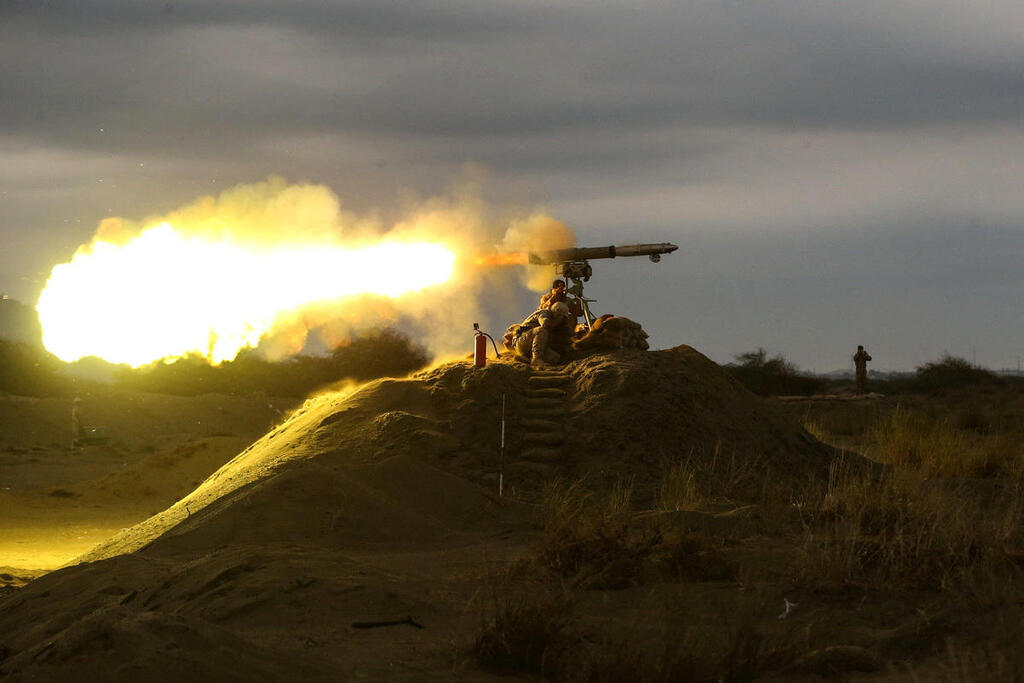
An Iranian military drill in the Strait of Hormuz
(Photo: Reuters/Iranian Army/WANA)
A somewhat different report was published by CNN, citing an Iranian official who said the Iranian regime plans to impose “security tariffs” on oil tankers and commercial vessels belonging to U.S. allies that pass through the strait.
The Iranian official insisted that despite Trump's statements claiming the strait had effectively reopened, it remains closed.
“We have leverage to influence global oil prices,” the official said. “Energy prices have become volatile and we will continue to fight until Trump declares defeat.”
At the same time, a senior Revolutionary Guard officer, Gen. Ali Mohammad Naini, said according to Iranian media that Iranian forces are “waiting for the U.S. Navy in the Strait of Hormuz.”
The remarks came after Trump said he was considering sending the U.S. Navy to escort oil tankers through the strait and protect them from potential Iranian attacks. Trump has not yet committed to the move, saying overnight only that such escorts would take place “when the time comes.”
Trump told CBS in an interview on Monday that the war was “very complete.” But overnight, he struck a somewhat different tone, telling a Republican conference in Florida: “We’ve already won in many ways, but we haven’t won enough. We go forward, more determined than ever to achieve ultimate victory that will end this long-running danger once and for all.”
At a press conference immediately after the conference, Trump was asked about his earlier comments to CBS and offered an ambiguous answer.
“We could call it a tremendous success right now — as we leave here, I could call it — or we could go further, and we’re going to go further,” he said.
Asked what he would consider a “satisfactory” victory, Trump replied that Iran would have to abandon its nuclear ambitions and refrain from developing weapons that could threaten the United States or Israel.
The number of ships sunk jumps in Trump’s statements — within an hour
In his speech on Monday, Trump promised that passage through the Strait of Hormuz would “remain safe” — a remark that appeared to suggest that shipping through the waterway had already resumed, even though Iran’s threat remains in place and the number of vessels passing through the strait has dropped sharply.
Trump: We're crushing the enemy
(Video: FOX NEWS)
“I will not allow a terrorist regime to hold the world hostage and attempt to stop the globe’s oil supply,” Trump said. “If Iran does anything to do that, they’ll get hit at a much harder level. I will take out those targets… that I mentioned just before. We'll take them so quickly they will never be able to recover. If they want to play that game, they had better not play that game.”
Trump also delivered somewhat conflicting remarks about Iran’s remaining military capabilities.
In an interview with CBS on Monday, he said Iran “have no navy, no communications, they've got no air force,” adding that Tehran's “missiles are down to a scatter” and that “there's nothing left in a military sense.”
At the press conference overnight, he again claimed Iran had “no radar, they have no telecommunications. … It’s all gone,” but later described those capabilities as severely damaged rather than completely eliminated.
For example, he said that “most of Iran’s naval power has been sunk.” He also said that, contrary to his earlier claim that Iran had “shot basically everything it had,” the country’s missile capabilities were “down to about 10%, maybe less.” At another point he said that “most” of the missiles had already been launched or destroyed.
“The drones are down to probably 25%, and they’ll be soon be down to nothing,” he added.
Trump also quickly increased the number of Iranian vessels he said had been sunk.
At the Republican conference, held around midnight Israel time, he said: “It's all lying at the bottom of the ocean — 46 ships.”
But just one hour later, at the press conference following the conference, he said: “Most of Iran’s naval power has been sunk. It’s on the bottom of the sea. It’s almost 50 ships — I was just notified it’s 51 ships. I didn’t know they had that many. It didn’t last very long. And these are fighting vessels. They’re meant to fight, but they’re not meant to fight against us.”