

Israeli and U.S. aerial bombing campaigns on Houthi military targets notwithstanding, the Iranian-proxy continues its stubborn attacks against Israel, using both missiles and UAVs, and takes all the credit after each attack.
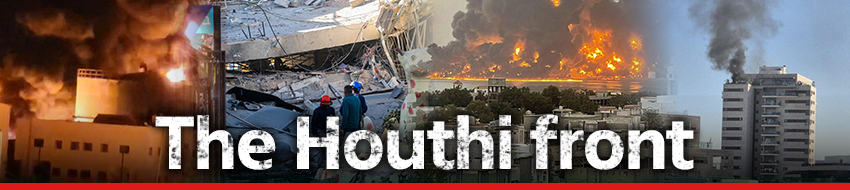
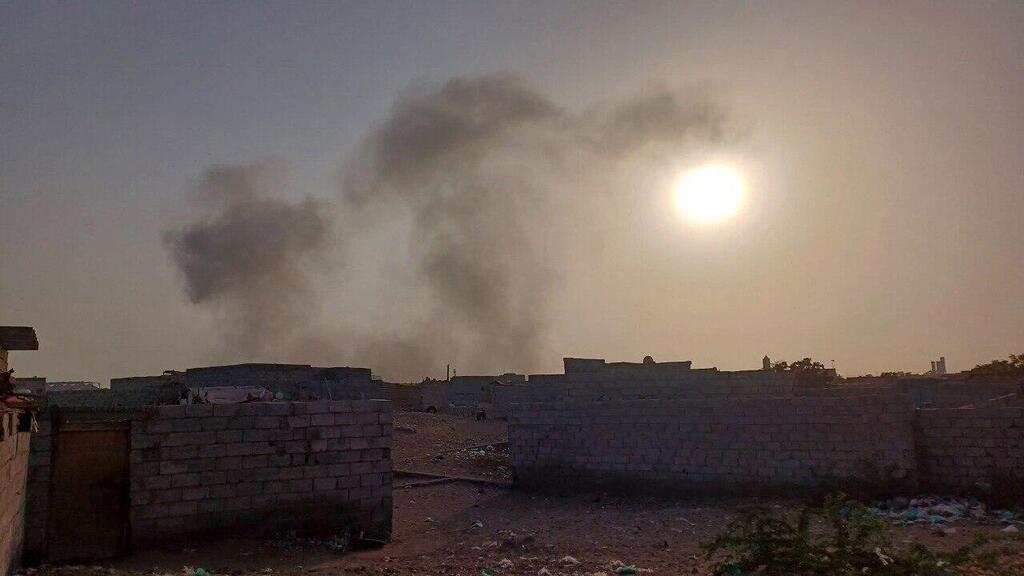
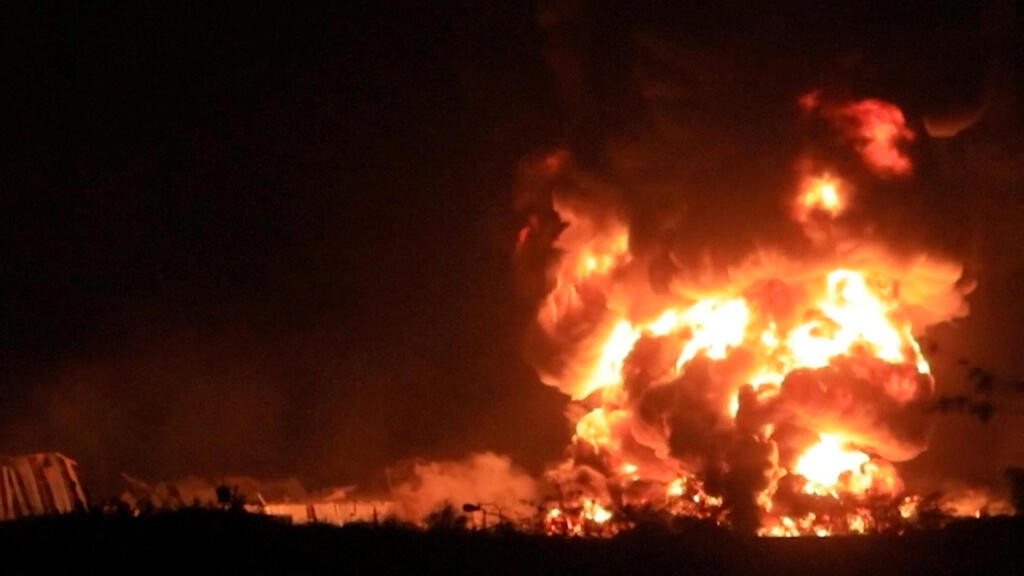
The Houthis announced Sunday at a press conference held by the Red Sea Ports Corporation, which is under their control, that U.S.-Israeli airstrikes targeting ports in the Hodeidah province over the past 10 months has resulted in damages exceeding $1 billion. According to the corporation, strikes on infrastructure and facilities at the Hodeidah, As-Salif, and Ras Isa ports caused direct losses of $531 million and indirect damages of $856 million due to disruptions in services and supply chains.
Attacks on Hodeidah port


The strikes reportedly destroyed six docks, two main cranes, power stations, generators, service and logistics facilities, floating docks, and warehouses used for unloading food, aid and medicine. Despite this, the corporation stated that it "continued to operate, receive ships, and ensure the flow of essential goods to millions of Yemenis." Houthi Minister of Transportation Mohammad Qahim, who attended the event, warned: "The strikes will not change our steadfast stance toward the Palestinian people and our support for the resistance until the attacks stop and the Gaza blockade is lifted."
A report in the Saudi-owned Asharq Al-Awsat newspaper, published in London, noted that the Red Sea ports are a "vital artery" supplying more than 80% of Yemen’s needs. The report also highlighted concerns among Yemeni sources about an escalation in Houthi missile launches toward Israel, which could prompt another wave of Israeli airstrikes on the troubled gulf nation. Such attacks, the report warned, would not only harm the Houthis but also "destroy what remains of essential infrastructure and facilities in areas under the control of the terror group." The report emphasized that the question is not whether Israel will strike again in Yemen, but rather what are the specific locations it will target this time.
Fares Al-Bil, a Yemeni researcher interviewed for the report, argued that the number one danger facing the Iranian proxy is the aerial threat posed by the Israeli Air Force, following the neutralization of Hezbollah and the cessation of pro-Iranian militia activity in Syria. He also suggested that Israel faces a "lack of accurate intelligence regarding the Houthis, their weapons, and leadership, making precise strikes difficult."
The researcher further claimed that the U.S. possesses this accurate intelligence, which it used to target militarily and politically sensitive sites, as well as weapons depots and communication centers. According to him, Israel is likely to target infrastructure considered critical to the Houthis, but "destroying it directly harms Yemeni civilians."
Political analyst Mahmoud al-Taher told the newspaper that he expects additional Israeli strikes but believes they will remain "symbolic." He explained that such strikes will likely target marginal sites and facilities that will not significantly weaken the Houthis militarily or politically. In some cases, these actions may even benefit the Houthis by improving their image.
"Israeli responses do not harm the organization but instead provide it with political and media momentum," he said.
A security source in Yemen told Ynet that Israeli strikes are "strong and powerful, but less precise than those of the U.S." Although not officially confirmed, the source claimed that, during one of the U.S. strikes in Yemen, Abdul Khaliq Badr al-Din, the brother of Houthi leader Abdul-Malik al-Houthi, was injured. He was reportedly hospitalized at the Al-Oqaf Hospital in Sanaa for several days before being moved to a house in the Hadda neighborhood, where a treatment room with a special medical team had been set up. He was later transferred to a third hiding place.
The source added that al-Houthi’s brother is suffering from a serious injury, but this specific detail remains unconfirmed at the moment.
(Photo: AL-MASIRAH TV/Handout via REUTERS )
Danny Citrinowicz, a research fellow in the Iran Program at the Institute for National Security Studies (INSS) and former head of the Iran branch at the IDF's Military Intelligence Directorate, explained: "The U.S. had a significant advantage in proximity to the theater and the ability to act based on precise intelligence. For Israel, even if you have intelligence, you lack continuous presence in the arena. You are reliant on an air force that can strike Yemen, but certainly not daily. This forces you to target classic infrastructure sites, causing economic damage but failing to create a sense of vulnerability among the leadership. It also does not disrupt mobile launchers or stop rocket fire into Israel. That is why, at present, without continuous pressure, they are able to launch more rockets toward Israel."
"Israeli activity, while inflicting economic damage, does not harm Houthi leadership or their missile-launching capabilities," Citrinowicz added. "The Americans had the means to do so, but since their campaign ended, nothing has recreated that sense of vulnerability. The economic cost to the Houthis is substantial but tolerable compared to the gains they perceive from striking Israel. Even if we bomb Hodeidah another 100 times, it won’t help. Their strength lies in their weakness—they have no 'center of gravity' for Israel to target that would compel them to stop their attacks."
Get the Ynetnews app on your smartphone: Google Play: https://bit.ly/4eJ37pE | Apple App Store: https://bit.ly/3ZL7iNv
He concluded that "the Houthi threat will not disappear even if there is a ceasefire in Gaza. There is a need for cooperation with the U.S., Gulf states, and southern Yemeni militias, with the ultimate goal of overthrowing the Houthi regime. At this point, that seems impossible, and halting their rocket fire will only occur through reaching an agreement in Gaza. Despite the heavy losses, the Houthis, at least according to them, have managed to repair some of the infrastructure relatively quickly."
He added that, unlike the civilians living under their control, the Houthi leadership "has money, sourced from taxes, levies, oil, and, of course, Iran."
"Like all terrorist regimes, the funds are directed toward the group’s needs, including military purposes, while civilian needs are neglected. On May 17, it was reported in Yemen that the first commercial flight of the national airline, carrying 136 passengers, landed at Sanaa airport—just two weeks after the airport was bombed. Spokesman Yahya Saree explicitly stated that the rocket fire was carried out 'in response to the storming of the Al-Aqsa Mosque by thousands of Zionists and the desecration of its sacred courtyards.' Thus, in the current situation, the Houthis are effectively choosing what to respond to and when."