

The harsh remarks voiced Thursday by U.S. President Donald Trump against President Isaac Herzog for not granting a pardon to Prime Minister Benjamin Netanyahu surprised many. In practice, however, they marked another milestone in a style long associated with Trump, one far more explicit than the American interventions of past decades in other countries’ domestic affairs, particularly elections. In earlier eras, such efforts were carried out through covert or special CIA operations. Today, the approach appears different.
Trump: Herzog should be ashamed for not granting Netanyahu a pardon
(Footage: Reuters)


Trump’s extension of influence into political systems abroad seems paradoxical in light of statements he made just last year. In a speech in Riyadh in May, he condemned interference in the affairs of foreign states, at least in the Middle Eastern context, saying past American attempts had turned into disasters.
His interventionist approach has been especially blunt in Latin America, a region with a long history of U.S. involvement. The most memorable recent episode was the U.S. move in Venezuela, where Washington had been unable to influence the elections. American Delta Force soldiers raided the fortified compound of President Nicolás Maduro, arrested him and brought him, along with his wife, to stand trial in the United States. His vice president, Delcy Rodríguez, was subsequently appointed president and has cooperated almost fully with American demands.
In Brazil, Trump intervened in an effort to aid his ally, former President Jair Bolsonaro. His administration imposed sanctions on senior judicial officials over their role in prosecuting Bolsonaro for an alleged coup attempt. Trump also temporarily imposed tariffs on Brazilian goods in an attempt to pressure authorities to release him.
In Argentina, Trump pledged last year to inject $220 billion into the country’s struggling economy but warned he would withhold the funds if voters rejected the party of President Javier Milei, a libertarian right-wing ally, in midterm legislative elections. Milei’s party ultimately prevailed.
Gallery
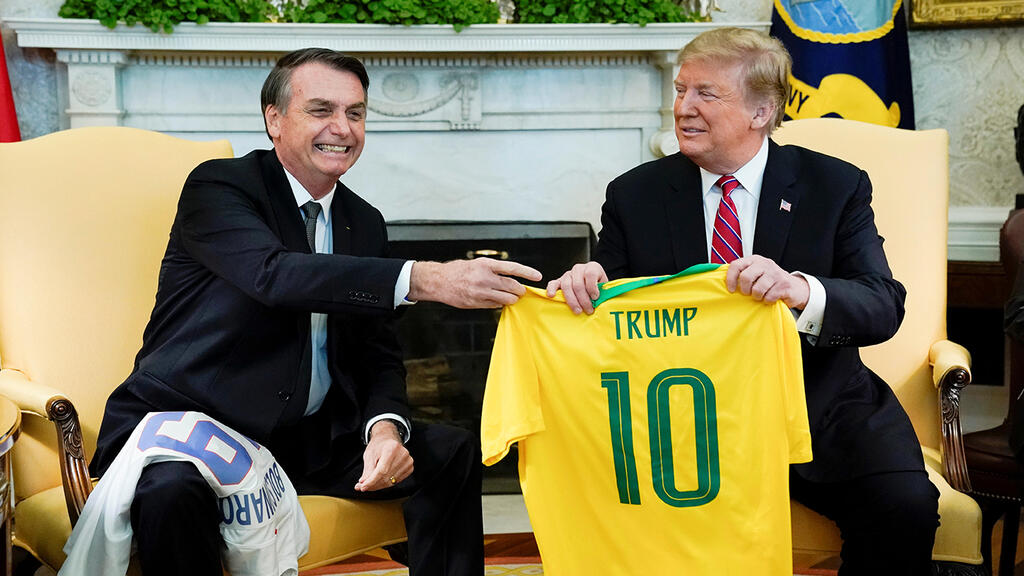
Donald Trump and Bolsonaro in 2019, stops at nothing when it comes to friends
(Photo: Reuters)
Another notable intervention came late last year in Honduras, when Trump urged voters to support right-wing candidate Nasry Asfura, the son of Palestinian immigrants, calling him “the only true friend of liberty.” In a post, Trump promised cooperation if Asfura won but warned that if he lost, U.S. aid to the impoverished country would be cut. Asfura went on to win.
Silman’s warning: No pardon could mean sanctions
Whether Trump intends to intervene in Israel’s elections this year remains an open question. Israel maintains far deeper ties in Washington than most of the countries mentioned. During his first term, Trump explicitly said he would be happy to work with any prime minister Israelis chose, including Benny Gantz. Still, it is difficult to ignore the unusual praise he has heaped on Netanyahu in recent months, calling him, among other things, “a great leader in a time of war.”
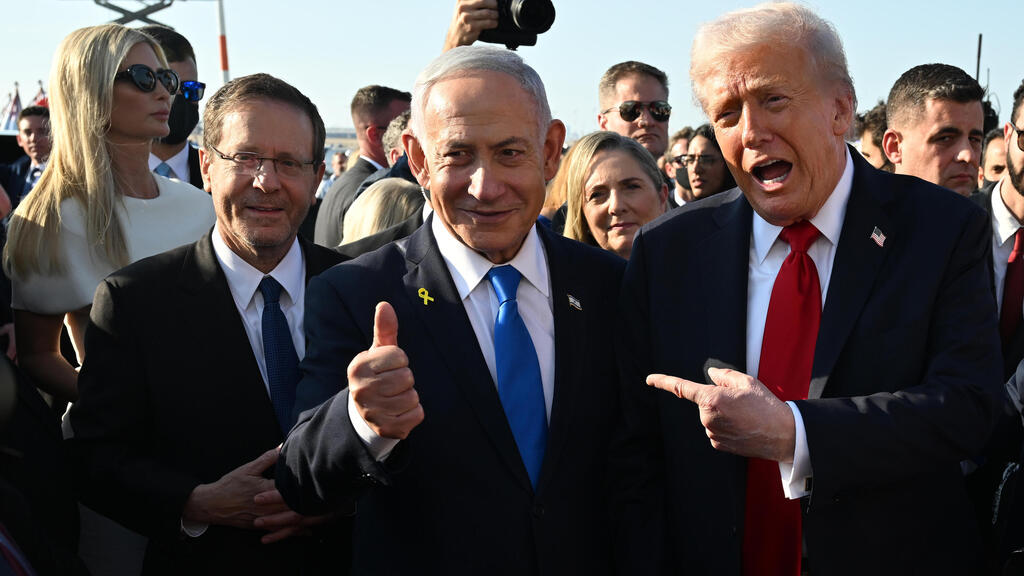
Herzog, Netanyahu and Trump
(Photo: Chip Somodevilla/Getty Images)
After criticizing Herzog on Thursday, Trump said, “Bibi was a great prime minister during war, and I was the best friend Israel, I think, has ever had. People say more than any president they ever had. And I will continue to be.” The pardon issue Trump is promoting, both publicly and behind the scenes, has already led figures in Netanyahu’s camp to harness that intervention to advance their interests. Chief among them is Environmental Protection Minister Idit Silman, who warned that if Herzog does not heed Trump’s request to grant a pardon, the U.S. president “could take steps and impose sanctions, possibly on senior officials in the judicial system.” For now, Trump has limited himself to attacking Herzog and has not said he intends to take action. “He should be ashamed that he is not giving a pardon to Prime Minister Netanyahu,” Trump said emphatically, a day after meeting Netanyahu at the White House.
Netanyahu himself has not commented on Trump’s involvement in the pardon matter, perhaps unsurprisingly. When Trump raised the issue in a speech at the Knesset last October, Netanyahu appeared uncomfortable in his seat in the plenum but thanked Trump while clasping his hands. Herzog also smiled awkwardly at the remarks. Not only Netanyahu and coalition members remained silent after Trump’s comments Thursday, opposition lawmakers were also largely quiet. The President’s Residence later clarified that consideration of the request would not be influenced by external pressure.
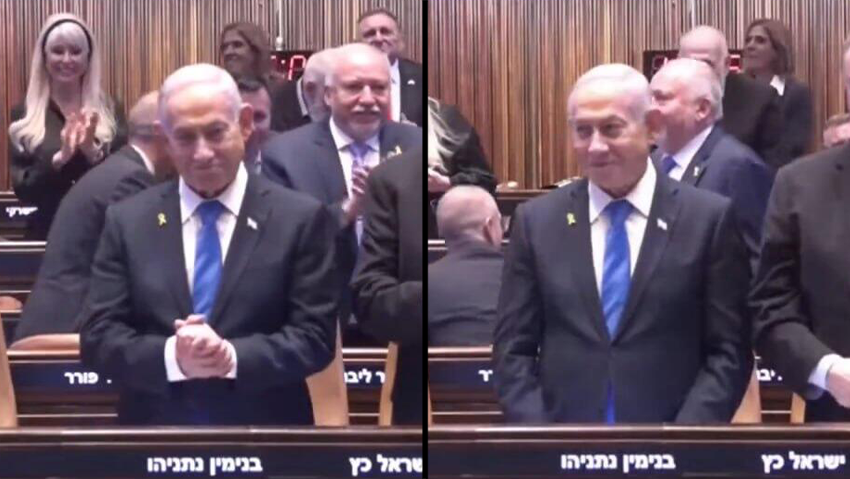
Netanyahu smiles after Trump’s request at the Knesset. The opposition is also silent following the U.S. president’s remarks
(Photo: Knesset channel)
“The prime minister’s request is, according to the rules, under review at the Justice Ministry for a legal opinion, and only after the process is complete will the president examine the request in accordance with the law, the good of the state, and his conscience, without any influence from external or internal pressures,” the statement said.
In his pardon request, Netanyahu did not admit to the charges against him. He argued that while his personal interest is to continue managing the trial and prove his innocence, the public interest dictates otherwise. “In recent years, tensions and divisions have intensified among segments of the people and between state authorities,” Netanyahu wrote to Herzog. “I am aware that the proceedings in my case have become a focal point of fierce disputes. I bear broad public and moral responsibility, understanding the implications of all these events.”
According to the request, the grounds for a pardon are “the good of the state,” which would enable him to continue managing state affairs. “The prime minister believed from the outset, and still believes, that if the legal process runs its course it will end in full acquittal,” the request states. “He has significant criticism of law enforcement authorities’ conduct in handling his case, and these matters have been and continue to be proven in court. For many years, the prime minister has been determined to prove these matters through every legal means available to him.”
‘Trump feels he has friends he wants to help’
Trump has also sought to weigh in on European elections. His homeland security secretary, Kristi Noem, expressed open support during a visit to Poland for conservative presidential candidate Karol Nawrocki, who later won the election. In Romania, however, Trump saw less success when his far-right ally lost, albeit in a rerun vote after the initial ballot was controversially annulled. Vice President JD Vance has also taken part. During a visit to Germany, he publicly criticized restrictions imposed on the far-right Alternative for Germany party, known as AfD.
In Britain, Trump and his aides have praised rising right-wing leader Nigel Farage, who campaigns against immigration and is climbing in the polls. In France, they criticized the conviction of far-right leader Marine Le Pen for embezzlement, a ruling expected to prevent her from running for president in 2027 at a time when she is at the height of her political strength.
Researcher Dov Levin wrote in a 2021 book that since World War II, the United States has intervened in more than 80 foreign elections, more than any other country in the world. Still, according to Thomas Carothers, director of the Democracy, Conflict and Governance Program at the Carnegie Endowment for International Peace, Trump is unique not only in the public manner in which he acts, but also in his apparent motives. “This is different from the Cold War era, when the United States often preferred a particular individual but did so for geostrategic reasons,” Carothers said. “What we have here is more a situation in which Donald Trump feels he has a group of friends around the world that he wants to help.”
Carothers said only Russia, which frequently interferes in elections in former Soviet bloc countries such as Moldova, comes close to U.S. methods. “A very high percentage of European leaders would like to see Hungarian Prime Minister Viktor Orbán lose next year’s election, but they would not say so out loud,” he said. Trump, for his part, has repeatedly welcomed Orbán, including at the White House. At a joint news conference last year, he used the opportunity to bolster him, saying European leaders should appreciate Orbán more.