

U.S. President Donald Trump warned Monday that a response to Iran’s strike on Israel’s largest oil refinery in Haifa was coming “shortly,” as Tehran broadened attacks on regional infrastructure.
Fragments from an intercepted Iranian missile hit the Bazan oil refinery complex in Haifa Bay earlier Monday, striking a gasoline storage tank and an industrial building and sparking a fire that sent thick smoke into the air before firefighters brought the blaze under control.
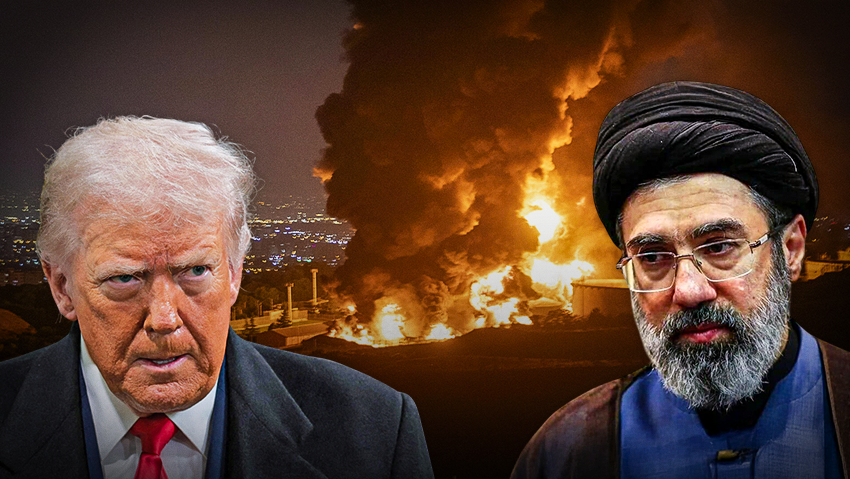
(Photo: Anna Moneymaker / AFP, Stringer / Getty Images)
In a filing to the Tel Aviv Stock Exchange, Bazan said the strike caused what it described as “non-material damage” limited to the roof of a distillates tank, and that no casualties were reported. The company added that all production facilities were still operating at the time of the filing.
Energy Minister Eli Cohen said there were no casualties at the site, that production facilities were not hit and that Israel’s fuel supply would not be disrupted.
Speaking with the New York Post in an interview, Trump also signaled that Washington would soon determine whether Iranian Parliament Speaker Mohammad Bagher Ghalibaf was prepared to engage with the United States.
Trump told the Post that what remained of Iran’s leadership was more “reasonable” than in the past and suggested dramatic internal changes in Tehran following the fighting that began on Feb. 28. He also raised questions about the condition of Iran’s Supreme Leader Mojtaba Khamenei, saying the United States did not know for certain whether he was alive, though he said Washington believed he was likely alive but badly injured.
Global energy markets reacted sharply to the latest escalation, with oil prices rising to $115 a barrel in early Monday trading and average U.S. gasoline prices climbing to $3.99 a gallon, the highest level since 2022.
Trump also threatened further action against Iran’s energy infrastructure, saying Washington could strike the Islamic Republic’s power plants, oil wells and Kharg Island—the country's main energy export hub—if a deal is not reached soon, as oil prices jumped on fears of broader regional disruption.