

President Isaac Herzog accused the leader of Hamas of blocking progress on a ceasefire and hostage deal, saying the group’s internal decision-making structure allows opponents of an agreement to derail negotiations.
Speaking at Chatham House in London days after an Israeli strike in Doha aimed at killing Hamas’ leadership, Herzog said intelligence showed Khalil al-Hayya has repeatedly sabotaged proposals.
“I could attest to the fact, because I'm exposed to intelligence all the time, that Khalil al-Hayya … kept on refusing and or saying yes with a poison pill … endless slime that doesn’t end,” Herzog said, using the group’s internal debates as evidence of obstruction. “All you need is one person to say no and there’s no deal. And if you want to move on, you have to remove some of the people if they are not willing to get to a deal.”
Herzog said he was unaware of the Doha operation, launched while he was traveling to the United Kingdom. But he argued the strike could still open the door for progress, saying Israel remains ready for a comprehensive agreement. “We want a deal and we want to finish the war … we are ready to exit the war with a full hostage deal and a ceasefire, but for that you need Hamas to say yes,” he said.
During the visit, Herzog met British Prime Minister Keir Starmer, who has said the UK is prepared to recognize a Palestinian state in the coming weeks unless Israel makes progress toward ending the war.
Herzog described the discussion as a candid exchange between allies. “It was a meeting between allies, but it was a tough meeting. Things were said that were tough and strong, and clearly we can argue because when allies meet, they can argue,” he said.
He warned against unilateral recognition of a Palestinian state, calling it “adverse and negatively affect[ing] any future process because it will be dangerous, it won’t help one Palestinian, one hostage, and can be adversely interpreted by Hamas.”
President Issac Herzog meeting with British PM Keir Starmer
(Video: Roi Avraham)


Humanitarian aid and international criticism
The Doha strike added to international unease with Israel’s military campaign, which has drawn condemnation from European governments and fueled mass protests. Critics argue Israel has exacerbated Gaza’s humanitarian crisis, with the UN and aid agencies warning of famine conditions.
Herzog rejected those accusations, insisting Israel has not blocked aid. “In the last 24 hours alone, 600 trucks have gone into Gaza … the prices have gone down sharply and dramatically,” he said. He accused Hamas of diverting supplies, “reselling at triple price, laundering the money and using it for their war machine.”
He proposed a British-led “fact-finding mission” to Israel to assess aid delivery, saying: “We have full answers and we are fully transparent.”
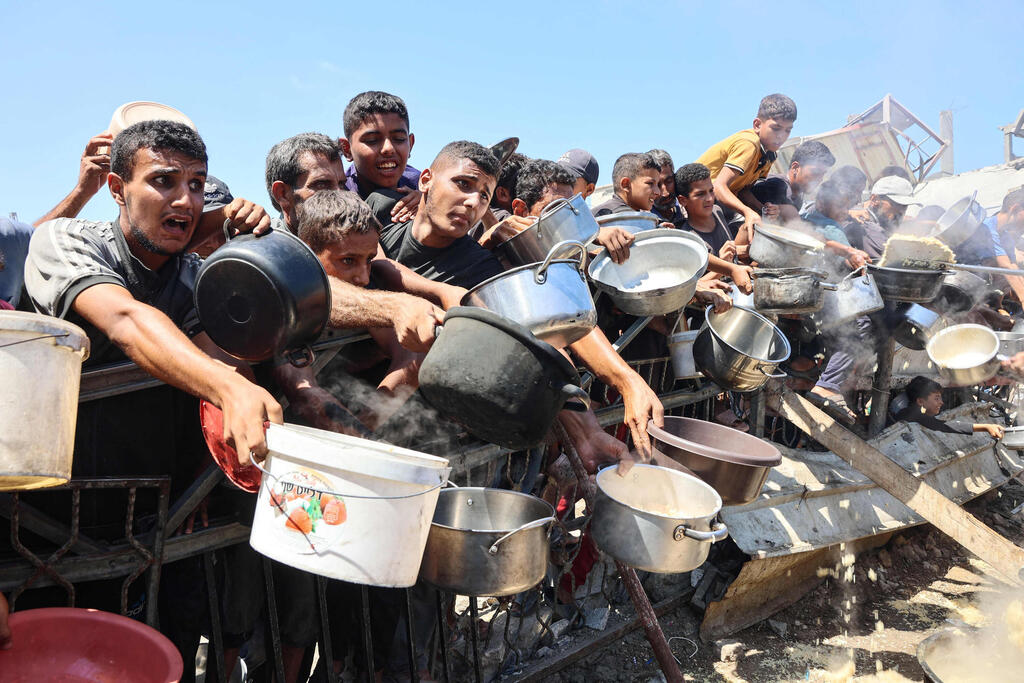
Gazans waiting for aid
(Photo: Omar AL-QATTAA / AFP)
Herzog also pushed back against growing isolation, framing Israel’s war as part of a larger global struggle. “We are defending Western values and the free world with the blood and the tears of our sons and daughters and families. That’s what we’re doing,” he said. “We’re fighting an aggressive, barbaric enemy that has butchered, slaughtered, burnt our citizens … we have not attacked seven countries. We were attacked from seven corners of the earth by ballistic missiles, by the most advanced weapons supplied by Iran to the proxies who want to eradicate us.”
Herzog emphasized that Israel does not intend to expel Palestinians from Gaza, distancing himself from far-right ministers who have suggested otherwise. He said his focus was on a “day after” plan that would combine regional cooperation with a Marshall Plan-style reconstruction effort, while ensuring Hamas cannot return to power.
“For the get our hostages back, we see it as a top priority,” he said. “Israel has said yes to every proposal.”