

Israel is seeking a side letter of understandings from the Trump administration to accompany a forthcoming United Nations Security Council resolution on the future of the Gaza Strip, according to three Israeli officials speaking on condition of anonymity.
The proposed resolution is expected to outline the demilitarization of Gaza and establish a mandate for an international stabilization force that would be deployed in the territory. Israeli officials are pressing Washington for written assurances on Israel’s freedom of action under the resolution, which is currently being drafted by the U.S.
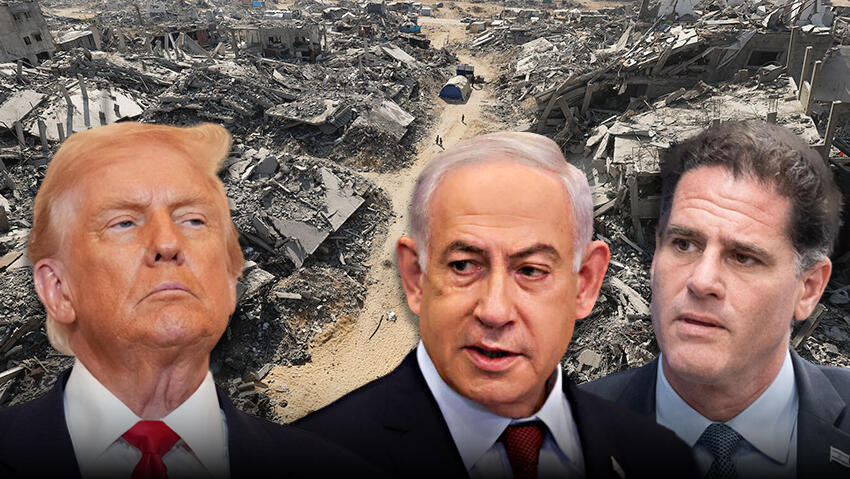
Donald Trump, Benjamin Netanyahu, Ron Dermer
(Photo: Andrew Harnik / GETTY IMAGES NORTH AMERICA / AFP, REUTERS/Mahmoud Issa, Yonatan Sindel, Emil Salman)
A similar arrangement was made following the 2006 Lebanon War, when the U.S. provided Israel with a side letter clarifying its operational leeway under the ceasefire framework established by UN Security Council Resolution 1701. However, officials noted that this case is different: the Gaza war has already been internationalized, with Arab states involved in shaping the resolution text, and it remains unclear whether the U.S. will agree to issue a parallel letter for a resolution it is authoring.
Israeli officials say the goal of the side letter is twofold: to secure U.S. backing for Israel's freedom of military action in relation to the international force and to guarantee American support if the force fails to disarm Hamas.
According to the draft resolution, the stabilization force would include troops from several Arab and Muslim-majority countries—potentially including Indonesia, Pakistan and Azerbaijan—alongside Palestinian forces. The mandate, as outlined in the draft, would emphasize disarming terrorist groups, rather than serving as a traditional peacekeeping force.
Some ministers from the hardline Religious Zionist Party voiced criticism that negotiations over the plan have not been presented to either the full or security cabinets, but are instead being conducted privately between Prime Minister Benjamin Netanyahu, Strategic Affairs Minister Ron Dermer and U.S. officials.
Members of Netanyahu’s right-wing coalition have raised concerns about what level of military freedom Israel would retain if the international force fails to disarm Hamas, and what the status of the Palestinian Authority would be under the resolution.
In addition to security concerns, Netanyahu also faces political pressure: a U.S. side letter could help him reassure coalition partners about controversial or vague clauses in the UN resolution. Because the United States holds veto power at the Security Council, direct understandings with the Trump administration could also shield Israel from potential sanctions if it acts outside the resolution’s framework.